
Best Time to Trek Annapurna Base Camp – Seasons, Weather, and Expert Tips
28 Dec 2025
The Annapurna Base Camp trek stands among the world's most iconic Himalayan adventures. Every year, thousands of trekkers from across the globe journe...


You need only one permit to trek to Annapurna Base Camp in 2026: the Annapurna Conservation Area Permit (ACAP), which costs NPR 3,000 for foreign nationals and NPR 1,000 for SAARC nationals. The TIMS card is no longer required. And the biggest change most guides haven't caught up with: you can now get your permit entirely online through the official NTNC portal — pay by card, receive it by email, and skip the office queue completely.
If you have read elsewhere that you need two permits, or that a guide is mandatory, that information is out of date. This guide gives you the current, official position — taken directly from the National Trust for Nature Conservation (NTNC), the body that actually issues the permit.
Key Takeaways:
| Detail | Information |
|---|---|
| Permit required | ACAP (Annapurna Conservation Area Permit) |
| TIMS card | Not required |
| Cost (foreign) | NPR 3,000 (~USD 23) |
| Cost (SAARC) | NPR 1,000 |
| Children under 10 | No permit required |
| Online application | Yes — permit emailed to you |
| Online surcharge | +2.9% payment gateway charge |
| Counter payment | Cash only, at the EP counter |
| At a check-post | Double fee |
| Validity | Single entry |
| Issued by | National Trust for Nature Conservation (NTNC) |
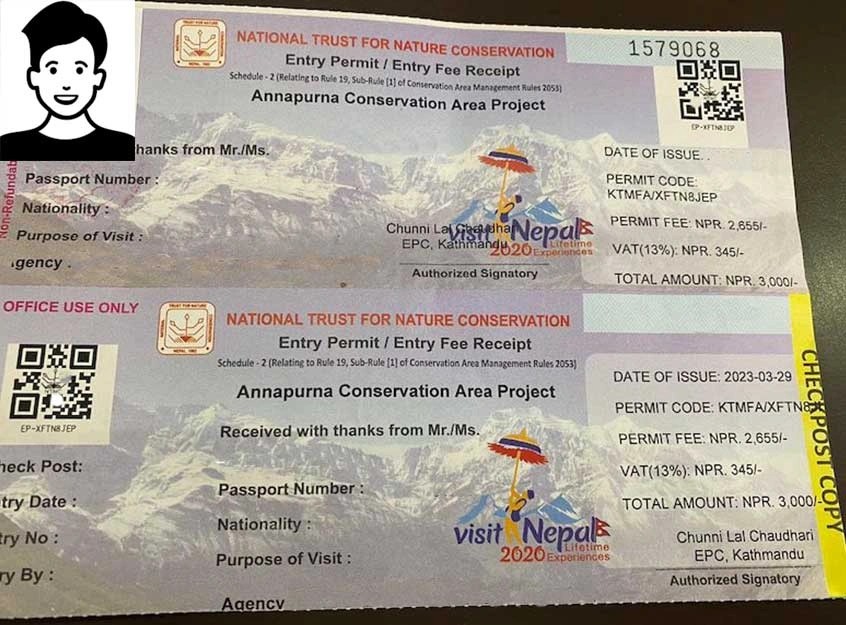
You need exactly one permit for the Annapurna Base Camp trek: the Annapurna Conservation Area Permit (ACAP). It is issued by the National Trust for Nature Conservation and grants you legal entry to the Annapurna Conservation Area, which covers the entire ABC trail.
That is the complete requirement. No second permit, no national park fee, no TIMS card.
The ACAP fee funds trail maintenance, waste management, wildlife conservation, and community projects across the 7,629 km² conservation area — so the money goes directly back into the landscape you have come to walk through.
If you are trekking into a restricted area instead (Upper Mustang, Nar Phu), you need additional special permits from the Department of Immigration. But for the standard Annapurna Base Camp trek — including via Ghorepani and Poon Hill — the ACAP alone is all you need.
No. The TIMS card is not required for the Annapurna Base Camp trek. This is the single most confusing point in Nepal trekking, because a large share of the trekking blogs and even some agency websites still tell you that you need one.
Here is the honest picture:
We are being direct about this because trekkers regularly arrive in Kathmandu having budgeted for two permits, or worse, waste half a day queuing at a second office for a document they do not need. One permit. That is it.
The ACAP permit costs NPR 3,000 for foreign nationals and NPR 1,000 for SAARC nationals, with tax included. These are the official rates set by NTNC and they do not change by season — you pay the same in peak October as you do in monsoon July.
| Trekker | ACAP fee |
|---|---|
| Foreign nationals | NPR 3,000 (~USD 23) |
| SAARC nationals (India, etc.) | NPR 1,000 |
| Children under 10 | Free — no permit required |
| Issued at a check-post | Double the standard fee |
Two things to budget for beyond the fee itself: if you pay online, a 2.9% payment gateway charge is added; and if you need passport photos, expect a small cost for those in Kathmandu or Pokhara. Nepali citizens should check current rates directly at the counter, as domestic pricing is handled separately.
The headline point is that this is a genuinely cheap permit by world standards — around USD 23 for access to one of the great trekking regions on Earth.
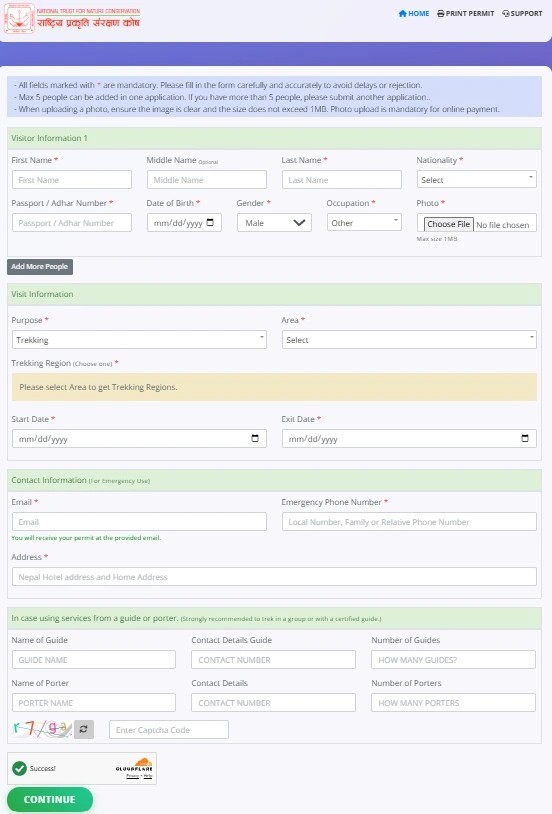
You can now get your Annapurna Base Camp permit entirely online through the official NTNC e-permit portal — no office visit, no queue, no cash. You fill in the application, pay by Visa or Mastercard, and the permit arrives by email. This is the single biggest improvement to Nepal's permit system in years, and it is still not widely known.
The official portal: Epermit
How it works:
You do not need to visit the permit counter if you pay online. For trekkers arriving on a tight schedule, this alone can save you half a day in Kathmandu.
One important note: carry a printed copy. Connectivity on the trail is unreliable, and checkpoints may not accept a permit shown on a phone screen.
If you prefer to pay in cash, you can apply online and select Counter Payment, then collect and pay for your permit in person. There is no gateway surcharge on counter payment.
Where to go:
Bring your passport or valid identification to collect the permit. The process usually takes well under an hour if you arrive with your documents ready, though queues build in peak season — mornings are quieter.
Honest advice: if you are pressed for time or arriving during October or April, just do it online. The 2.9% surcharge on a NPR 3,000 permit is under a dollar, and it buys you a free morning in Kathmandu.
The ACAP application is simple, and you do not need a detailed day-by-day itinerary — a general route outline is enough. Here is what to have ready.
Make sure every detail matches your passport exactly. The permit is checked against your passport at the checkpoints, and a mismatch causes problems on the trail.
Permits issued at a check-post are charged at double the standard fee. This is stated explicitly by NTNC. If you turn up at Birethanti without a permit, you will pay NPR 6,000 instead of NPR 3,000.
Get your permit before you leave Kathmandu or Pokhara — either online (fastest) or at the counter. There is no advantage whatsoever to leaving it until the trail, and it is one of the easiest ways to waste money on this trek.
The same logic applies to timing: the permit is non-refundable and non-transferable, so if your dates change after purchase, you cannot swap it. Buy it once you are confident in your start date.
Your ACAP permit is checked at official checkpoints along the route by conservation authorities, and you must carry it with you for the entire trek. NTNC also asks trekkers to register at check-posts, which helps them monitor visitor numbers and — importantly — improves your chances of rescue in an emergency.
The main checkpoints on the ABC trail:
Random additional checks can happen higher up. Keep your printed permit accessible — not buried at the bottom of your duffel. If you trek with us, your guide handles all permit check-in and check-out at every post.
The ACAP comes with a set of official conditions that most trekkers never read — and one of them catches people out badly.
The drone rule deserves emphasis, because it is genuinely enforced and very few blogs mention it. If you are planning to fly a drone in the Annapurna Conservation Area, you need prior approval — turning up with one and hoping is a real risk to your gear.
Yes — one ACAP permit covers your entire stay within the Annapurna Conservation Area, not just a single trail. If you plan to combine Annapurna Base Camp with Ghorepani Poon Hill, Mardi Himal, or another route inside the conservation area, the same permit covers all of it.
To make this work smoothly:
This is genuinely useful if you are combining treks — for example, Mardi Himal plus ABC, or ABC via Ghorepani Poon Hill. One permit, one fee. Note that this does not extend to restricted areas like Upper Mustang or Nar Phu, which need their own special permits.
A guide is not compulsory for the Annapurna Base Camp trek. The official NTNC permit application lists guide and porter details as optional — the form states them as applying only "in case using services from a guide or porter," and describes trekking with a certified guide as "strongly recommended," not required. You can legally obtain an ACAP and trek to ABC independently.
We are saying this plainly because several agency websites claim a guide is legally mandatory for ABC. That is not what the official permit system says.
That said, NTNC recommends a guide for good reasons, and after years on this trail, so do we — not because of the paperwork, but because of what actually goes wrong up there:
So: trek independently if that is what you want, and do it legally. But make the choice knowing what a guide actually adds — which is not a stamp on a form.
Only one — the Annapurna Conservation Area Permit (ACAP), costing NPR 3,000 for foreign nationals and NPR 1,000 for SAARC nationals. The TIMS card is not required.
NPR 3,000 (about USD 23) for foreign nationals, NPR 1,000 for SAARC nationals. Children under 10 do not need a permit. Buying at a check-post costs double.
No. TIMS is not required for the Annapurna Base Camp trek and is not checked on the trail. Websites still listing TIMS as mandatory are out of date.
Yes. Apply through the official NTNC portal at epermit, pay by Visa or Mastercard, and the permit is emailed to you. A 2.9% payment gateway charge applies. Print it and carry it on the trek.
At the permit counter at the Nepal Tourism Board, Bhrikutimandap. In Pokhara, the counter is at Damside. Bring your passport. Or skip the queue entirely and apply online.
No. The official NTNC permit application lists guide and porter details as optional and describes a certified guide as "strongly recommended," not required. You can legally trek ABC independently with a valid ACAP.
You will be stopped at the Birethanti checkpoint and turned back, or forced to buy a permit at double the standard fee. There is no way around the checkpoints — permits are checked and matched to your passport.
Yes. A single ACAP covers your whole stay in the Annapurna Conservation Area, so you can combine ABC with Poon Hill or Mardi Himal on one permit. Just list all your intended routes on the application.
No — drones are strictly prohibited in the conservation area unless you have prior approval from the authorities. This is officially enforced, so do not assume you can fly one.
The permit side of the Annapurna Base Camp trek is far simpler than the internet makes it look. One permit — the ACAP. NPR 3,000. No TIMS. No mandatory guide. And now you can get it online in a few minutes without ever visiting an office.
The three things worth remembering: get your permit before you reach the trail (a check-post permit costs double), carry a printed copy (connectivity fails, and checkpoints want paper), and get your dates right (the permit is non-refundable).
If you trek with us, none of this is your problem — we arrange your ACAP before you arrive, handle every checkpoint check-in on the trail, and you never see a form.
→ See our 14-day Annapurna Base Camp Trek — permits, guide, and teahouses all arranged
→ The 9-day ABC Express Trek — for those short on time
→ Read our ABC trek difficulty guide — how hard is it really?
→ Trekking in October? Read our October guide
The Annapurna Base Camp trek stands among the world's most iconic Himalayan adventures. Every year, thousands of trekkers from across the globe journe...

Trekking to Annapurna Base Camp Trek is one of Nepal’s most iconic mountain journeys. For mountaineers, the climb begins here, but for trekkers, Annap...
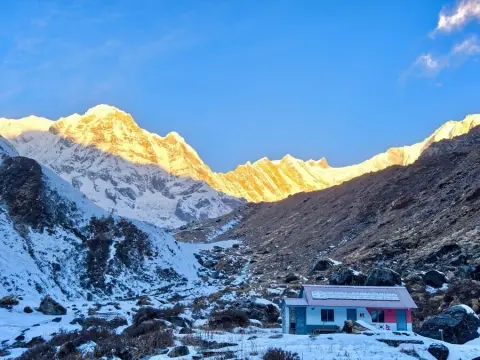
The morning mist lifted slowly from the Modi Khola valley as our trekking group paused near Deurali. Suddenly, movement caught my eye—a Himalayan tahr...
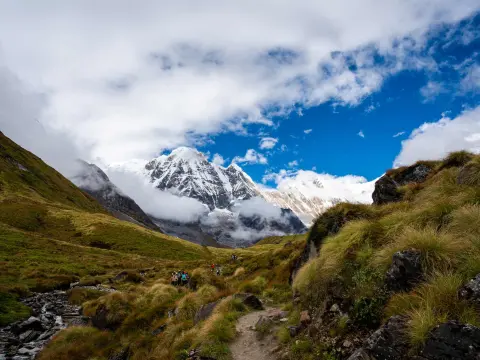
The Annapurna Base Camp trek is a moderate trek, suitable for fit beginners, with no technical climbing required. Its main challenge is not the altitu...
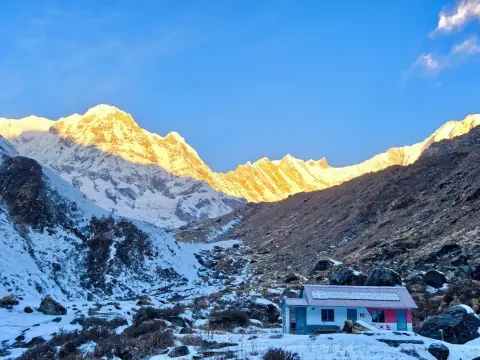
Nestled at 4,130 meters within a dramatic glacial amphitheater, the Annapurna Base Camp (ABC) trek stands among Nepal's most iconic Himalayan journeys...
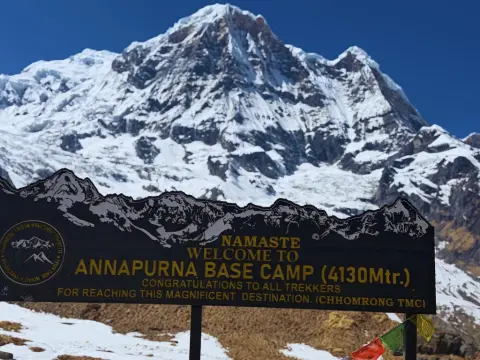
Why Every Trekker Asks "Where Is Annapurna Base Camp?"Few places on Earth stir the imagination of mountain lovers quite like Annapurna Base Camp. Nest...
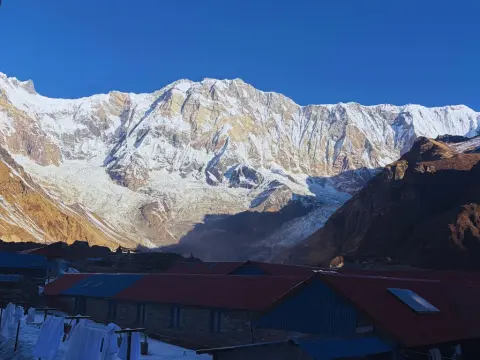
When trekkers ask us at Majestic Trails Nepal about the Annapurna Base Camp trek, one question comes up more than any other: "What's the accommodation...
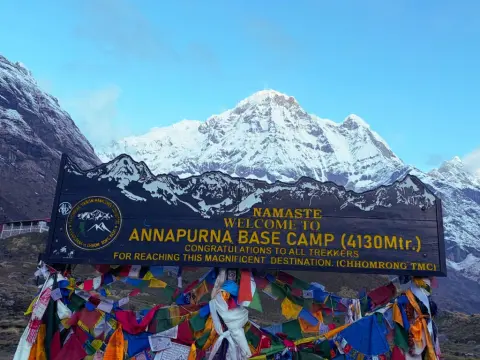
I remember the first time I stood at Annapurna Base Camp. I was 18 years old, still new to guiding, and I genuinely did not expect to cry. But when yo...

The height of Annapurna Base Camp (South) is 4,130 meters (13,550 feet) above sea level, making it one of the most Popular trekking destinations in Ne...
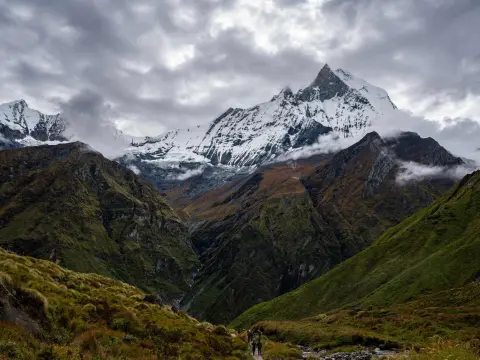
October is the best month of the year to trek to Annapurna Base Camp. The monsoon has cleared, the skies are at their sharpest, the trails are dry, an...
