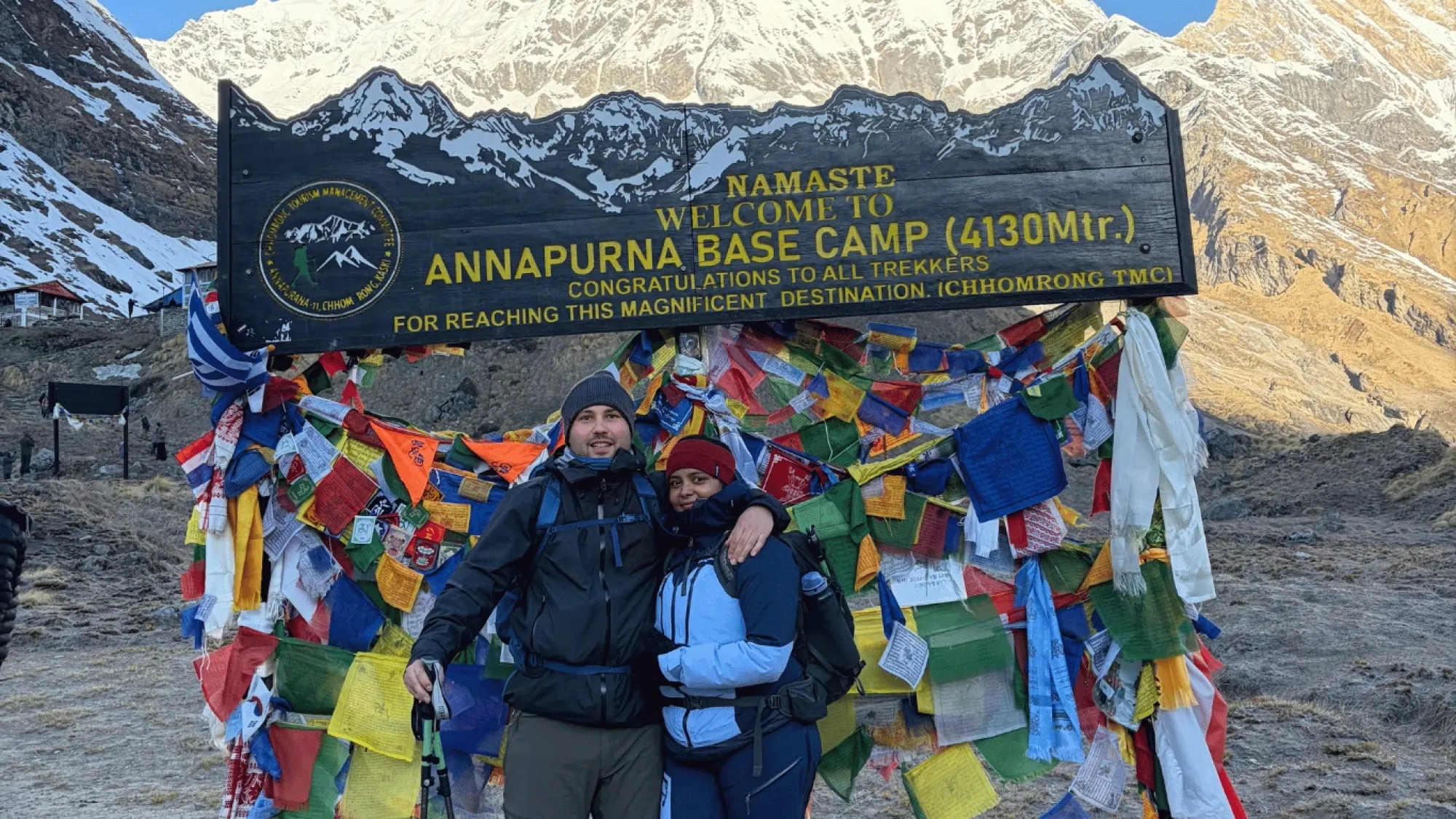
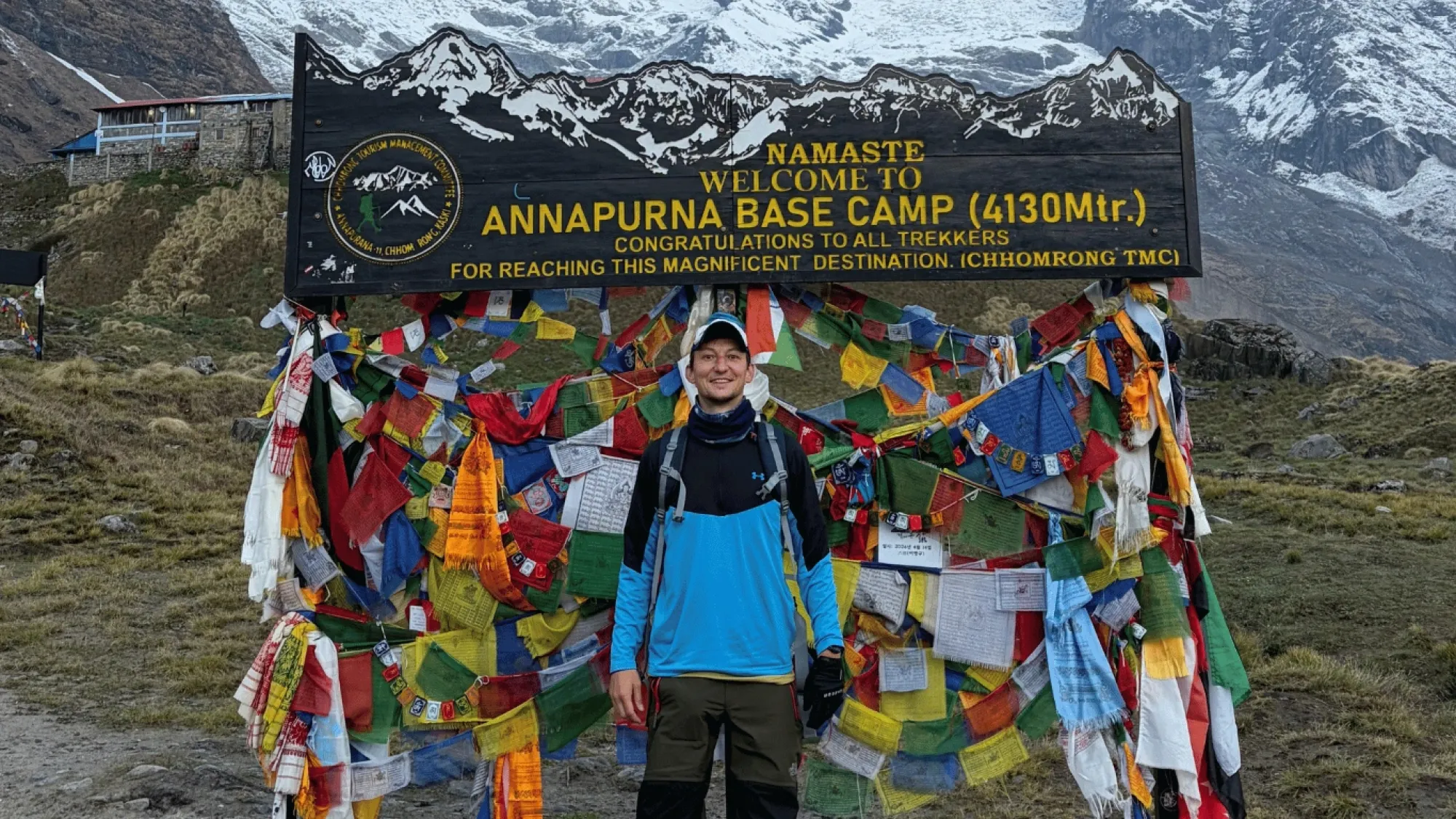
The Annapurna Base Camp Trek is a 14-day journey reaching 4,130 m inside the Annapurna Sanctuary — through the world's largest rhododendron forest, the sacred Barahi Temple, and a glacier amphitheatre directly below Annapurna South. No prior experience required — anyone who can walk 2–3 hours daily can complete this trek.
The Annapurna Base Camp Trek is a 14-day guided package in the Annapurna Conservation Area of north-central Nepal, reaching 4,130 m at the base camp amphitheatre directly below the south face of Annapurna South (7,219 m). It is the most accessible high-altitude trek in Nepal for first-time trekkers — no technical skills are required, no high-altitude pass must be crossed, and any trekker capable of walking 4–5 hours per day on staired mountain trails can complete this route. The trek begins at Birethanti and ends at Jhinu Danda, covering 10 trekking days within the full 14-day package including transport from Kathmandu.
Unlike Everest Base Camp (5,364 m) and the Annapurna Circuit (5,416 m), Annapurna Base Camp at 4,130 m is the lowest-altitude of Nepal's three major base camp treks and requires no prior trekking experience, no acclimatization rest days, and no high-altitude pass crossing. The primary physical challenge on this route is not altitude but stairs — as of 2026, the majority of the trail from Birethanti to Machhapuchhre Base Camp is heavily staired, requiring sustained stair climbing across multiple consecutive days. Between MBC and ABC the stairs reduce, but the altitude gradient becomes the dominant challenge for the final section. This trek is specifically suited to first-time trekkers and anyone who exercises lightly in daily life — any trekker capable of walking 2–3 hours per day can complete this route with proper pacing. It is not recommended for trekkers with serious knee conditions, as the staircase descent places significant load on the knees over several hours.
One detail that surprises nearly every trekker on this route is the hidden elevation between villages. Chhomrong sits at 2,170 m and Dovan at 2,600 m — a 430 m difference that appears manageable on paper. In reality the trail descends 300 m from Chhomrong before climbing 500 m to reach Dovan, meaning trekkers cover significantly more vertical effort than the net elevation gain suggests. This pattern repeats at several points on the route and is one reason daily walking time cannot be judged by altitude difference alone.
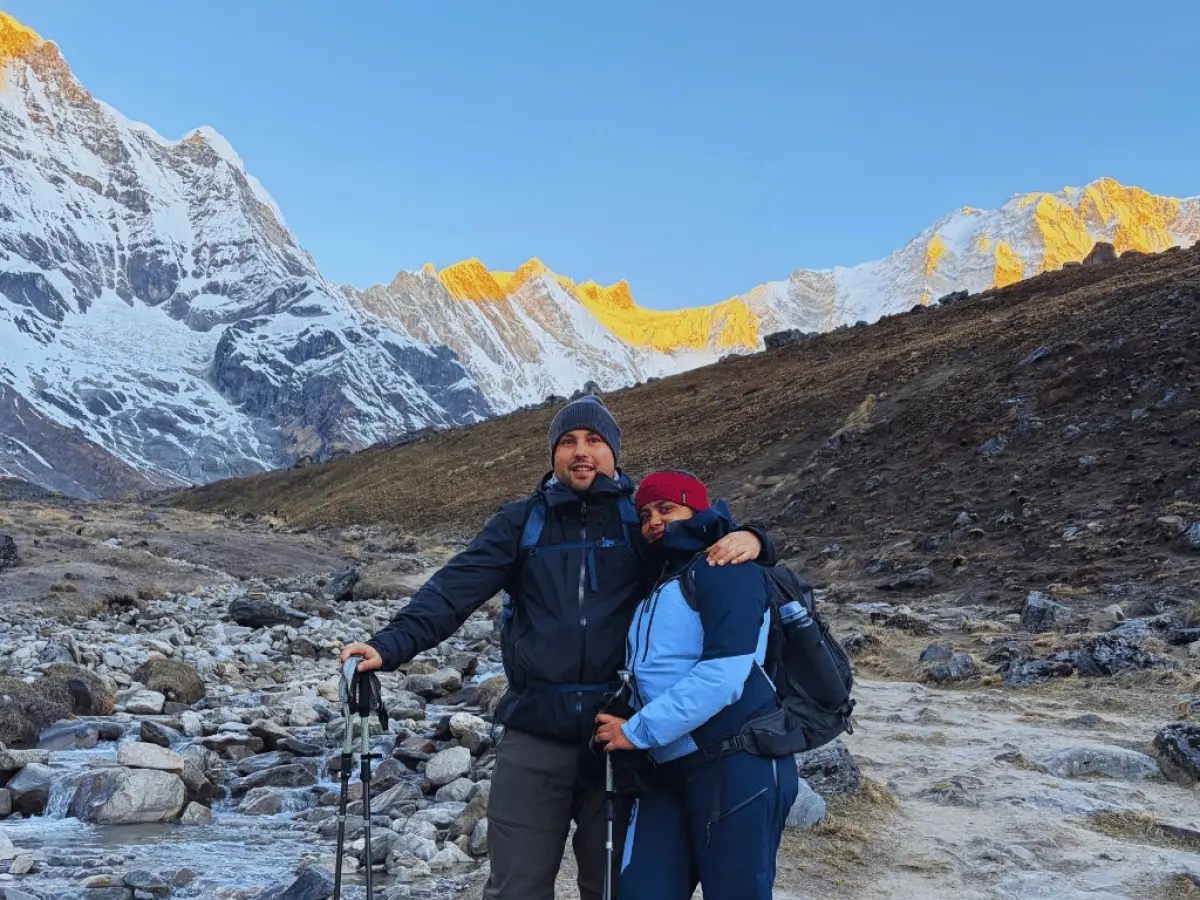
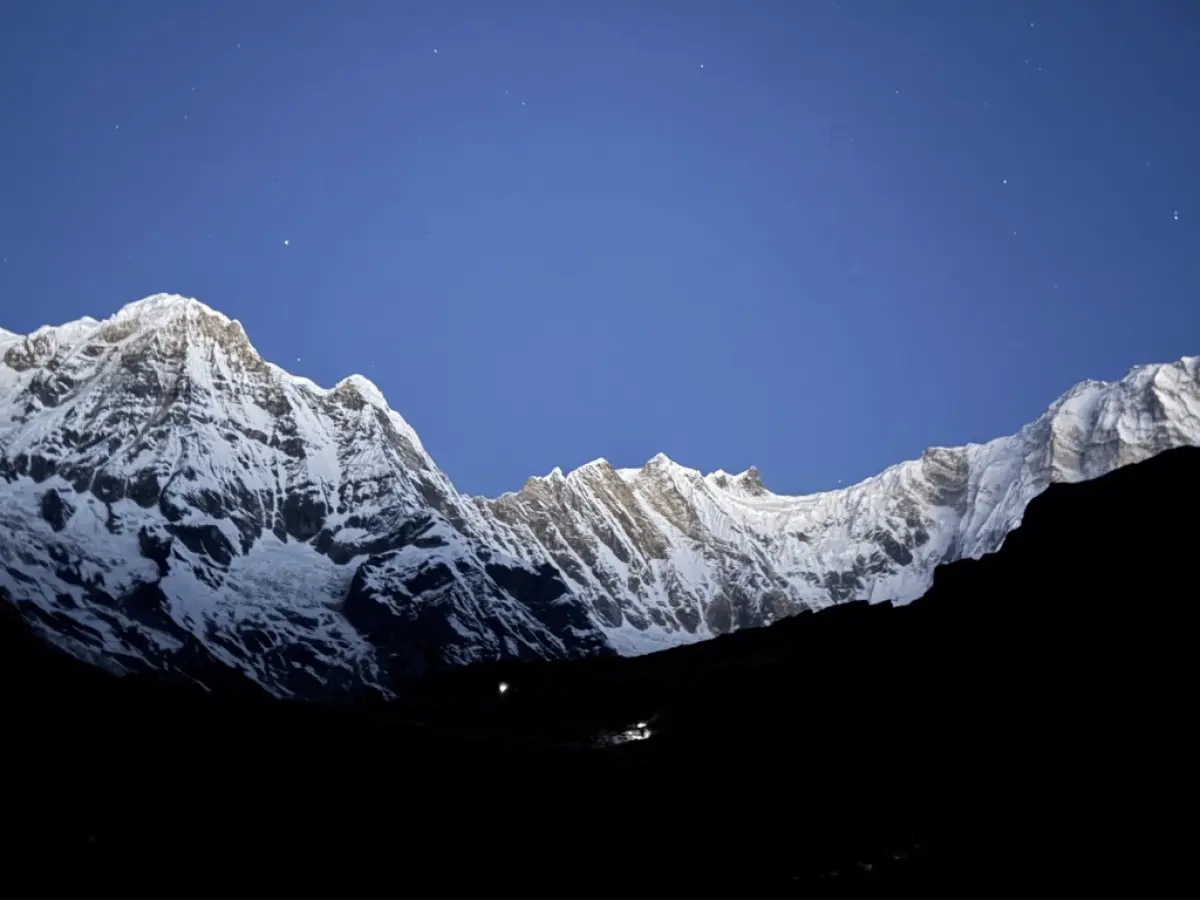
The route passes through seven distinct landscape types. The lower sections between Birethanti and Chhomrong follow river streams and pass through small Gurung and Magar villages with terraced fields and subtropical forest. Between 2,800 m and 3,000 m, rhododendron forest dominates — most spectacular during spring when the trees are in full bloom. Above Chhomrong, Machhapuchhre (Fishtail, 6,993 m) comes into direct view and remains visible for much of the upper route. Annapurna Base Camp itself sits inside a natural amphitheatre directly below Annapurna South (7,219 m). Annapurna I (8,091 m) is visible from base camp but stands separated by a glacier in the middle distance — giving trekkers a full glacial panorama rather than a single peak directly overhead.
Culturally the route passes through Chhomrong, one of the largest Gurung villages in the Annapurna region, where trekkers encounter traditional stone-paved lanes, a working monastery, and daily village life. Between Dovan and Himalaya Hotel stands the Barahi Temple — a sacred site above which the carrying of meat and the use of pack animals including horses and donkeys is prohibited by local tradition. This restriction applies to all trekkers and operators and marks the boundary into the upper sanctuary.
Only one permit is required for this trek: the Annapurna Conservation Area Permit (ACAP), costing NPR 3,000 for foreign nationals and NPR 1,000 for SAARC nationals, obtainable in Kathmandu or at the checkpoint in Birethanti. Transport from Kathmandu to Pokhara is by tourist bus; from Pokhara to the trek start at Birethanti by private car; and from the trek endpoint at Jhinu Danda back to Pokhara by private jeep. Accommodation along the route ranges from attached bathroom rooms at Ulleri and Ghorepani to private non-attached rooms at Tadapani, Jhinu Danda, and Chhomrong. At Dovan, Deurali, ABC, and Bamboo, solo trekkers travelling during peak season should expect shared rooms.
October is the strongest month for Annapurna Base Camp. The post-monsoon atmosphere produces consistently clear skies, and because the base camp sits directly below Annapurna South, sunrise light strikes the mountain face at full intensity from directly above camp — one of the most dramatic close-range sunrise views of any Nepal base camp trek. November offers equally clear skies with fewer trekkers and colder nights above 3,500 m, dropping to approximately −5 to −10°C. Autumn generally offers exceptional visibility with Machhapuchhre appearing particularly sharp against blue skies. Spring (March–May) brings rhododendron blooms across the 2,800–3,000 m section — the most visually beautiful lower-altitude section of any season — though recent springs as of 2026 have seen increased rainfall below treeline. Winter (December–February) is cold but offers clear views and very low crowd density, making it an underrated window for prepared trekkers. The monsoon season (June–September) brings heavy rainfall and a specific risk of trail blockage between Deurali and MBC — the most exposed section of the route — and is not recommended for most trekkers.
Based on more than 10 years of guiding this trail, Majestic Trails Nepal has not recorded a single altitude sickness case among its guests. Our guides carry pulse oximeters on every departure and are trained in wilderness first aid and altitude assessment. In the event a trekker cannot continue, three exit options exist depending on location. From Ghorepani, vehicle access to Pokhara is available directly as of 2026. From Chhomrong, approximately one hour of additional walking reaches a road-accessible exit point. Above Himalaya Hotel, the only evacuation option is helicopter rescue. Helicopter landing is possible at every village on the upper route with the exception of Bamboo, which does not have a suitable landing area. All trekkers are required to carry travel insurance covering helicopter evacuation to a minimum altitude of 4,500 m.
Explore other similar trekking experiences that offer comparable landscapes, difficulty levels, and cultural encounters to the Annapurna Base Camp Trek. The prices listed below are per person and vary based on itinerary, season, and group size.
| Trek Name | Duration | Difficulty | Price | Key Features |
|---|---|---|---|---|
| Langtang Valley Trek | 10 Days | Easy | From USD 690 | Deeper Himalayan experience with dramatic scenery |
| Mardi Himal Trek | 9 Days | Moderate | From USD 630 | Secluded trail with close-up Mardi Himalayan views |
| Pikey Peak Trek | 10 Days | Moderate | From USD 1,090 | Quiet trails, cultural villages, panoramic Everest region views |
Upon your arrival at Tribhuvan International Airport, a Majestic Trails Nepal team member will be waiting at the arrival terminal holding our signboard. A private vehicle transfers you to your hotel in Thamel — Hotel Thamel Park, approximately 30 minutes from the airport.
That evening, a Majestic Trails Nepal team member meets you for a full trek briefing — covering the itinerary day by day, what to expect on the trail, and answering any questions before departure. This is also when you meet your guide for the first time. If you have specific requirements or want to adjust the itinerary, this is the moment to discuss — customised itineraries can be arranged at this stage.
Your guide will also check your packing to make sure you have everything needed for the trail and nothing unnecessary adding weight to your bag. At the briefing, Majestic Trails Nepal provides your duffle bag, down jacket, and sleeping bag.
One tip from our guides: avoid street food in Kathmandu the evening before the trek. A stomach problem on Day 1 of the trail is the most preventable way to ruin a trek — eat at your hotel restaurant and rest well.
Your guide meets you at the Hotel lobby early in the morning. The hotel prepares a packed breakfast for the road — the bus station is just 5 minutes from the hotel, and departure is between 7:00 and 7:30 AM.
The drive from Kathmandu to Pokhara covers 206 km and has three distinct sections worth knowing before you sit down. The first 95 km out of Kathmandu is bumpy with winding mountain road — the most uncomfortable section of the journey. If the weather is clear, approximately one hour into the drive, look north for your first Himalayan views of the Ganesh Himal ranges appearing above the ridgeline — an unexpected highlight of what most trekkers assume is just a transit day.
For much of the middle section, the Trishuli River runs alongside the highway — one of the longest rivers in Nepal, flowing through a dramatic gorge that follows the road for hours. On the right side of the road, watch for the Manakamana Temple, one of the most sacred Hindu temples in Nepal, recognisable from the road by its cable car rising up the hillside. Most Nepali passengers on the bus will know exactly when it appears.
Approximately one hour before reaching Pokhara the road opens into a fully maintained 6-lane highway — 3 lanes in each direction — making the final stretch smooth and comfortable. As of 2026 this is one of the best maintained highway sections in Nepal. On a clear day the Annapurna ranges begin appearing on the horizon as you approach Pokhara — your first view of the mountains you will be walking into tomorrow.
Depending on traffic you will arrive in Pokhara between 3 and 5 PM. Your guide assists with check-in at Hidden Kingdom Hotel, located just 5 minutes walk from Pokhara's famous Lakeside area on Phewa Lake. If you have energy after the drive the Lakeside is worth a short evening walk — restaurants, cafes, and lake views within minutes of the hotel. Rest well — tomorrow the trek begins.
Our tip: If you prefer to skip the long drive, adding USD 110 upgrades your Kathmandu to Pokhara journey to a 25-minute mountain flight with aerial Himalayan views — giving you more time to explore Pokhara before the trek starts. This can be arranged through Majestic Trails Nepal at the time of booking.
Today, you drive to Birethati (1,110 m / 3,644 ft) and trek to Ulleri (1,960 m / 6,430 ft). You will leave at around 7:00 am in the morning after breakfast from Pokhara and drive to Birethati, which is around 50 km, and the drive will be approximately 90 minutes. By watching the view of the Annapurna ranges, you will reach Birethati. Birethati is the first checkpoint we have to check in at and the starting point of the 14-day Annapurna Base Camp trek.
From here, we will start walking. For the first 3 hours, we will walk on the off-road and beside the river and forest. During the season, vehicles will pass by you. After 3 hours, depending on your pace, we will start to walk from the trails and reach a traditional village called Tikhedhunga, which means “sharp stone,” standing at an altitude of 1,540 m. Leaving Tikhedhunga, we will cross 2 suspension bridges. You might see some local fishers fishing also.
Our last part will be a steep uphill all the way to Ulleri. The uphill is famous for 3,000 stone steps. That uphill will take around 2 hours, depending on your pace. After you walk 1 hr, on the right side, if there are no clouds, you might see Annapurna South 7,219 m / 23,684 ft. After the uphill, you will reach the hotel. The hotel in Ulleri is nice. You will get a comfortable room with an attached bathroom.
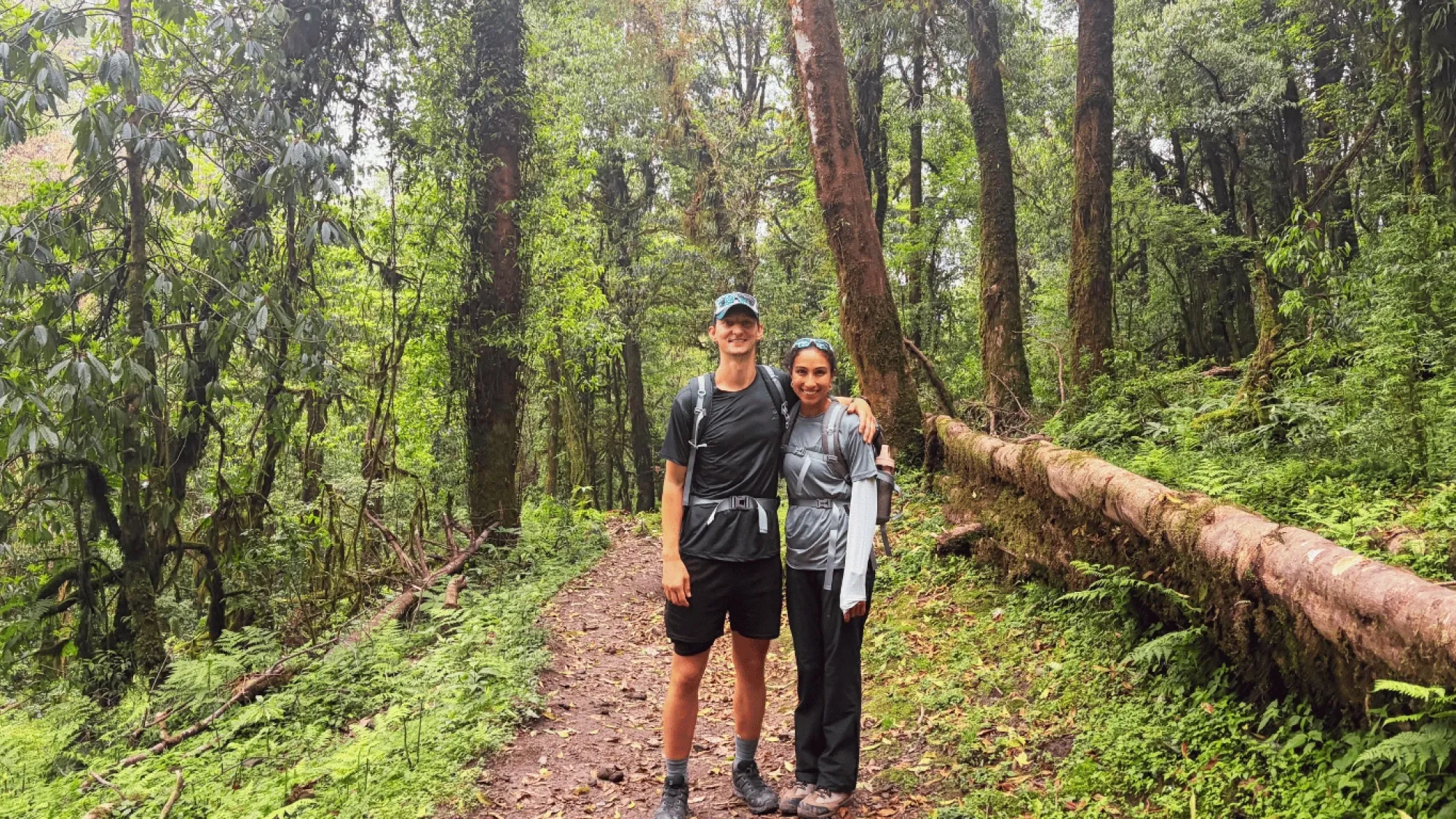
After breakfast, the trail climbs steadily through Ulleri village past local farmers and small tea houses. Within the first hour, Machhapuchhre, Hiunchuli, and Annapurna South appear ahead — your first clear mountain views of the trek. You pass through Banthati — meaning "forest resting place" in Nepali — before entering the largest rhododendron forest in the world, a 2–3 hour walk through dense canopy with wooden bridges, waterfalls, and a chance of spotting langur monkeys in the trees above. During spring, the trail between 2,400 m and 2,880 m is covered in spectacular pink rhododendron blooms — the most vivid and concentrated section of the entire forest.
A village midway through the forest is a natural lunch stop before the final approach to Ghorepani. Note that as of November 2026, a new road connects Pokhara to Ghorepani — the last section follows this road briefly before the checkpoint.
Majestic Trails Nepal always stays in Upper Ghorepani — 15 minutes above Lower Ghorepani on stone stairs — for one reason: the views. The full Annapurna and Dhaulagiri ranges are visible from here on a clear evening. Sleep early — Poon Hill sunrise departure is between 4 and 5 AM tomorrow.
Your guide gives you the exact wake-up time at dinner the night before — departure for Poon Hill is between 4 and 5 AM depending on sunrise. The climb from the hotel to Poon Hill (3,210 m) takes 45 minutes to 1 hour on maintained stone stairs all the way to the top.
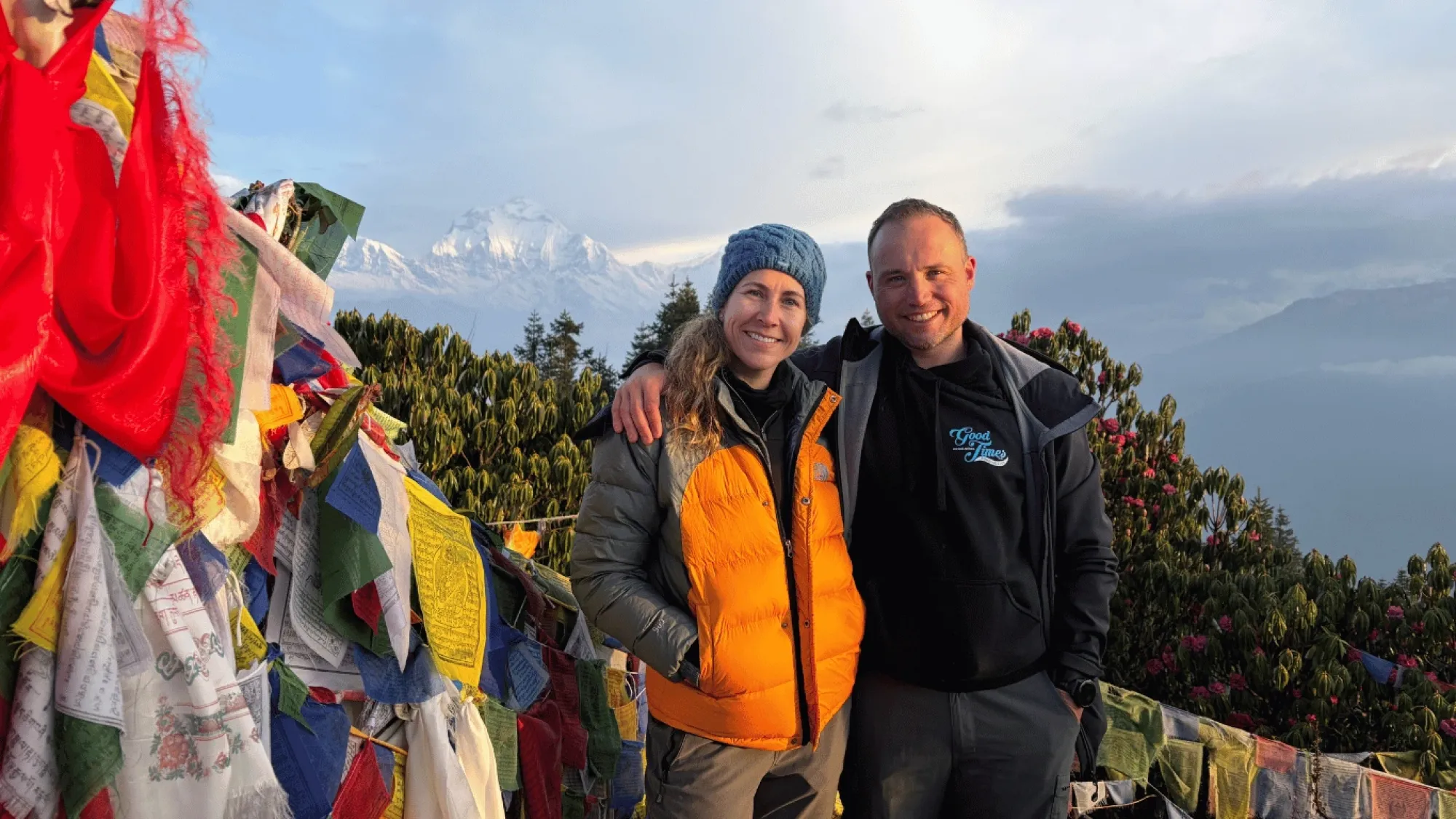
At Poon Hill, the sunrise unfolds across one of the widest Himalayan panoramas in Nepal — Dhaulagiri catches the first light on its summit, followed by Annapurna South, Annapurna Fang, Nilgiri, and Machhapuchhre (Fishtail) emerging from the pre-dawn darkness one by one. Spend time at the top before descending the same trail back to Upper Ghorepani for breakfast. Pack your bags — the main trekking day begins after breakfast.
From Ghorepani, a flat 5-minute trail leads to the base of the day's first climb — 1 hour 45 minutes of uphill to Thapla Danda Pass (3,160 m). After Thapla danda, the trail descends all the way to Banthati (2,660 m) — a beautiful downhill walk through forest but with one specific hazard: tree roots crossing the trail surface. Descend slowly and watch your footing, especially after rain. Banthati is the natural lunch stop.
After lunch, a 30 min downhill and 45-minute uphill followed by the final section into Tadapani — a mix of stone stairs, steep and flat, with the last 10 minutes climbing before the village appears. Tadapani is a small settlement of 7-8 guest houses with no attached bathrooms. The reward for the day's effort is immediate — Annapurna South, Hiunchuli, and Machhapuchhre are now noticeably closer than they were from Ghorepani.
Start the day with breakfast in Tadapani — try the local Tibetan bread, a staple on this section of the trail. Tadapani also offers one of the best static views of Annapurna South, Hiunchuli, and Machhapuchhre before you descend into the forest.
The first 30 minutes downhill through rhododendron forest is the most peaceful section of the entire trek — only birdsong and the chance of spotting langurs moving through the trees above. After that, the trail transitions to well-maintained stone stairs for the remaining 1 hour of descent.
At the bottom, a suspension bridge crosses the Khimrong Khola river before the trail climbs gradually through Ghurjung village. Watch for locals making Raksi — a traditional Nepali rice or wheat wine produced in small family distilleries along the village. It is one of the few places along the ABC route where you can see authentic daily mountain village life, unchanged by the trekking industry.
A gradual uphill from Ghurjung leads into Chhomrong (2,170 m). Arriving here Annapurna South, Hiunchuli, and Machhapuchhre are suddenly and dramatically closer — the moment most trekkers realise the mountains are no longer a backdrop but directly ahead.
Today you officially enter the Annapurna Sanctuary. After breakfast, 10 minutes of stone stairs leads to the last checkpoint at the edge of Chhomrong — your guide handles the entry formalities before continuing.
A few minutes past the checkpoint stands a small stupa. Trekkers can light a lamp here for good health and a safe trek — no fixed charge, donation only. It is a quiet moment before the trail drops steeply downhill for 30 minutes through old houses and forest, crossing a suspension bridge at the bottom.
What follows is the hidden elevation of the route. Chhomrong sits at 2,170 m and Dovan at 2,600 m — a 430 m difference that looks easy on paper. In reality, the trail descends 300 m from Chhomrong before climbing 500 m to reach Dovan. The 2-hour uphill to Upper Sinuwa is the most tiring section of this day — not because of altitude or exhaustion but because the trail is fully exposed to the sun at this point and the heat builds quickly. Upper Sinuwa is the natural rest stop — cold drinks with a close view of Machhapuchhre directly ahead. The mountain takes its name from its peak, which splits exactly like a fish tail when viewed from this angle.
From Upper Sinuwa the trail continues 1 hour 30 minutes to Bamboo — the landscape shifts here, bamboo trees mixing with rhododendron and the temperature dropping as the trail enters thick forest shade. Lunch at Bamboo. After lunch a final 1 hour 30 minutes brings you to Dovan (2,600 m).
Dovan is one of the smallest stops on the entire route — only 3 tea houses. In peak season every room fills. Majestic Trails Nepal reserves rooms at Dovan in advance — one of the reasons booking early matters on this itinerary. As of March 2026 Dovan tea houses serve chicken dishes — worth noting as it is one of the last stops on the route where meat is available. Above the Barahi Temple further up the trail, carrying and serving meat is prohibited by local tradition.
The day starts with the sound of the Modi Khola river outside your window — one of those small details that stays with trekkers long after the trek ends. After breakfast, the trail enters jungle for 15 minutes past small streams before reaching Upper Dovan, a cluster of just 2 tea houses. From here, 1 hour through dense jungle leads to the Barahi Temple (2,750 m).
The Barahi Temple sits beside the river with a waterfall directly behind it — one of the most naturally beautiful religious sites on any Nepal trek. Trekkers cannot enter but can observe from outside. Spitting is not permitted in this area. This is the sacred boundary above which horses, donkeys, and meat are prohibited — the official entrance into the upper sanctuary.
After the temple, a steep 40-minute stone staircase climbs hard before 15 minutes of gradual trail into Himalaya Hotel (2,900 m). Do not walk past without stopping — it has the only coffee machine on the upper route and locally made Himalayan cookies baked on site. Every trekker remembers this stop.
From Himalaya Hotel the treeline gradually disappears as 1 hour 30 minutes of well-maintained stone stairs climbs into open alpine terrain. The Hinku river crossing requires full attention — slippery rocks and avalanche risk in winter and early spring. Your guide checks conditions and manages the crossing carefully. The final 10 minutes uphill brings you into Deurali (3,200 m).
One thing to know about Deurali — once the sun goes down the temperature drops sharply and it becomes significantly colder than ABC itself. Layer up early, stay warm in the dining hall, and rest well. Tomorrow is Annapurna Base Camp day.
Before leaving Deurali your guide points out the natural Buddha statue visible on the rock face across the Modi Khola — easy to miss without someone who knows where to look.
The first section passes through the avalanche zone. Depending on the season local people may create an alternative crossing on the other side of the Modi Khola — your guide checks conditions before the group moves through. The trail then follows the river bank through open alpine terrain with a large flat stone along the way — the natural photo stop before MBC.
The 1 hour climb to Machhapuchhre Base Camp (3,700 m) is where altitude makes itself felt for the first time — slow pace and frequent breaks are the right approach. MBC sits directly at the base of Machhapuchhre (Fishtail) — the only mountain in Nepal that has never been climbed and remains permanently closed to all expeditions. Stop for a hot drink and take in the first direct view of the path ahead to ABC.
From MBC the trail climbs before reaching Tolyong — the Annapurna Sanctuary mirror lake at 3,980 m. This is the signal that uphill is finished. The terrain is now fully open — wind builds fast when weather changes. Windbreaker and buff are essential from here regardless of how warm the morning felt.
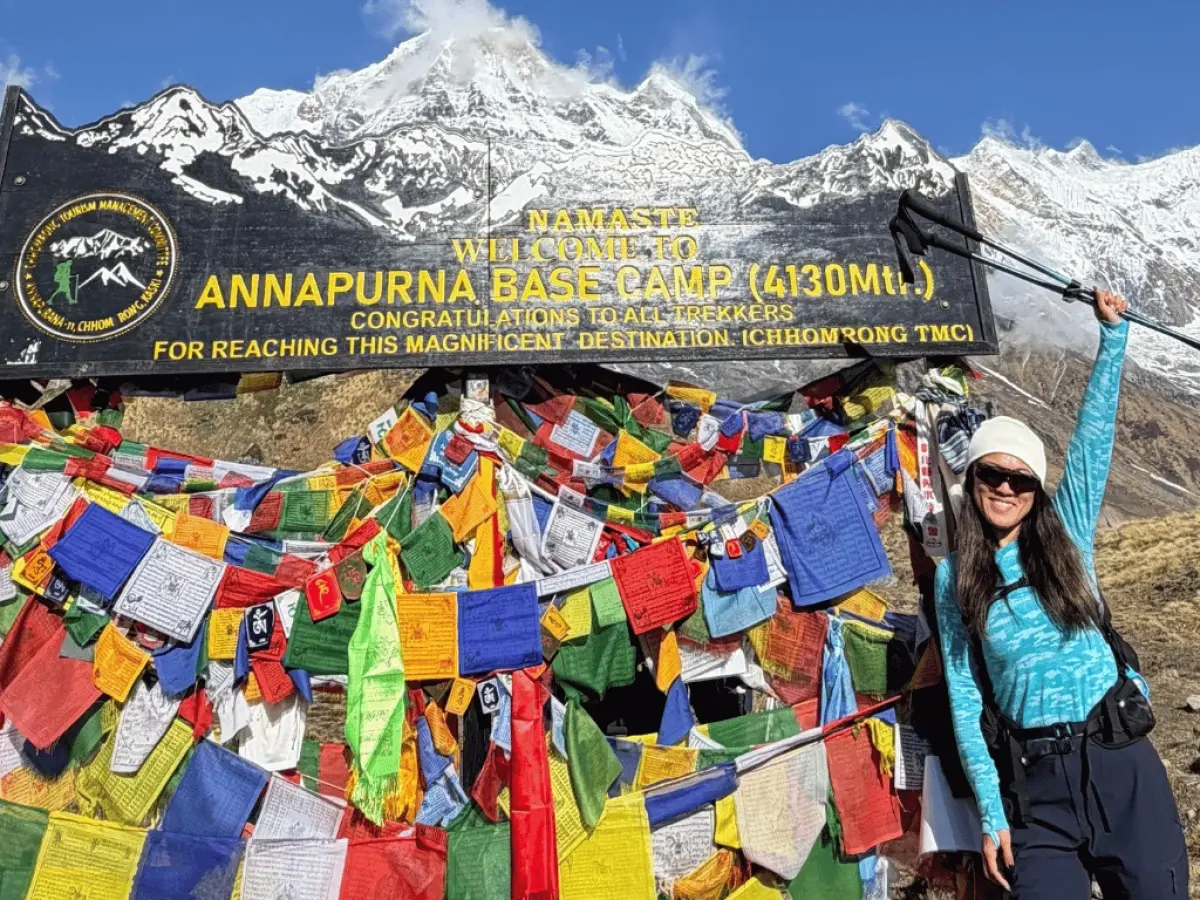
One hour from Tolyong the first ABC signboard appears — every trekker stops here for photos. The glacier viewpoint is 2 minutes from the tea house — your guide takes the group there after check in if weather permits.
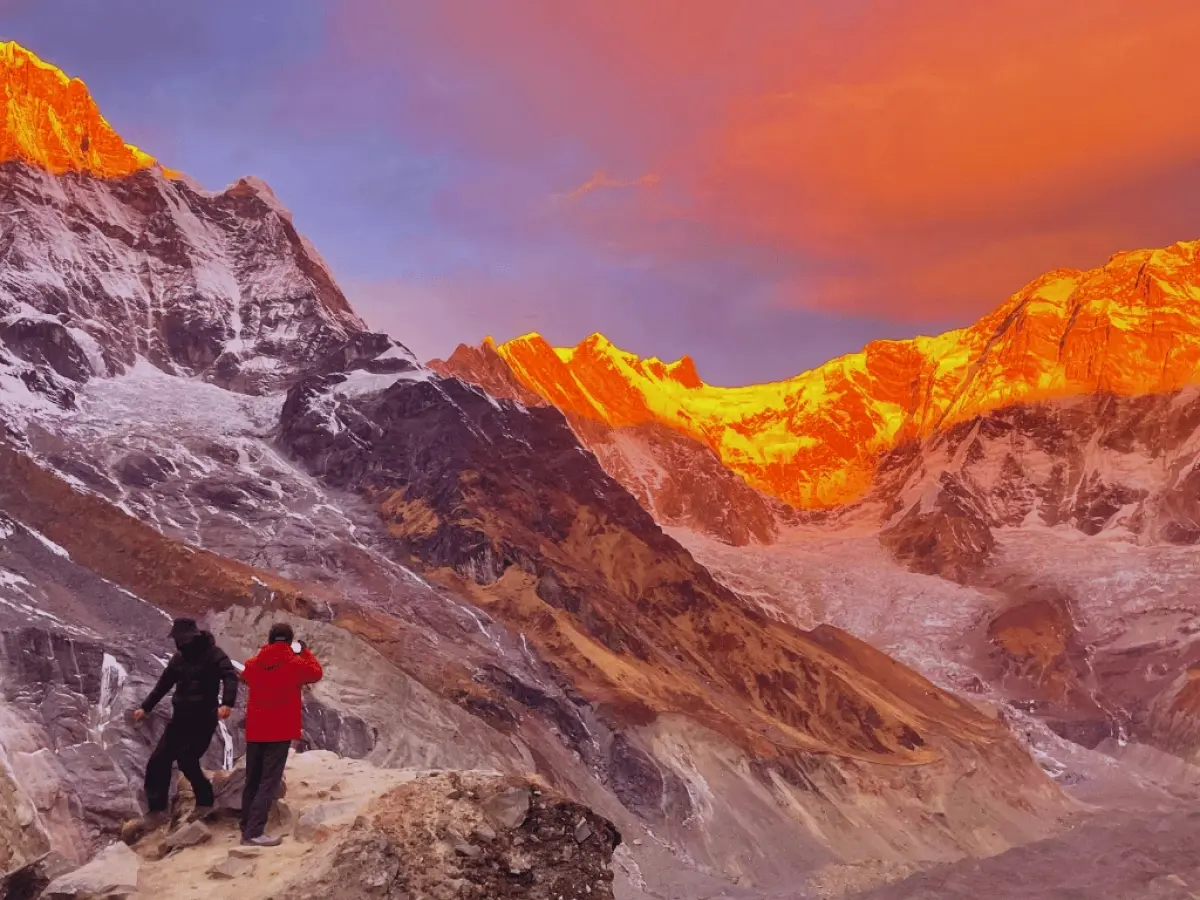
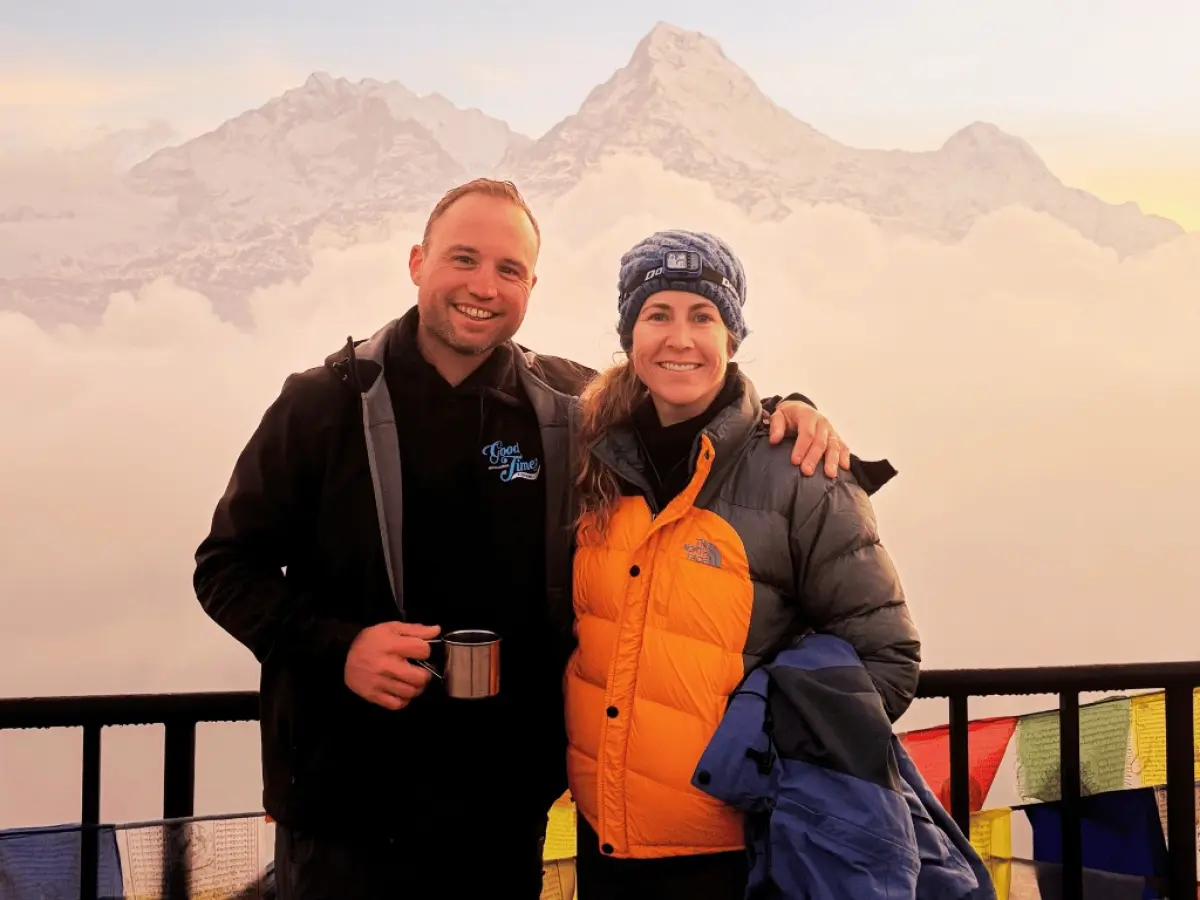
Your guide gives the exact sunrise wake-up time at the previous evening briefing. The viewpoint is 3 minutes from the tea house — be dressed and ready before departure. As the sky lightens, the sun rises from directly behind Machhapuchhre (Fishtail) and strikes Annapurna South, Annapurna Fang, and Annapurna I — the 10th highest mountain in the world at 8,091 m — in full morning light. Every guest smiles. Most say it is the most beautiful morning of their life. After ten years of guiding this route, our team has watched this moment hundreds of times, and it never becomes ordinary.
After sunrise, take time to watch the glaciers in the morning light before returning to the tea house for breakfast. Then the long descent begins.
Today is the longest walking day of the trek — 13 to 14 km mostly downhill. The section from ABC to MBC requires extra caution — the trail is partially slippery and demands careful footing on every step. Use trekking poles if you have them and follow your guide's pace. As you descend Machhapuchhre appears ahead and grows larger with every step. At some point on the trail trekkers naturally stop, turn around, and look back at Annapurna South one final time before the amphitheatre disappears behind the ridgeline. Every trekker feels it — a quiet goodbye to the mountain they came so far to reach.
Bamboo (2,310 m) is the overnight stop — a welcome rest after the biggest day of the trek in both distance and emotion.
Today is the final trekking day, and it ends with the most rewarding evening of the entire journey. The trail has one last test, though: just after leaving Bamboo, a steep 30-minute uphill climb begins immediately with no warm-up. After that, a 1-hour 30-minute mix of jungle trail leads to Upper Sinuwa before a 300 m descent followed immediately by a climb back up to Chhomrong. All stone stairs, steep in both directions — but you have come this far, and your legs know what to do.
Chhomrong is the natural lunch stop. Sit, eat, and look up — Annapurna South, Hiunchuli, and Machhapuchhre are all visible from here. A few days ago you were standing behind Annapurna South at base camp. From Chhomrong you can see the full mountain from the front — a perspective that hits differently after everything you have walked through to get here.
After lunch, all maintained stone stairs descend from Chhomrong down to Jhinu Danda (1,780 m). Drop your bag at the hotel and your guide takes you to the Jhinu Danda hot spring, 20 to 30 minutes downhill near the Modi Khola river. As of June 2026 there are 3 natural pools fed by geothermal water sitting under natural stone.
Our guide's tip: buy cold drinks, carry them down, soak in the hot spring, drink cold while your body recovers in the warm water. Then walk back up and sleep well — tomorrow is an easy drive day.
The final morning starts with one last short walk — 20 minutes from the hotel to the jeep station. On the way, the trail crosses the longest suspension bridge of the entire trek at 280 metres. Before stepping on, your guide checks both sides for mule trains — if one is coming, you wait, as turning back from the middle of a 280-metre bridge is not ideal. Seven minutes after the bridge, the private jeep is waiting.
The drive from Jhinu Danda to Pokhara takes approximately 3 hours. The first hour is off-road and bumpy — the last rough road of the entire trip. After that the surface becomes well-maintained tarmac all the way into Pokhara. Arriving back at Pokhara's Hotel, the trek is officially complete.
The afternoon is yours. Most trekkers are tired but too happy to sleep. Your guide recommends finding a lakeside restaurant for sunset — sitting at Phewa Lake watching the Annapurna ranges catch the evening light from a comfortable chair is a completely different experience after 10 days of walking toward those same mountains. If energy allows, paragliding over Pokhara valley and Phewa Lake is available nearby, as is the World Peace Pagoda across the lake for those who want one last viewpoint.
Your guide meets you at the hotel lobby and transfers you to the tourist bus park for the return drive to Kathmandu — the same scenic 206 km route, this time with the Annapurna ranges behind you and the memories of 10 trekking days ahead.
Back in Kathmandu, a Majestic Trails Nepal team member meets you at the hotel to collect your feedback and hear about your experience on the trail. This is also the moment to confirm your departure transfer to Tribhuvan International Airport for the following day.
If you want to extend your stay in Nepal — whether for sightseeing in Kathmandu, another trek, or a side trip — our team arranges everything from here.
Tip: Adding USD 110 upgrades the return journey to a 25-minute Pokhara to Kathmandu mountain flight — the same aerial Himalayan views, one last time before you leave Nepal.
According to your flight schedule a Majestic Trails Nepal team member and private vehicle will be waiting at Hotel Thamel Park to transfer you directly to Tribhuvan International Airport. Your Annapurna Base Camp journey is complete.
Late October is the single strongest window for Annapurna Base Camp. Post-monsoon skies are at their clearest, the sunrise from ABC strikes Annapurna South directly above camp at full intensity, and trail conditions are stable throughout the entire route. November offers equally clear skies with fewer trekkers and colder nights above 3,500 m — a strong second choice for those who prefer quieter trails.
End of March is the most underrated window of the year. Rainfall is minimal compared to April and May, and the rhododendron forest between Ulleri, Ghorepani, and Tadapani — the largest rhododendron forest in the world — is in full pink bloom. Trekkers who want the spring flower experience without the heavier April rainfall should target the last two weeks of March specifically.
Winter trekking is possible but December is the only winter month we recommend. The first week of December still offers clear skies, manageable temperatures, and almost no crowds. February is the harshest month of the year on this route — cold, windy, and with limited tea house services above Chhomrong. Avoid February unless you are an experienced winter trekker with specialist gear.
Monsoon season runs June to September. July brings the heaviest rainfall of the year and is not recommended under any circumstances. The specific danger zone is between Hinku Cave and Deurali — the Hinku river floods significantly during peak monsoon, making this section dangerous or impassable. Even experienced trekkers should avoid this window.
→ Read our complete month by month ABC trekking guide for full seasonal breakdown
Annapurna Base Camp is the most beginner friendly high altitude trek in Nepal. Our oldest client to complete the full route was 70 years old and first time trekkers complete this route regularly. If you can walk 2–3 hours daily in normal life, you can complete ABC with proper pacing. No prior trekking experience, technical skills, or mountaineering background is required.
The real difficulty on this route is stairs — not altitude. As of 2026 the majority of the trail from Birethanti to Machhapuchhre Base Camp consists of stone staircases. The single hardest section physically is between Chhomrong and Upper Sinuwa on Day 7 — a sustained climb on tired legs that challenges even fit trekkers. The descent on Day 11 from Chhomrong to Jhinu Danda is where knees take the most punishment. Based on our guiding experience approximately 65% of trekkers feel significant knee strain on this descent — trekking poles are the single most effective piece of equipment you can carry on this trek.
For pre-trek preparation, stair climbing is the most specific and effective exercise you can do at home. Build your stair stamina over 8–12 weeks before departure — nothing prepares your legs for this route better than the actual movement pattern of climbing and descending stairs repeatedly.
The most common mistake we see from trekkers who struggle is walking too fast. Slow pace is not a sign of weakness on this route — it is the strategy that gets you to base camp. Every guide on our team gives the same instruction from Day 1: slow down, breathe steadily, and let the mountain set your pace.
Annapurna Base Camp reaches 4,130 m — significantly lower than Everest Base Camp (5,364 m) and the Annapurna Circuit (5,416 m). In over 10 years of guiding this route Majestic Trails Nepal has not recorded a single serious altitude sickness case among our guests. The reason is not luck — it is itinerary design. The route naturally acclimatizes trekkers without a dedicated rest day: Ghorepani at 2,880 m, Poon Hill at 3,210 m, then back down to Chhomrong at 2,170 m before climbing gradually to ABC. By the time trekkers reach Deurali at 3,200 m their bodies have already been to 3,210 m and back — the acclimatization happens within the itinerary itself.
Our guides carry pulse oximeters on every departure and begin checking oxygen saturation levels from Deurali onward. The early warning signs we watch for are loss of appetite, vomiting, and persistent headache. A mild headache immediately after arriving at a new altitude is normal — it is your body adjusting. A headache that does not improve after rest and water is the signal that requires attention.
If a trekker shows serious symptoms the protocol is straightforward — serious cases go by helicopter, moderate cases descend immediately on foot. There is no waiting to see how things develop above 3,500 m.
On Diamox — our guides do not recommend it as a preventative measure for ABC specifically. The altitude is manageable without medication for most trekkers. Drinking enough water throughout the day and having garlic soup at tea houses from Deurali upward are the two most effective natural measures on this route.
Tea houses serve food at every stop on the ABC route from Birethanti to Annapurna Base Camp. The menu is largely consistent throughout — the only significant change is at Himalaya Hotel and above, where the menu reduces due to the cost of carrying supplies to higher altitude. As of spring 2026 Dovan tea houses added chicken dishes — one of the last stops where meat is available before the Barahi Temple boundary above which meat is prohibited.
For breakfast the set breakfast is the strongest option — toast, egg, and fried potatoes with hot drinks gives sustained energy for the morning climb. For lunch order dal bhat, fried rice, fried noodles, or spaghetti. Avoid pizza, momos, and similar items at lunch — they take significantly longer to prepare and slow the group down. Save those for dinner when time is not a factor. The best dal bhat on the entire route is found at Ghorepani, Chhomrong, and Jhinu Danda — our guides recommend these stops specifically for a full meal.
Accommodation ranges from comfortable to basic depending on altitude. Ghorepani offers the best overall tea house experience on the route — good rooms, attached bathrooms, and reliable facilities. Deurali, ABC, and Bamboo are the most basic — simple rooms, shared facilities, and limited services. At ABC electricity runs on solar power only — charge your phone and power bank immediately upon arrival before the solar supply runs low. Hot showers are available at all villages up to and including Deurali but not at ABC. WiFi and phone charging fees apply from Sinuwa upward throughout the route.
→ Read our complete ABC trek accommodation guide for tea house details by village.
As of 2026 only one permit is required for Annapurna Base Camp — the Annapurna Conservation Area Permit (ACAP). The TIMS card has been removed from this route. Foreign nationals pay NPR 3,000, SAARC nationals pay NPR 1,000, and children below 10 years enter free.
Three ways to get the permit. Online via the NTNC website — permit arrives by email, 2.9% card surcharge applies. At the Kathmandu counter in person — cash only, no surcharge, bring your passport. At Birethanti checkpoint on trek start day — available but charged at double the standard fee. Trekkers booking through Majestic Trails Nepal have permits arranged as part of the package.
One critical detail most trekkers miss: permits are non-transferable and non-refundable. If your name, nationality, or dates are entered incorrectly you cannot correct them after payment. Check every field before confirming.
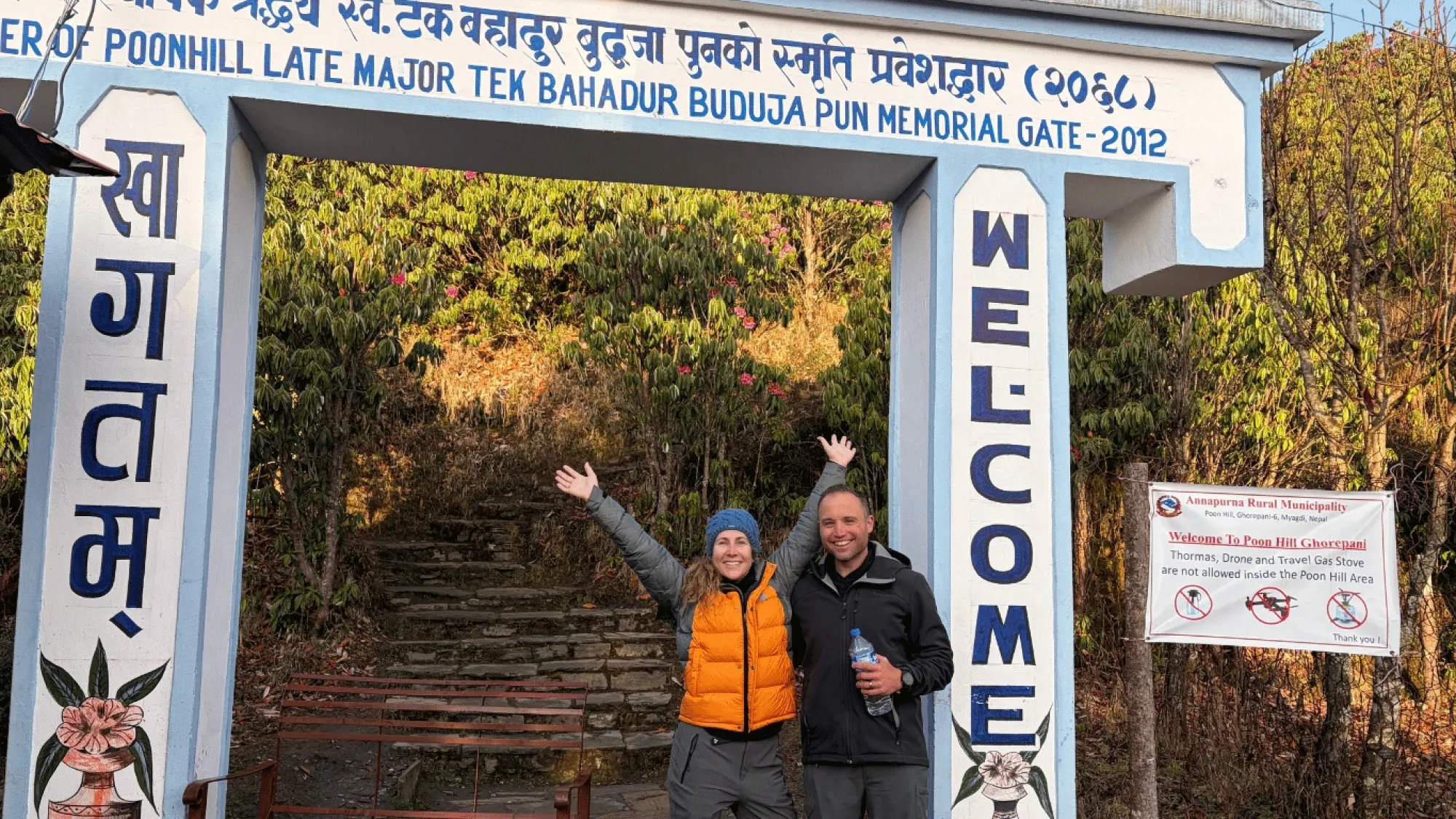
Two rules that apply from the moment you enter the conservation area: drones are strictly prohibited without prior government approval — confiscation happens at checkpoints with no exceptions. Registering at every checkpoint is mandatory — not just a formality. In the event of a rescue operation your last registered checkpoint is what search teams use to locate you. It has saved lives on this route.
The Annapurna Base Camp Trek was an unforgettable journey through some of the most breathtaking landscapes in the Himalayas. Every step brought new wonders—from lush rhododendron forests to stunning mountain vistas of Annapurna and Machapuchare peaks. The trail is challenging but rewarding, with cozy teahouses offering warm hospitality along the way. Reaching the base camp felt like a true achievement, surrounded by towering snow-capped giants that left me speechless. What made the trek even better was the support of our guide and team, who ensured safety and shared valuable insights about the local culture and nature. This trek is perfect for adventure seekers looking to connect deeply with Nepal’s natural beauty and serene mountain life. I highly recommend the Annapurna Base Camp Trek for anyone wanting a perfect mix of challenge, culture, and awe-inspiring scenery.
My Annapurna Base Camp trek with Majestic Trails Nepal was nothing short of spectacular. The well-planned itinerary allowed for acclimatization, and the views were absolutely breathtaking. The guides were knowledgeable, and their passion for the region was contagious. The trek was challenging but rewarding, with each day bringing new landscapes and experiences. I highly recommend this trek for anyone looking for a true Himalayan adventure.
From the very first day, this private Annapurna Base Camp trek with Poon Hill felt like a dream. Ramesh guided me patiently through terraced fields and rhododendron forests, while Dawa made sure my backpack never felt heavy. The morning of Poon Hill sunrise was unforgettable—the sky exploded in hues of pink and gold over Machapuchare and Annapurna South. One evening, I sprained my ankle slightly, but Ramesh immediately helped me, and Dawa even carried my bag for a few kilometers. Staying in cozy tea houses, sipping hot chai, and sharing stories with fellow trekkers added warmth to every day. Majestic Trails Nepal handled everything seamlessly, allowing me to fully enjoy the Himalayan adventure. Reaching Annapurna Base Camp itself was surreal; the snowy peaks surrounding us made the long trek completely worth it.
On day 6, I started feeling dizzy from the altitude. Karma quickly assessed the situation and called Majestic Trails Nepal, who arranged a helicopter transfer within an hour—something I never imagined could happen so smoothly. Mingma stayed with me, keeping spirits high and making sure I was comfortable. The trek itself was breathtaking, with every day bringing new views—from Ghorepani’s rhododendron forests to the panoramic sunrise at Poon Hill. At Annapurna Base Camp, standing surrounded by the massive peaks, I felt humbled and exhilarated. The small group atmosphere made the trek fun and social, and the guides’ storytelling about Gurung culture added depth to the adventure. Majestic Trails Nepal’s support truly made this a stress-free, once-in-a-lifetime experience.
I chose a private trek for a more personalized experience, and Santosh and Nima exceeded my expectations. Every morning, trekking past terraced rice fields and small villages felt magical. On day 4, it rained heavily while we were ascending Chhomrong—Santosh guided us carefully along slippery trails, and Nima kept our packs dry. The sunrise at Poon Hill the next morning was a perfect reward for the challenging climb. At Annapurna Base Camp, I sat silently, overwhelmed by the scale and beauty of the mountains. Majestic Trails Nepal ensured every detail—from transportation to tea house bookings—was flawless. This trek wasn’t just a physical journey; it was a spiritual and emotional experience I’ll never forget.
October brought unexpected snowfall on the trail, but our guide Tenzing and porter Karma made everything manageable. They shared jokes and stories that kept our group laughing even on icy paths. The sunrise at Poon Hill was a highlight—I had never seen the mountains glow so vividly. Staying in tea houses, enjoying hearty dal bhat, and chatting with locals made the trek feel immersive. Majestic Trails Nepal handled permits, local arrangements, and minor itinerary adjustments perfectly. Reaching Annapurna Base Camp was surreal, surrounded by snow, ice, and towering peaks. Our small group’s camaraderie, combined with expert guidance, made this trek an adventure I’ll remember forever.
Every step on this trek felt meaningful. Dorje’s calm guidance and Pemba’s cheerful assistance made even the steepest trails manageable. On day 5, one group member had mild altitude sickness, and Dorje adjusted the pace while Pemba carried extra water and snacks. The morning at Poon Hill, watching golden sunlight illuminate Machapuchare, left me speechless. Annapurna Base Camp itself was surreal—standing among frozen peaks, I felt a mix of awe, relief, and accomplishment. Majestic Trails Nepal took care of every detail, from local transportation to ensuring our safety at high altitudes. This private trek wasn’t just about hiking; it was about discovering beauty, culture, and inner strength.
The trek began with lush terraced villages and ended in snow-capped wonder at Annapurna Base Camp. Mingma guided our small group expertly, while Lhakpa made carrying heavy backpacks seem effortless. One night, a sudden rainstorm flooded the trail slightly; the guides helped us navigate safely and kept everyone in good spirits. Sunrise at Poon Hill was unforgettable—pink and golden peaks stretching across the horizon. Tea houses offered warmth, local food, and a chance to connect with other trekkers. Majestic Trails Nepal’s arrangements, including local transport and permits, made the trek stress-free. The combination of adventure, cultural immersion, and breathtaking views made this trek life-changing.
I loved the personalized attention on my private trek. Sita’s guidance kept me safe and motivated, and Dorje’s cheerful energy made carrying my bag feel easy. On day 3, I accidentally dropped my camera in a stream, but Dorje quickly rescued it—small moments like this made me feel cared for. Watching the sunrise at Poon Hill was magical, with golden light illuminating the Himalayan peaks. Annapurna Base Camp itself was surreal—icy winds, towering mountains, and a sense of accomplishment. Majestic Trails Nepal made everything easy: permits, local coordination, and even small requests were handled promptly. This trek gave me adventure, culture, and memories I’ll treasure forever.
The first day walking through terraced fields and rivers felt gentle, but the trail became challenging as we approached Chhomrong and Ghorepani. Karma guided us expertly, while Pemba ensured our bags were safe and dry. Unexpected snow on the ABC trail made me nervous, but the team handled it calmly. Poon Hill sunrise was the highlight—the mountains glowed in golden hues, and I felt completely alive. Tea houses provided comfort, warm meals, and a chance to meet fellow trekkers. Majestic Trails Nepal handled permits and logistics flawlessly. Reaching Annapurna Base Camp was overwhelming in the best way, surrounded by massive peaks and pristine nature.
I opted for a private trek and it was worth every penny. Dorje guided me with patience, while Mingma carried my heavier items and made me laugh every day. One evening, heavy winds shook our tea house roof, but Dorje reassured us, and Mingma ensured our sleeping bags were dry. Watching sunrise at Poon Hill was the perfect reward for all the effort—pink peaks stretching across the horizon. Annapurna Base Camp itself was humbling; the snow, ice, and scale of the peaks made me feel small yet accomplished. Majestic Trails Nepal handled every detail flawlessly, from permits to local arrangements, making this trek worry-free.
The journey from Pokhara to Annapurna Base Camp was incredible. Our small group bonded quickly, guided by Tenzing and assisted by Lhakpa. On day 4, we got lost briefly in fog near Tadapani, but Tenzing calmly navigated the path. Poon Hill sunrise was unforgettable—the colors over Annapurna South and Machapuchare left me speechless. Tea houses along the trail provided warmth, local food, and a peek into Nepali culture. Majestic Trails Nepal ensured everything ran smoothly, from transportation to permits. Reaching ABC, surrounded by snow and towering peaks, felt like the pinnacle of achievement. Every challenge, every step, every sunrise made this trek an unforgettable adventure.
The trek began under a soft morning mist that made the terraced rice fields look enchanted. Pema guided our small group expertly, explaining the local flora and traditions, while Karma carried our bags and kept everyone laughing. On day 3, we had to cross a narrow wooden bridge over a rushing river during light rain—it was exhilarating but safe, thanks to our guide. The next morning, the Poon Hill sunrise was a spectacle beyond words. The peaks of Machapuchare and Annapurna South glowed pink and gold while clouds danced around them. Tea houses were cozy, offering hot meals, and the evenings were filled with stories of previous trekkers. Finally, reaching Annapurna Base Camp was surreal—the snow, towering peaks, and serene silence created a profound sense of awe. Majestic Trails Nepal handled permits, transport, and accommodations flawlessly, letting us enjoy the trek fully. This journey was magical, challenging, and deeply rewarding.
From the very first step, I felt immersed in the Himalayas. Dorje’s calm guidance and Mingma’s cheerful support made steep climbs and long days manageable. On day 4, a sudden snowfall turned the trail white, and Dorje made sure I was safe while Mingma carried extra blankets and snacks. Poon Hill sunrise was breathtaking—the pink light illuminating Annapurna South and Machapuchare was surreal. Nights in tea houses were warm and welcoming, and I loved chatting with other trekkers and villagers. Reaching Annapurna Base Camp was humbling; the vast peaks, icy winds, and silence created a profound sense of achievement. Majestic Trails Nepal handled every detail perfectly—from permits to logistics—making this private trek seamless and unforgettable.
The temperature changes dramatically across ABC. Day 1 at Birethanti (1,030 m) can be 25°C. Day 9 at ABC (4,130 m) drops below freezing at night. Layering handles every condition.
Base layers:
Mid layers:
Outer layers:
Trekking pants:
The single most important gear category for ABC. Get this right and the trek is comfortable. Get it wrong and you suffer for 10 days.
Important: Do not bring brand new boots. Break them in for at least 2-3 weeks before the trek. New boots cause blisters that ruin the experience.
You do not need to bring or rent these items:
All gear is returned after the trek.
Important note about ABC charging: Electricity at Annapurna Base Camp runs on solar power only. Charge your phone and power bank immediately upon arrival before the solar supply runs low. WiFi and charging fees apply from Sinuwa upward throughout the route.
You can book your 14-day trek directly on the Majestic Trails Nepal website. The package includes experienced guides, accommodation, meals, and trekking permits. After booking, you’ll receive a confirmation email with all itinerary details.
Majestic Trails Nepal provides rental options for essential gear, including trekking boots, down jackets, sleeping bags, and backpacks. All equipment is tested for high-altitude conditions and maintained to ensure safety.
Annapurna Base Camp sits at 4,130 meters (13,550 feet). It is the highest point of the standard trek. Machhapuchhre Base Camp (MBC) sits below at 3,700 m and Tolyong, the Annapurna Sanctuary mirror lake, sits at 3,980 m. ABC is positioned directly below the south face of Annapurna South (7,219 m).
Annapurna Base Camp is located in the Annapurna Sanctuary of the Annapurna Conservation Area in north-central Nepal, Kaski District, Gandaki Pradesh. It sits inside a natural amphitheatre surrounded by Annapurna South (7,219 m), Annapurna I (8,091 m), Hiunchuli, and Machhapuchhre (6,993 m).
A licensed guide is officially required by Nepal Tourism Board rules introduced in 2023, but as of June 2026 the rule is not actively enforced on the Annapurna Base Camp route. Trekkers without guides currently pass through checkpoints without being turned back. However, a guide is strongly recommended regardless — for altitude assessment, navigation, permit handling, tea house bookings, and emergency response. Majestic Trails Nepal provides NATHM-licensed guides and one porter per two trekkers on every departure.
You can book helicopter tours through Majestic Trails Nepal. Helicopter flights depart from Pokhara and provide stunning aerial views of Machapuchare, Annapurna South, and the surrounding Himalayan range. Tickets can be reserved along with your trek package.
The Annapurna Base Camp Trek takes 14 days if starting from Birethanti or 6-7 days if starting from Jhinu Danda or Ghandruk. The 14-day option from Birethanti includes Ulleri, Ghorepani, and the Poon Hill sunrise viewpoint. The shorter 6-7 day option skips the Poon Hill section and goes directly toward base camp. Majestic Trails Nepal's standard package uses the 14-day Birethanti route covering 10 trekking days and 4 transport days.
To reach Annapurna Base Camp from Kathmandu, travel by tourist bus or flight to Pokhara (7-8 hours by bus or 25 minutes by flight), then a 2-hour private car transfer to the trek start at Birethanti (1,030 m). The 14-day full route from Birethanti passes through Ulleri, Ghorepani, Tadapani, Chhomrong, Bamboo, Dovan, Himalaya Hotel, Deurali, and MBC before reaching base camp. For a shorter 6-7 day option, trekkers can start from Jhinu Danda or Ghandruk and skip the Poon Hill section. There is no road access to ABC itself.
No, you cannot see Mount Everest from Annapurna Base Camp. The two mountain regions are separated by approximately 240 km of Himalayan terrain. From ABC you see Annapurna South (7,219 m) directly above, Annapurna I (8,091 m) across the glacier, Hiunchuli, Annapurna Fang, and Machhapuchhre. To see Everest, you must trek the Everest Base Camp route in the Khumbu region — a separate trek entirely.
Yes, you can combine the Annapurna Circuit with Annapurna Base Camp into a 22-day combined trek. After completing the Annapurna Circuit and reaching Ghorepani, the route continues toward Tadapani, Chhomrong, and the Annapurna Base Camp section. As standard separate treks, they are different — the Annapurna Circuit is 10-16 days, crossing Thorong La Pass at 5,416 m, and the Annapurna Base Camp is a 14-day trek to base camp at 4,130 m.
Majestic Trails Nepal arranges luggage transfers to the trek start point, so you can trek light. Your extra bags are safely transported to the teahouses or final destination, minimizing hassle during the 14-day trek.
Majestic Trails Nepal offers eco-friendly packages, following responsible trekking practices such as proper waste disposal, use of reusable water bottles, and support for local businesses and communities.
Majestic Trails Nepal provides clear cancellation policies, including full or partial refunds depending on timing. We also recommend travel insurance for unexpected changes.
Majestic Trails Nepal combines trekking with cultural experiences — visits to local Gurung and Magar villages, homestays, and traditional meals. Booking directly ensures a fully immersive Himalayan experience.
Majestic Trails Nepal provides transparent pricing, full itineraries, and verified reviews, making it easy for US travelers to compare services and select the best package.
For high-altitude trekking, essentials include painkillers, altitude sickness medicine (Acetazolamide), blister care, bandages, and antiseptic wipes. Majestic Trails Nepal can provide a pre-packed first aid kit or guide you on what to buy locally before your trek.
Yes, travel insurance is mandatory for the Annapurna Base Camp trek. The insurance should cover emergency evacuation, medical expenses, and trekking up to 4,130 meters in altitude.
To prepare for Annapurna Base Camp Trek, focus on stair climbing and walking endurance for 8-12 weeks before departure. Climb stairs regularly to build the specific muscle pattern needed for the staired terrain. Add cardiovascular training with walking, hiking, running, or cycling 3-4 times per week. Strengthen knees with squats and lunges — approximately 65% of trekkers feel knee strain on the descent.
Required permits include:
Majestic Trails Nepal handles the application process for you, so all permits are ready before your trek.
No, the Annapurna Base Camp Trek is one of the safest major treks in Nepal and is not considered risky. The maximum altitude of 4,130 m is significantly lower than the altitude sickness thresholds that affect EBC or the Annapurna Circuit.
Yes, Annapurna Base Camp is one of the most beginner-friendly high-altitude treks in Nepal. Any trekker who can walk 2-3 hours daily can complete this route with proper pacing. No prior trekking experience, technical skills, or high-altitude pass crossing is required.
At Annapurna Base Camp, temperatures range from 5-15°C during the day to -5 to -15°C at night, depending on the season. December and January are coldest with nights potentially dropping below -15°C. October and November nights average -5 to -10°C. Surprisingly, Deurali (3,200 m, the night before ABC) is often colder than ABC itself due to greater wind exposure. A sleeping bag rated to -10°C minimum is essential year-round.