
Best Time to Trek in Nepal
17 Jan 2026
Let's cut straight to it. Autumn, specifically September through November, is the best time to trek in Nepal. Spring runs a very close second, coverin...

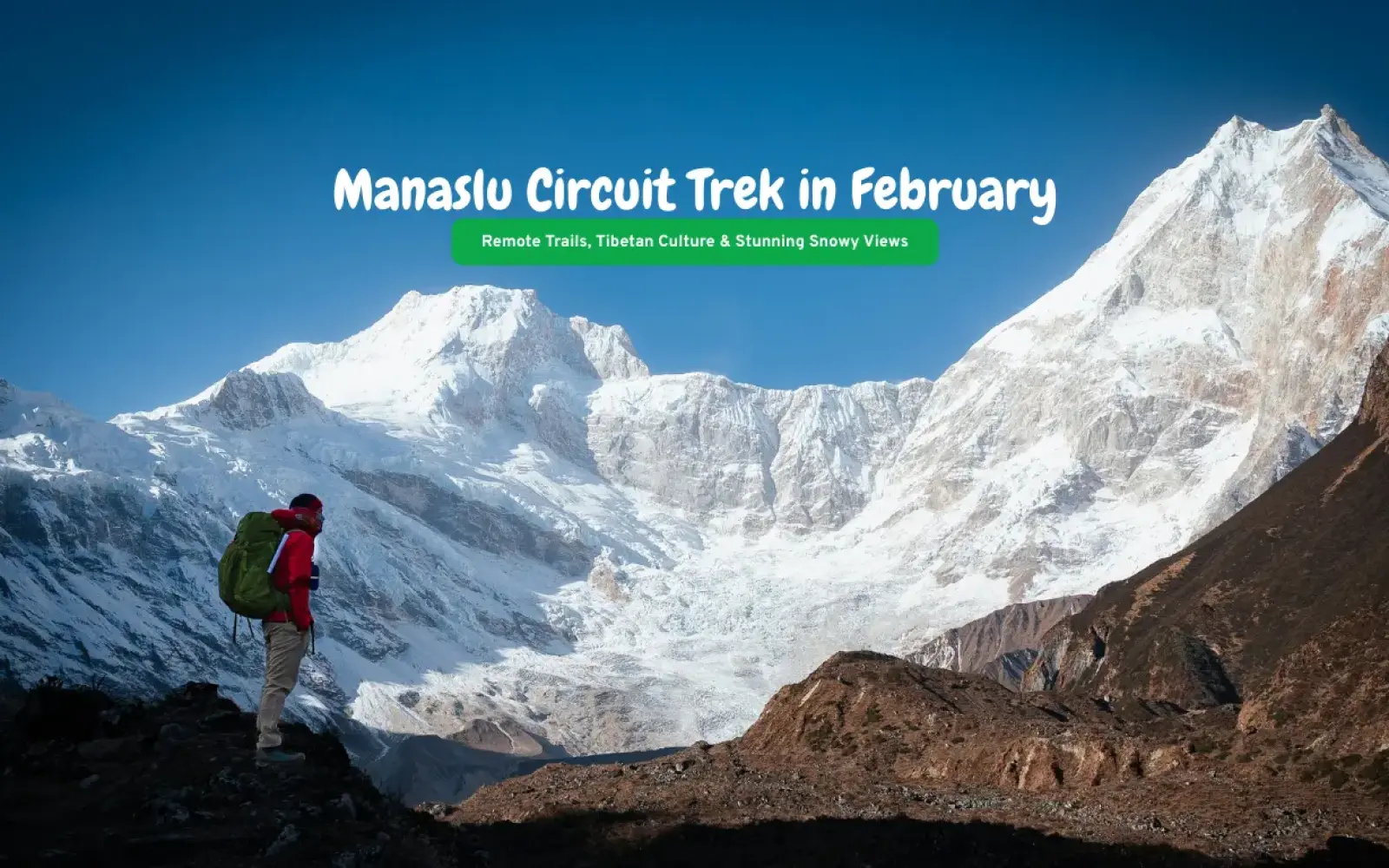

There are treks that impress you, and then there are treks that change you. As someone who has guided and explored many routes across the Himalayas with Majestic Trails Nepal, I can confidently say that experiencing the Manaslu Circuit Trek in February belongs firmly in the second category.
Nepal is famous for legendary routes like Everest Base Camp and the Annapurna Circuit Trek. They are iconic for a reason—but with popularity comes crowds, commercialization, and a slightly diluted mountain experience. If you’re looking for something quieter, rawer, and deeply authentic, the Manaslu Circuit Trek stands apart as one of Nepal’s most underrated Himalayan journeys.
Circling Mount Manaslu (8,163m)—the eighth-highest mountain in the world—this trek is a rugged, remote adventure that rewards patience, resilience, and curiosity. Over roughly 100 miles of hiking, you pass through untouched villages, deep river gorges, dense forests, ancient monasteries, and high-altitude landscapes that still feel wild and unfiltered.
At Majestic Trails Nepal, we often recommend the Manaslu Circuit Trek to trekkers who have already experienced popular routes like Everest Base Camp or Annapurna and are now searching for something more meaningful—less crowded, culturally deeper, and closer to how trekking in Nepal once felt.
One of the defining features of the Manaslu Circuit Trek is its restricted area status. This is officially classified as a restricted area trek in Nepal, meaning trekkers must obtain special permits and travel with a licensed guide. This region was closed to outsiders until the 1990s, and even today, trekkers must travel with a licensed guide and special permits. While this adds a layer of logistics, it also preserves something rare in the Himalayas—authenticity.
Unlike Everest or Annapurna, life along the Manaslu trail hasn’t been reshaped entirely by tourism. Locals still farm, raise livestock, and follow centuries-old traditions. Tibetan-influenced culture dominates the upper regions, with prayer flags, mani walls, and monasteries woven naturally into everyday life.
Here, trekking doesn’t feel like following a highway of hikers. Most days, the trail feels quiet, personal, and intimate—as if the mountains are revealing themselves only to those willing to venture a little further.
At Majestic Trails Nepal, we believe the Manaslu Circuit Trek represents what Himalayan trekking should feel like—challenging, respectful, culturally rich, and deeply personal.
The Manaslu Circuit Trek in February offers something increasingly rare in Nepal:
It’s not an easy trek. It demands time, fitness, and flexibility. But for those willing to embrace uncertainty, it delivers one of the most authentic Himalayan trekking experiences available today.
From our experience operating the Manaslu Circuit Trek for international trekkers, the transition from Kathmandu to the trailhead is often where the mental shift begins—from modern life to mountain rhythm.
The Manaslu Circuit Trek begins in Kathmandu, Nepal’s chaotic yet captivating capital. From the buzzing streets filled with motorbikes, incense, and color, the journey transitions into a long and bumpy jeep ride to the trailhead.
This drive is an adventure in itself—rough roads, winding river valleys, and gradual immersion into rural Nepal. As city noise fades, the rhythm of the mountains slowly takes over, setting the tone for what lies ahead.
The first days of trekking involve longer distances, often alongside newly built roads. While not every step feels remote at first, the landscape quickly begins to change. Suspension bridges, waterfalls, and the first glimpses of Himalayan peaks remind you that the real journey has begun.
Guiding trekkers on the Manaslu Circuit Trek in February, we often notice the same transformation happening quietly within the first few days. The mountains strip life back to its essentials—and that simplicity is exactly what many travelers are seeking.
Trekking the Manaslu Circuit is about returning to basics. Days revolve around walking, breathing, eating, and resting. Life reduces itself to simple needs—and that simplicity creates space.
For solo trekkers especially, the experience can feel introspective. Long stretches of quiet trail allow your thoughts to wander. Moments of loneliness appear, but so does clarity. In the mountains, distraction disappears. What remains is presence.
Evenings are spent in teahouses—basic but welcoming lodges that offer hot meals, warmth, and shared stories. Compared to Everest or Annapurna, teahouses here are simpler, reflecting the lower volume of visitors. Yet that simplicity adds to the charm.
And of course, there’s dal bhat—Nepal’s trekking staple. Nutritious, filling, and endlessly refillable, it fuels long days on the trail and becomes a comforting ritual.
Cold behaves differently at night. Above Samagaun, temperatures drop sharply after sunset, and warmth becomes something you manage carefully rather than assume. Layers stay on. Sleeping bags are zipped tight. Hot water bottles turn into small lifelines.
Evenings naturally gather everyone into a single heated dining room, where stories replace screens, and silence feels shared rather than lonely. Outside, the stars feel closer. Inside, the cold reminds you that rest here is earned—not guaranteed.
Once you enter the Manaslu Conservation Area, the trek truly begins. As a local trekking company, Majestic Trails Nepal handles all permit logistics in advance, allowing trekkers to focus purely on the experience.
A major turning point comes when you officially enter the Manaslu Conservation Area. Permits are checked, roads disappear, and the trail becomes narrower and more rugged.
Dense forests line the path. Rivers roar below. Snow-capped peaks begin to dominate the horizon. Each day brings more elevation, more challenge, and deeper immersion into the Himalayas.
Despite the remoteness, the trail never feels unsafe. Small villages appear just when you need them most, offering tea, shelter, and smiles. Fellow trekkers are few but welcome enough to share stories in the evening, yet sparse enough to keep the journey personal.
What makes the Manaslu Circuit Trek in February especially rewarding for culturally curious trekkers is how naturally spiritual life blends into daily routines. This is one of the reasons we describe it as one of the most culturally immersive restricted area treks in Nepal.
One of the most beautiful aspects of the Manaslu Circuit Trek is its cultural richness. This region lies close to the Tibetan border, and Tibetan Buddhism shapes daily life.
Prayer wheels line the trails. Mani stones carved with sacred mantras rest beside villages. Monasteries—some over 500 years old—sit quietly above the path, offering moments of reflection.
Timing the trek during the Tibetan New Year adds another layer of magic. Villagers and monks celebrate with traditional food, butter tea, prayers, and rituals. Being welcomed into these moments isn’t something you can plan—it’s something the Manaslu region generously offers.
From a guide’s perspective, winter on the Manaslu Circuit Trekis both breathtaking and demanding. At Majestic Trails Nepal, we only recommend winter departures to trekkers who are flexible, well-prepared, and comfortable with changing conditions.
Trekking the Manaslu Circuit in winter brings both beauty and unpredictability. Fresh snow transforms the landscape into a Himalayan dreamscape, but it also significantly raises the difficulty level.
Trails become slippery. Progress slows. Cold intensifies with altitude. Snow depth can determine whether crossing the high pass is possible at all.
Yet winter also brings rewards: fewer trekkers, dramatic mountain views, and a sense of true expedition-style trekking. Each step feels earned. Every clear morning feels like a gift.
What often goes unspoken about the Manaslu Circuit Trek in February is how quietly logistics change. Water pipes freeze overnight. Some mornings begin not with packing bags, but with waiting for water to thaw or snow to be melted.
Charging devices become uncertain. Hot showers disappear entirely in higher villages. None of this feels dramatic—but together, these small realities reshape how you move through the trek. Expectations soften. Time slows. February doesn’t announce its challenges loudly; it reveals them patiently.
Walking in winter to manaslu circuit trek follows a different rhythm. Ice hides in shaded corners. Descents demand more focus than ascents. Trekking poles stop being optional and start becoming anchors.
Some mornings, the snow is firm and forgiving. By afternoon, it softens, making every step heavier. Progress isn’t measured in distance, but in consistency—steady breath, balanced steps, and the understanding that arriving safely matters more than arriving early.
Hydration becomes subtle work in winter. Streams freeze. Bottles ice over. Drinking less feels natural in the cold, but altitude doesn’t forgive it.
Guides remind trekkers constantly—not with urgency, but repetition. In February, staying hydrated isn’t about comfort. It’s about clarity, acclimatization, and keeping the body quietly functioning while the mountains do the talking.
Even for seasoned local guides, seeing Mount Manaslu clearly is never something we take for granted. Every clear view feels earned—and unforgettable.
Seeing Mount Manaslu for the first time is unforgettable. Rising sharply above the surrounding peaks, its presence is both beautiful and intimidating.
At over 8,000 meters, Manaslu is no ordinary mountain. It’s technical, dangerous, and respected even by seasoned climbers. Standing beneath it, you’re reminded how small you are—and how powerful nature truly is.
Clear skies are never guaranteed here. Even experienced guides may see the mountain in full clarity only a handful of times. When it reveals itself, it feels like a moment meant only for you.
Crossing Larkya La Pass (5,160m) is the defining challenge of the Manaslu Circuit Trek in February. From years of guiding experience, we’ve learned that patience here is just as important as fitness.
The highest point of the trek, Larkya La Pass (5,160m), is both the ultimate goal and the biggest uncertainty. Heavy snowfall can close the pass without warning, forcing trekkers to wait—or turn back.
These waiting days teach patience. Tea replaces miles. Conversations replace footsteps. Acclimatization hikes replace ambition.
In the Manaslu Circuit Trek, success isn’t about pushing forward at all costs. It’s about respecting the mountains and adapting to their rules.
From a founder’s perspective at Majestic Trails Nepal, the Manaslu Circuit Trek isn’t just another itinerary—it’s one of the last remaining journeys where Nepal still feels untouched, unhurried, and profoundly real.
The Manaslu Circuit Trek isn’t about ticking off another famous route. It’s about slowing down, embracing discomfort, and rediscovering why you came to the mountains in the first place.
Somewhere between river crossings, snow-covered trails, and quiet monasteries, the journey becomes more than a trek. It becomes a conversation—with the land, the culture, and yourself.
For trekkers searching for Nepal beyond the crowds, Manaslu quietly waits.
This section answers common questions specifically related to trekking the Manaslu Circuit Trek in February, based on real winter conditions described above.
A: February is considered an off-season (winter) for the Manaslu Circuit Trek in February, offering solitude and raw Himalayan scenery but requiring good preparation. It offers fewer crowds and dramatic snowy landscapes, but conditions can be challenging due to cold temperatures and potential heavy snowfall, especially near Larkya La Pass.
A: Yes, the Manaslu Circuit Trek in February is open, but the crossing of Larkya La Pass depends entirely on weather and snow conditions. Temporary closures are common in winter, and flexibility is essential.
A: Temperatures in February can drop well below freezing at higher elevations, particularly at night. Proper winter gear, layers, and a good sleeping bag are essential.
A: Yes. The Manaslu Circuit is a restricted area trek in Nepal. Trekking independently is not allowed, and you must travel with a licensed guide and obtain special permits.
A: The Manaslu Circuit Trek is generally considered more remote and physically demanding than Everest Base Camp due to longer distances, fewer facilities, and higher terrain variability—especially in winter.
This article reflects a genuine winter experience on the Manaslu Circuit Trek in February, when winter conditions, solitude, and adaptability define the journey. At Majestic Trails Nepal, we treat the Manaslu Circuit Trek in February as an expedition-style journey—best suited for trekkers who value solitude, authenticity, and are comfortable adapting to mountain conditions.
If you are researching other classic routes, you may also find value in exploring the Everest Base Camp Trek or the Annapurna Circuit Trek, which offer very different experiences compared to the quieter Manaslu region.

Let's cut straight to it. Autumn, specifically September through November, is the best time to trek in Nepal. Spring runs a very close second, coverin...

The Langtang Valley Trek is one of Nepal’s most rewarding trekking adventures—less crowded than Everest or Annapurna, yet rich in culture, biodiversit...

Short on time but big on ambition? Nepal delivers extraordinary mountain experiences in as little as three days, and this guide breaks down exactly wh...
The Annapurna Base Camp trek stands among the world's most iconic Himalayan adventures. Every year, thousands of trekkers from across the globe journe...

Nepal, cradled by the majestic Himalayas, calls out to adventurers with its unrivaled trekking opportunities. While the Everest Base Camp (EBC) trek a...
Situated in the peaceful Solu-Khumbu region of Nepal, near the village of Junbesi, Thupten Chholing Monastery is a living testament to Tibetan Buddhis...

Solukhumbu is synonymous with Mount Everest, but beyond the famous peak lie quieter, magical destinations that often get overlooked. One such gem is P...
IntroductionNepal — the final destination for every mountaineer. A place where almost everyone dreams of going at least once in their lifetime. To see...
