
The 10 Best Treks in Nepal for 2026
10 Jun 2025
What makes for the best treks in Nepal can vary from person to person. While Everest Base Camp Trek (EBC) at 5545 m is ideal for a trekker wanting the...

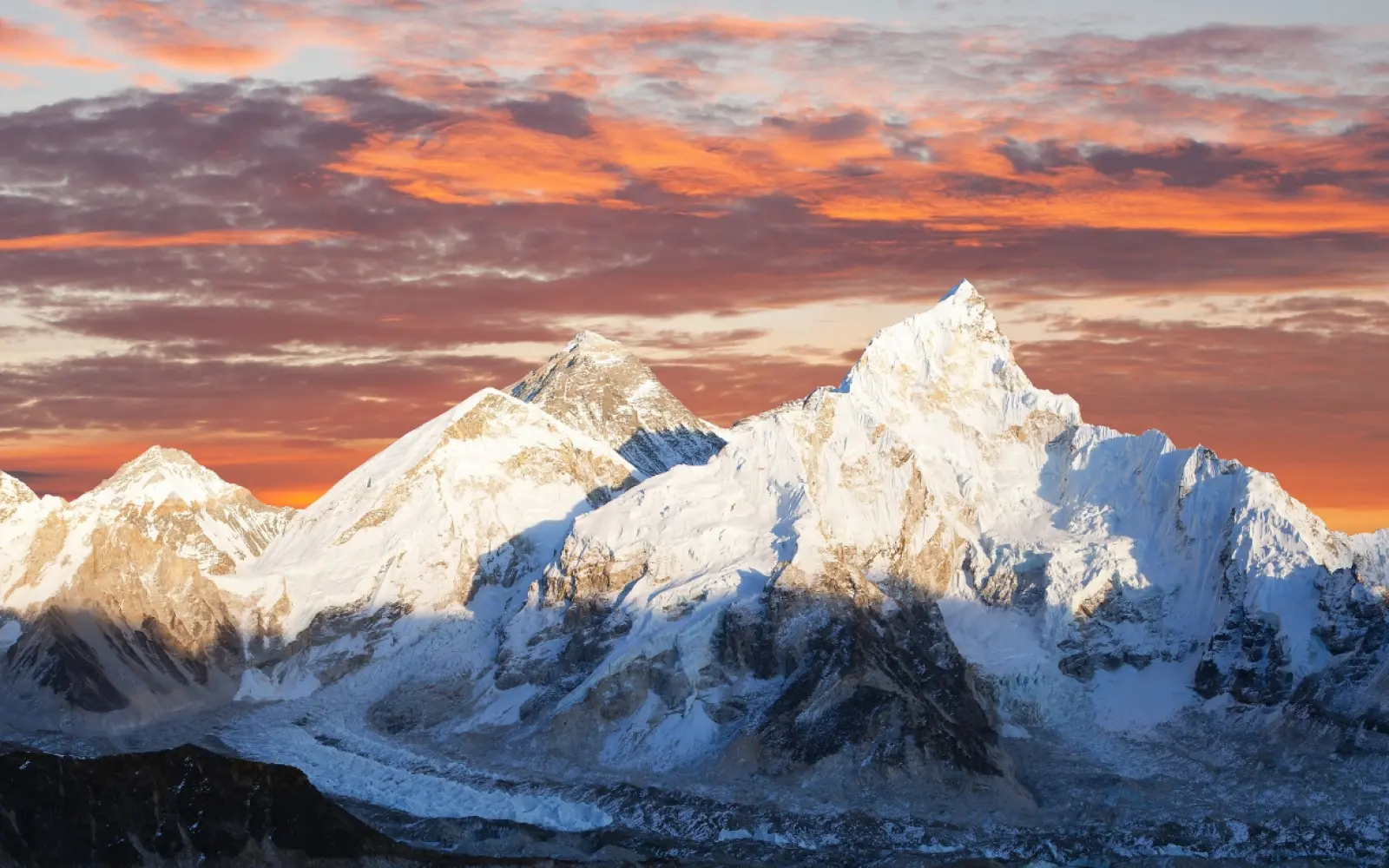

Nepal is a country defined by mountains. Stretching across the country’s northern edge, the Himalayas pack Earth’s highest peaks into one nation. Eight of the world's fourteen eight-thousanders — mountains exceeding 8,000 meters — rise within Nepal's borders. Add to that over 1,300 peaks above 6,000 meters.
Then it is clear why Nepal is a global hub for trekking and high-altitude climbing. Whether you plan an expedition to the roof of the world or want to learn about Nepal’s mountains, this guide helps.
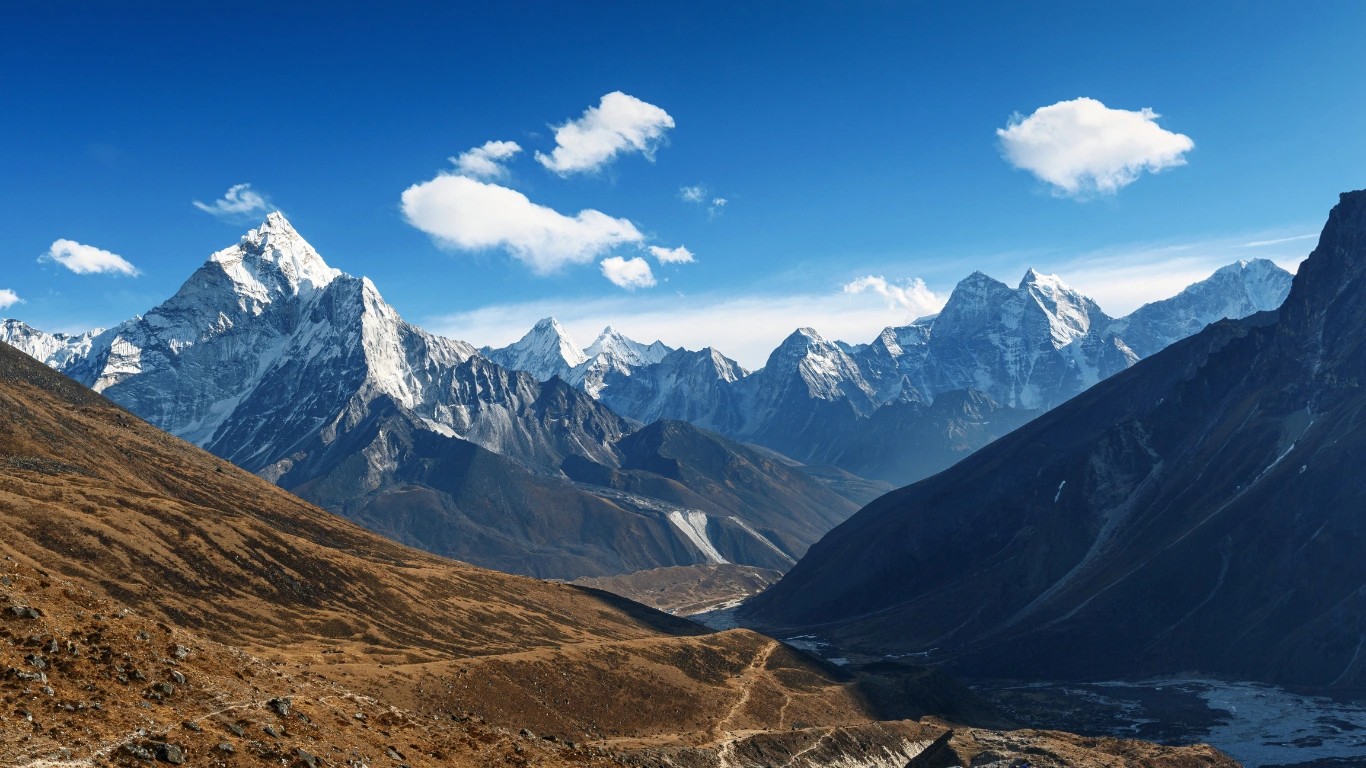
The honest answer is: it depends on how you count.
A government study, done with the Nepal Mountaineering Association, found that Nepal has about 3,310 peaks above 5,500 meters. It counted both trekking and climbing peaks. Of those, around 1,913 are classified as climbing peaks, meaning they require the use of mountaineering equipment and technique.
At higher elevations, Nepal officially recognizes:
Only a portion of these peaks are open to climbers. The Department of Tourism currently allows expeditions on over 400 mountains. The government adds new peaks at times, after it reviews its peak list.
The trekking peak category is managed by the Nepal Mountaineering Association. It includes accessible peaks between about 5,500 and 7,000 meters. You can attempt these peaks during a regular trekking trip. These are ideal for those stepping into mountaineering for the first time.
Nepal's mountains are distributed across three broad horizontal zones running west to east, aligned with the main Himalayan chain.
The western region holds Dhaulagiri and the Annapurna massif. The central region is home to Manaslu, Langtang, Gauri Shankar, and of course the Everest group. The eastern region is dominated by Makalu, the Kanchenjunga massif, and dozens of lesser-known but spectacular peaks.
The major trekking regions fan out from these mountain groups. Pokhara is the gateway to the Annapurna region.
Kathmandu is the gateway to the Langtang and Manaslu areas.
Lukla, reached by a short flight from Kathmandu, is the gateway to the Everest and Khumbu region. For Kanchenjunga, the journey begins in the far east from Taplejung.
Understanding this east-west spread is key when planning a trek or expedition in Nepal. Each region has its own character, permit rules, and best seasons.
Top 10 Highest Mountains in Nepal:
| Rank | Mountain | Elevation (m) | Elevation (ft) | World Rank |
|---|---|---|---|---|
| 1 | Mount Everest | 8,848.86 | 29,032 | 1st |
| 2 | Kanchenjunga | 8,586 | 28,169 | 3rd |
| 3 | Lhotse | 8,516 | 27,940 | 4th |
| 4 | Makalu | 8,485 | 27,838 | 5th |
| 5 | Cho Oyu | 8,188 | 26,864 | 6th |
| 6 | Dhaulagiri I | 8,167 | 26,795 | 7th |
| 7 | Manaslu | 8,163 | 26,781 | 8th |
| 8 | Annapurna I | 8,091 | 26,545 | 10th |
| 9 | Gyachung Kang | 7,952 | 26,089 | — |
| 10 | Himalchuli | 7,893 | 25,896 | — |
Note: K2, ranked 2nd in the world at 8,611 meters, is in Pakistan.
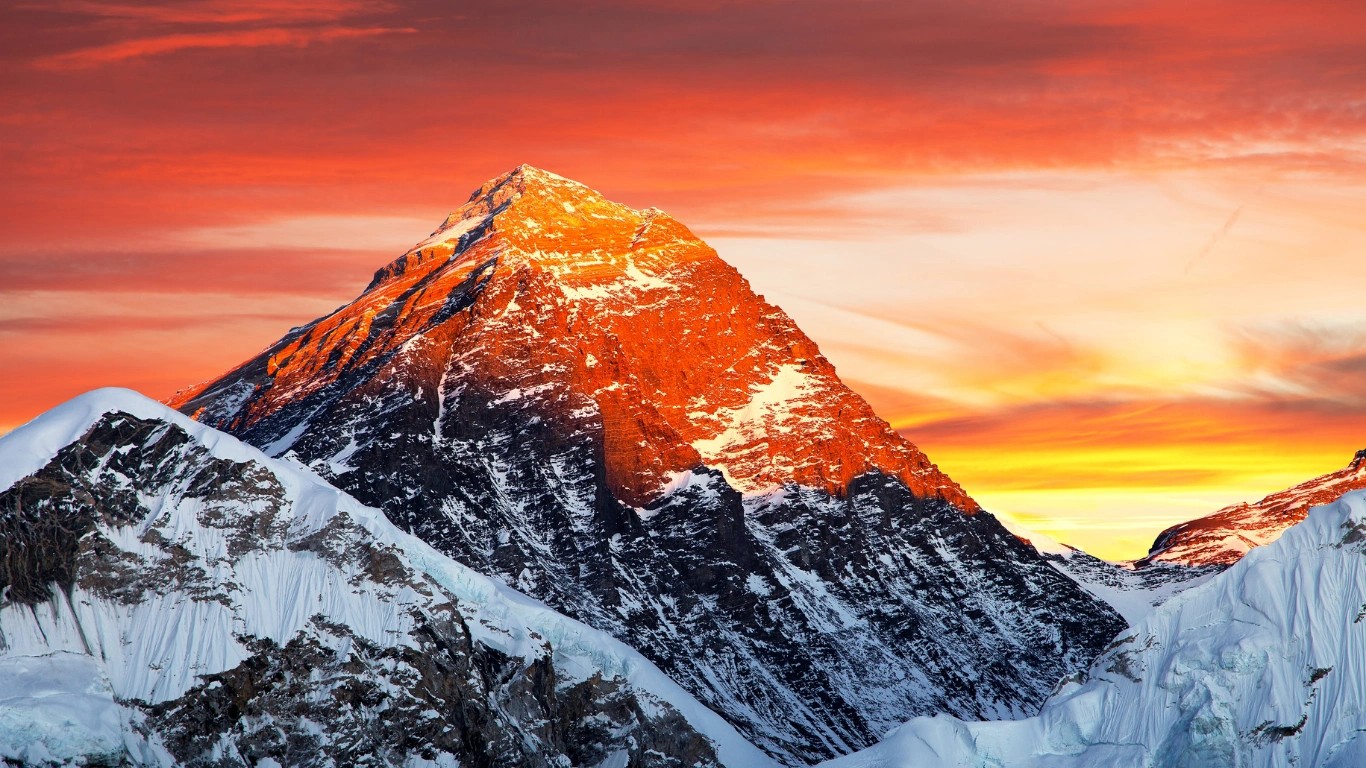
Mount Everest is called Sagarmatha in Nepali and Chomolungma in Tibetan.
It is the highest mountain in Nepal and the highest point on Earth.
It stands 8,848.86 meters (29,032 feet) tall. This height was confirmed in 2020 by a joint Nepal-China survey. It replaced the earlier figure of 8,848 meters.
Everest sits in the Mahalangur Himal subrange of the greater Himalayas, on the border between Nepal and Tibet. The first confirmed summit was reached on May 29, 1953, by Sir Edmund Hillary of New Zealand and Tenzing Norgay Sherpa of Nepal. Since then, more than 6,000 people have stood on its summit.
For trekkers who may not want to summit Everest, the trek to Everest Base Camp is still iconic. The camp sits at 5,364 meters.
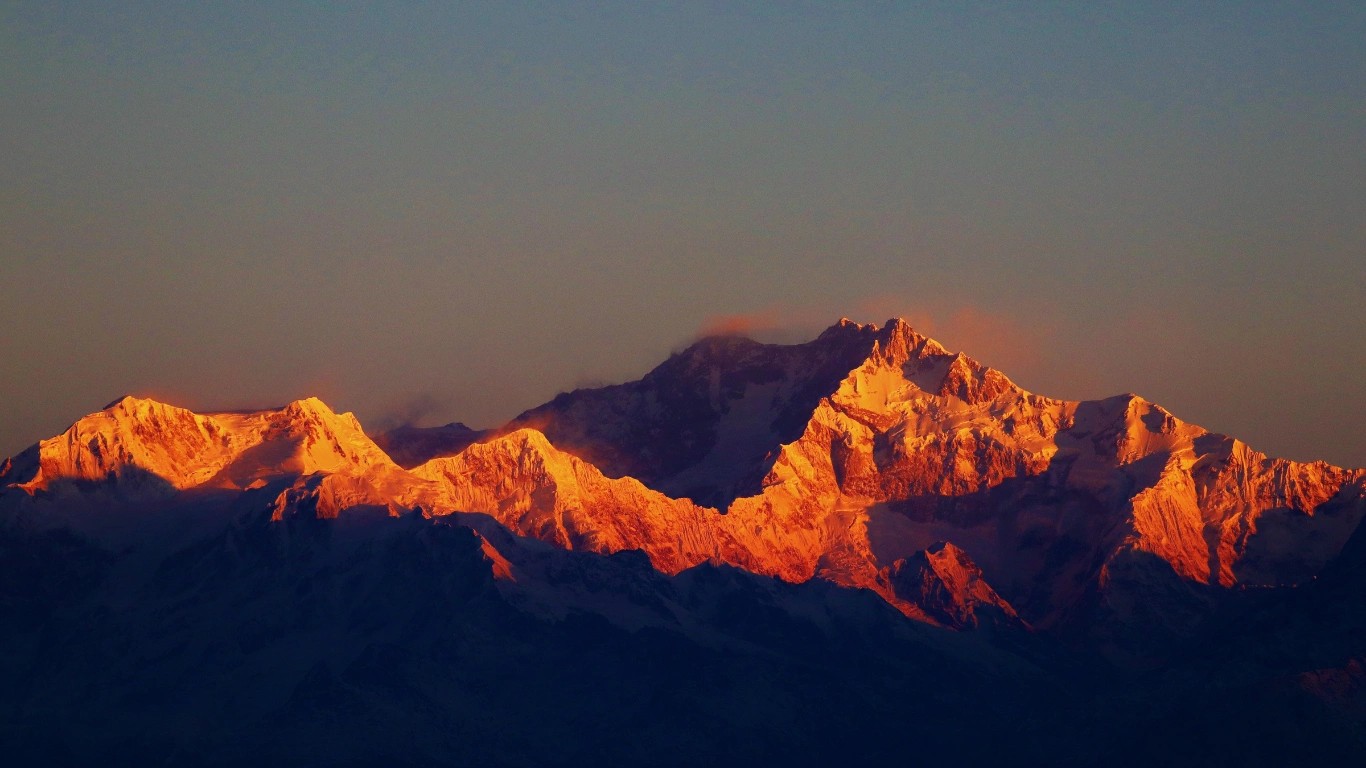
Kanchenjunga, at 8,586 meters (28,169 feet), is the second highest mountain in Nepal and the third highest in the world. It straddles the border between Nepal's Taplejung District and the Indian state of Sikkim. The name translates roughly as "Five Treasuries of the Great Snow," reflecting its five distinct summits, the highest being the main peak.
Kanchenjunga was first summited on May 25, 1955, by George Band and Joe Brown of Britain. By tradition, they stopped just short of the very top out of respect for the local belief that the summit is sacred.
The Kanchenjunga Trek in far eastern Nepal is one of the most remote and rewarding treks. It takes trekkers through quiet, rarely visited valleys. The route goes to both the north and south base camps.
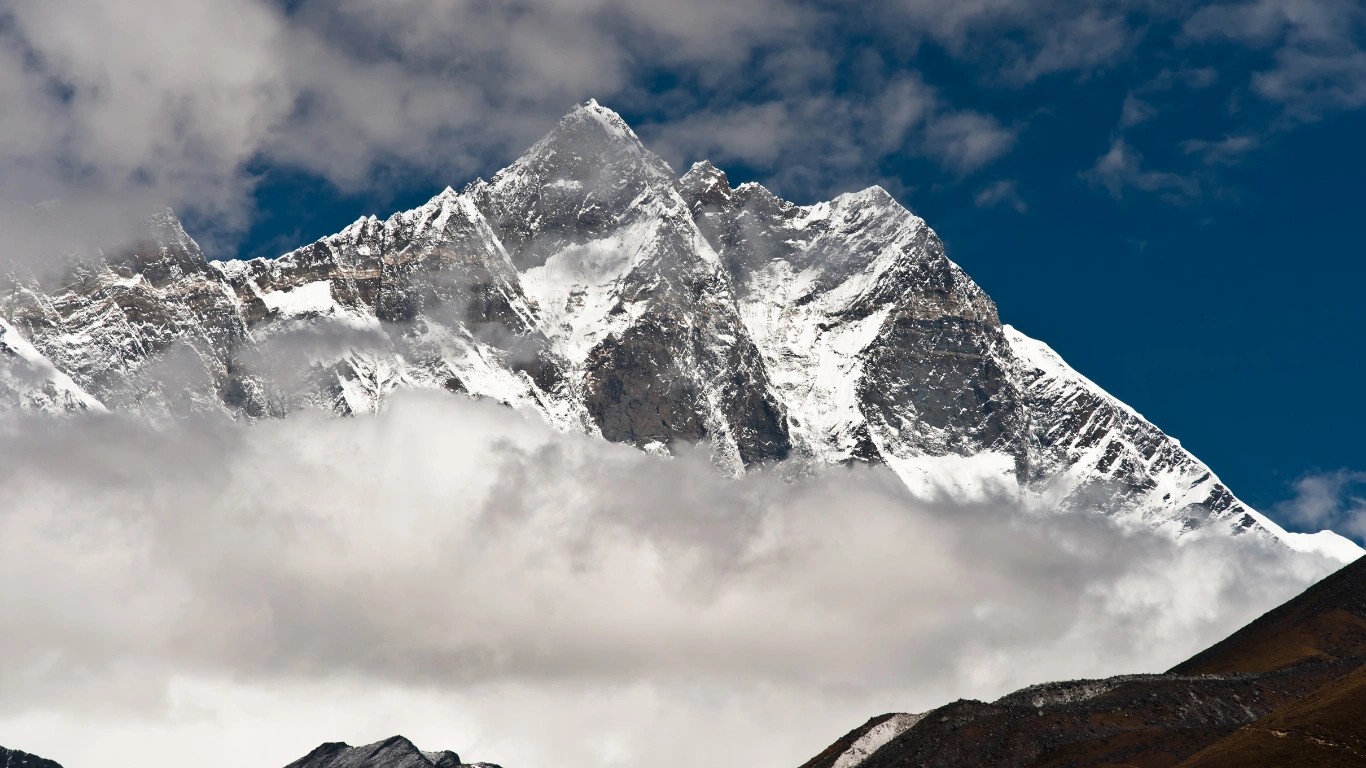
Lhotse, at 8,516 meters (27,940 feet), is the fourth highest peak in the world and the third highest in Nepal. It shares the South Col with Everest and is connected to the world's highest mountain via a high ridge. The name means "South Peak" in Tibetan, a reflection of its position directly south of Everest.
Lhotse was first climbed on May 18, 1956, by Fritz Luchsinger and Ernst Reiss of Switzerland. The standard climbing route for Lhotse follows the same path as Everest’s South Col route to Camp III. It is technically accessible for experienced climbers who have already attempted Everest.
Nepal is home to eight of the world's fourteen internationally recognized eight-thousanders. Each one is a world unto itself.
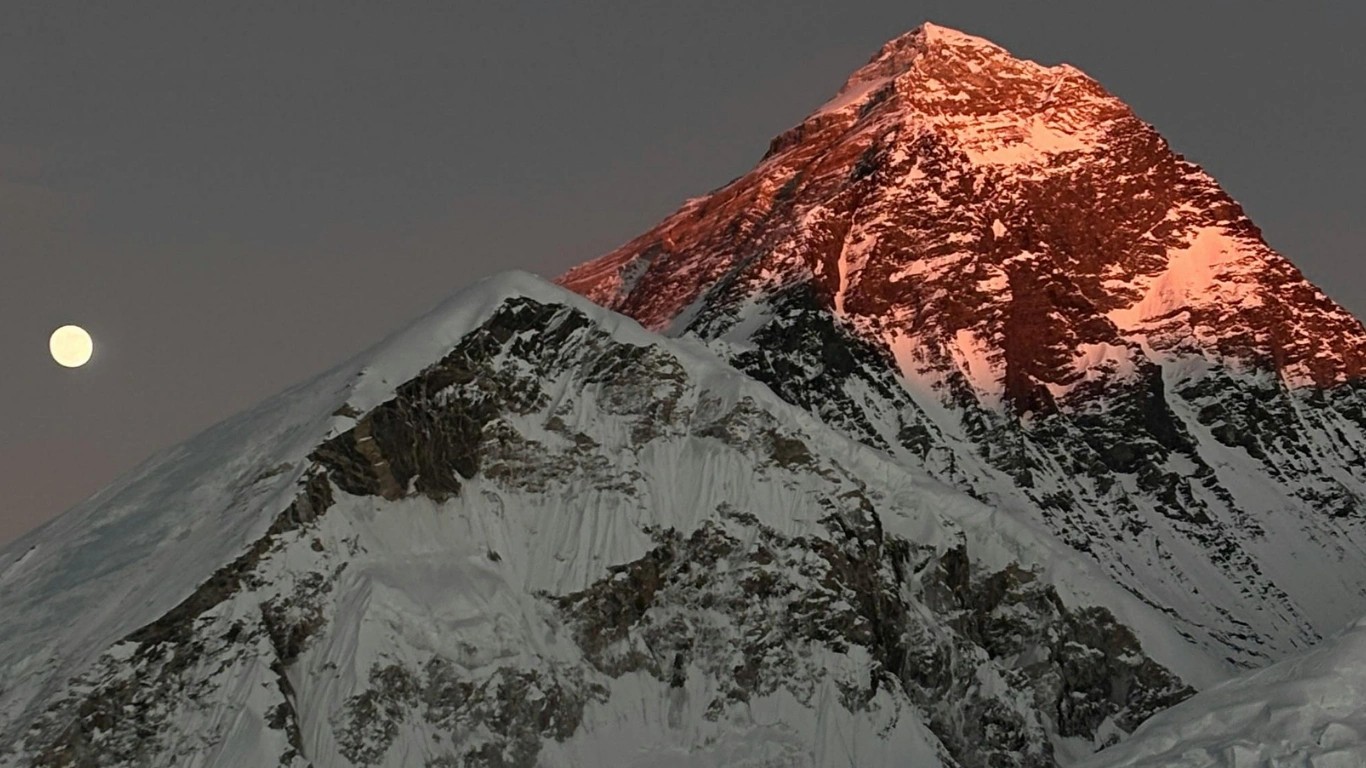
There is no mountain in the world more recognized than Everest, and with good reason. It is the highest point on Earth, a place that has drawn climbers, dreamers, and adventurers since 1852. The standard South Col route, accessed from Nepal's Khumbu side, remains the most popular path to the summit. Climbing permits now cost USD 11,000 per person in the main season, but total expedition costs are often much higher.
Beyond the summit, the Everest Base Camp Trek draws tens of thousands of trekkers each year. It brings them to the Khumbu region. It offers world-class mountain scenery, Sherpa culture, and Buddhist monasteries. You do not need technical climbing skills.
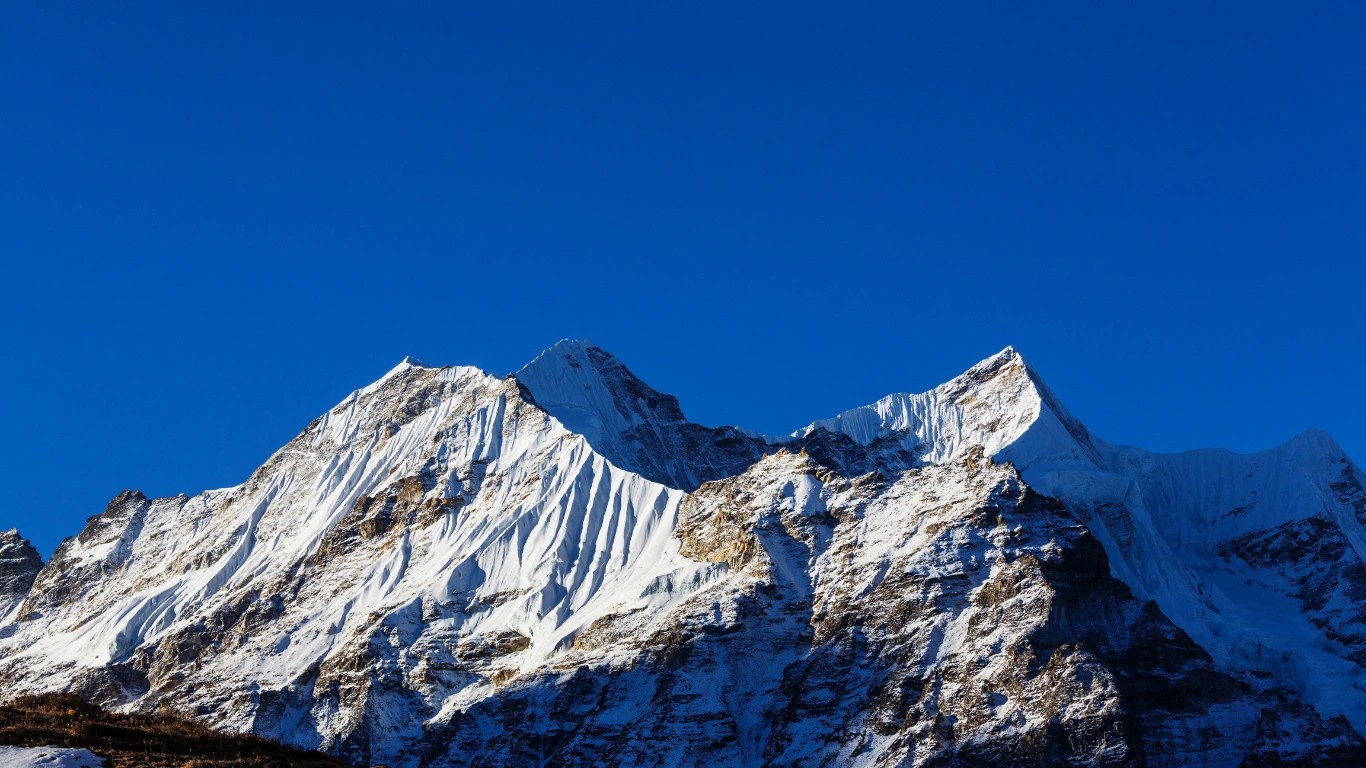
Nepal's easternmost eight-thousander, Kanchenjunga, is one of the most isolated great peaks. You can reach it only after days of walking from Taplejung. Its five summits rise above a staggering landscape of glaciers, rhododendron forests, and high-altitude meadows. The mountain has deep spiritual meaning for the Limbu and Sherpa communities in eastern Nepal. It also matters to people in Sikkim across the border.
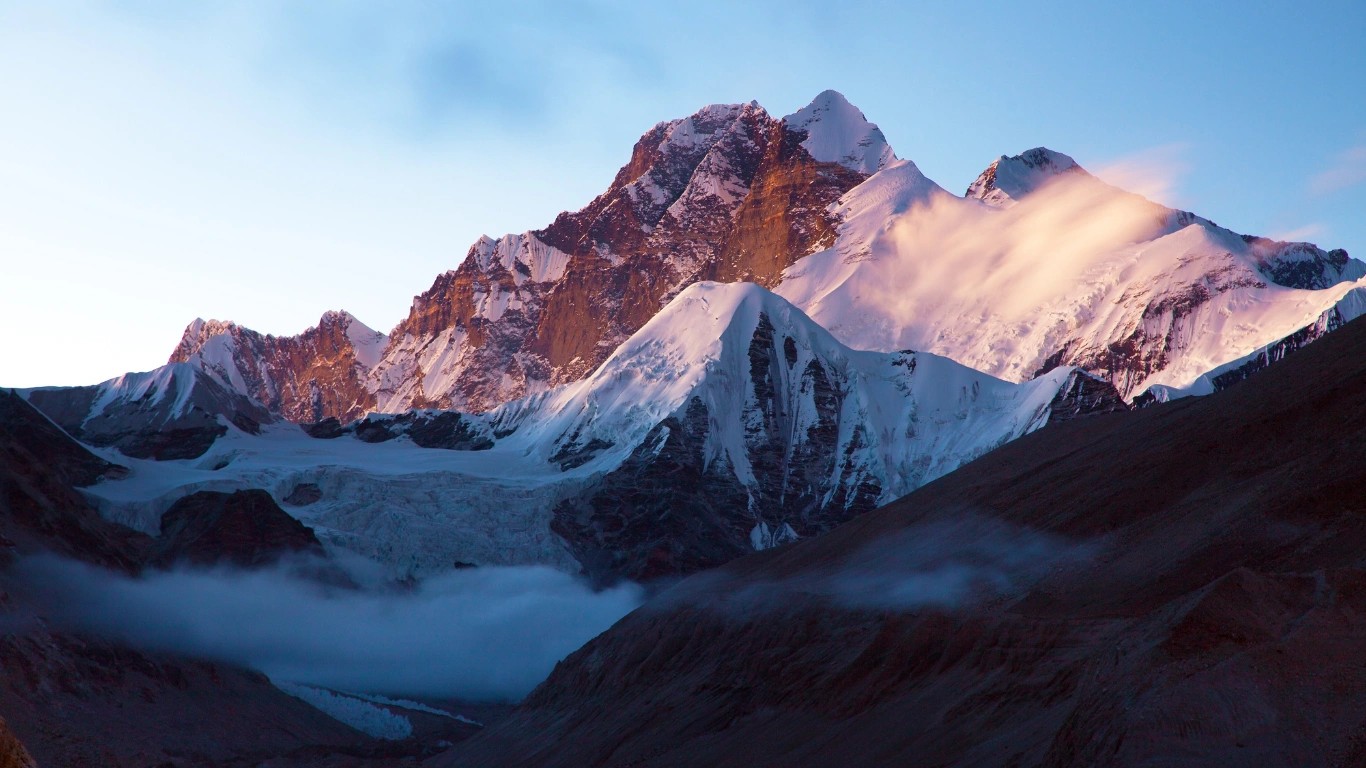
Lhotse is close to Everest, so many people see it in Everest’s shadow. This is unfair to such a huge mountain. The Lhotse Face is a steep wall of blue ice. It rises nearly 1,000 meters. It is one of the most intimidating parts of Himalayan climbing. For expeditions using the South Col route, climbers must ascend the face on fixed ropes. This makes it a major physical and mental test.
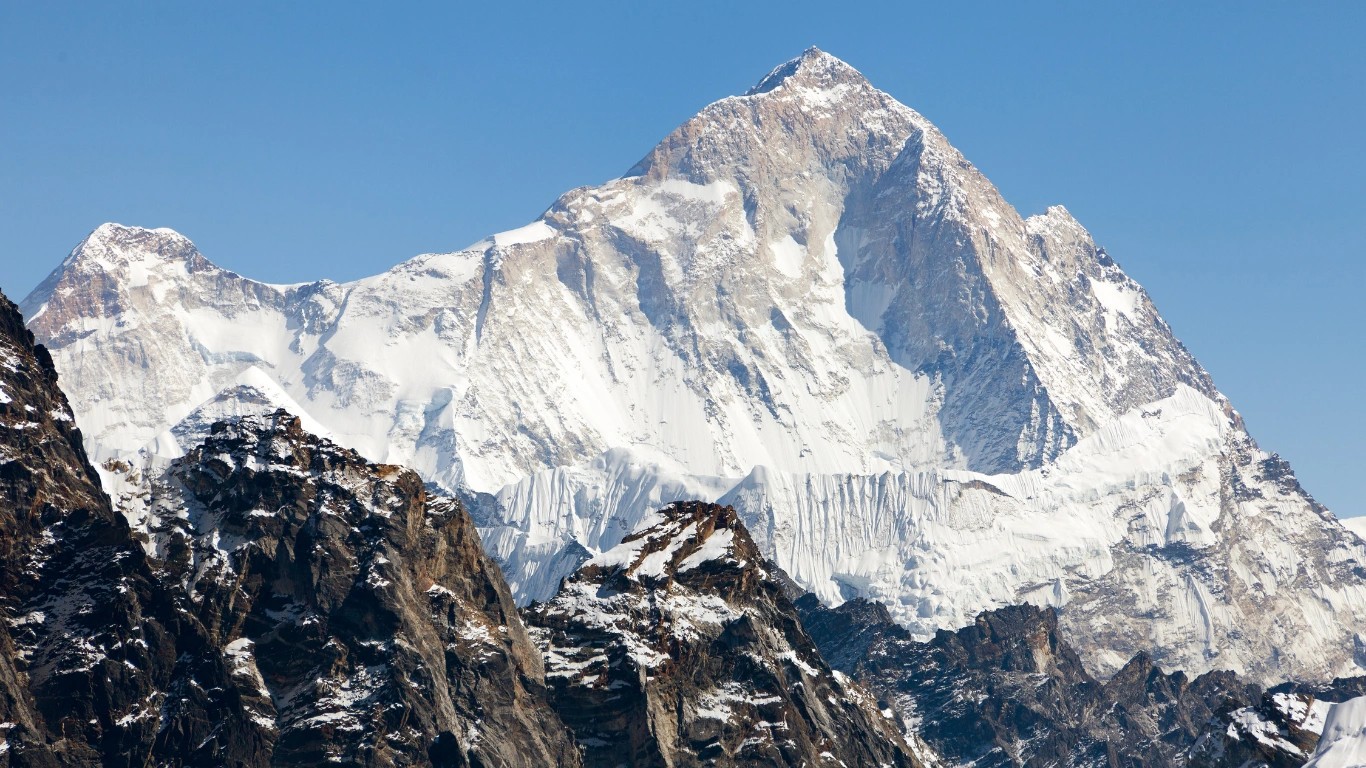
Makalu, the world’s fifth-highest peak, rises as an isolated four-sided pyramid. It is about 19 kilometers southeast of Everest in the Mahalangur range. Its geometric profile makes it one of the most striking mountains in Nepal when viewed from any angle. Makalu was first climbed in 1955 by a French expedition led by Jean Franco. It is known for its technical difficulty — particularly the upper sections requiring mixed ice and rock climbing skills.
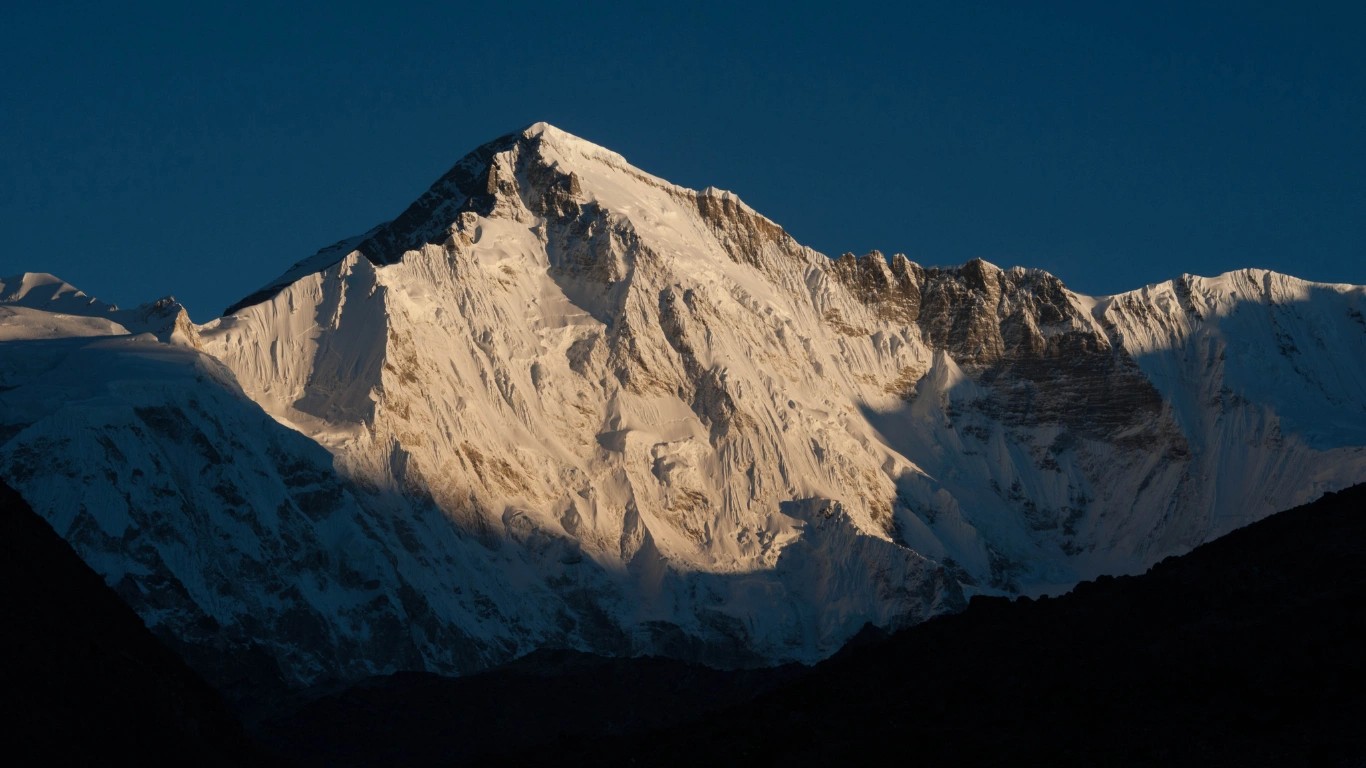
Cho Oyu, the world's sixth highest peak at 8,188 meters, sits on the Nepal-Tibet border in the western Khumbu region. It is widely seen as the easiest 8,000-meter peak from a technical standpoint. Many climbers choose it before Everest. Others choose it before attempting other very high peaks. The normal route ascends from the Tibetan side. Adjacent to the mountain is Nangpa La, a glacier pass that served for centuries as a crucial trade route between Khumbu Sherpas and Tibet.
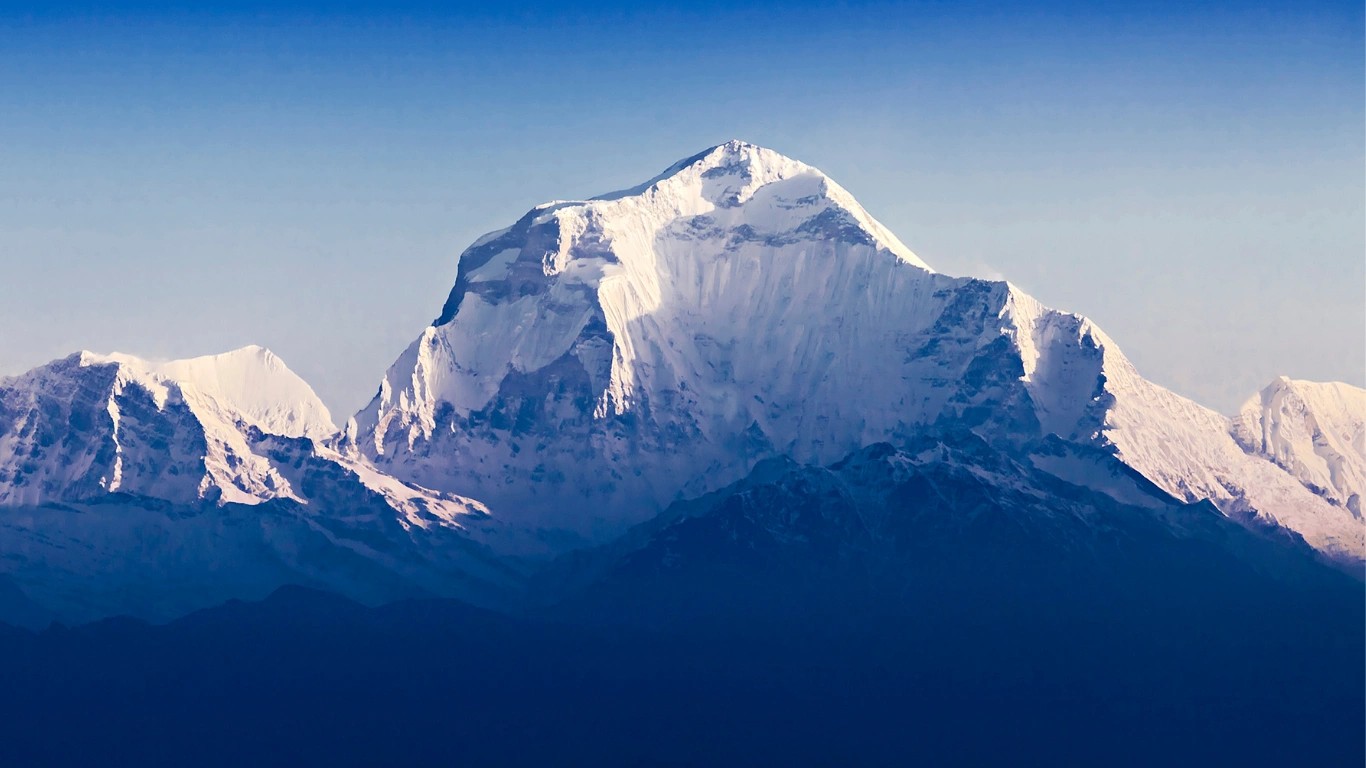
Dhaulagiri means “White Mountain” or “Dazzling Mountain” in Sanskrit. It dominates the Gandaki River basin in Nepal’s Myagdi and Mustang districts. At 8,167 meters, it is the world’s seventh-highest peak. It is also the highest mountain fully within one country. It does not touch any border. It was first summited in 1960 by a team that included Swiss, Austrian, and Nepali climbers. The northeast spur, known as the "Normal Route," remains the most commonly used ascent path.
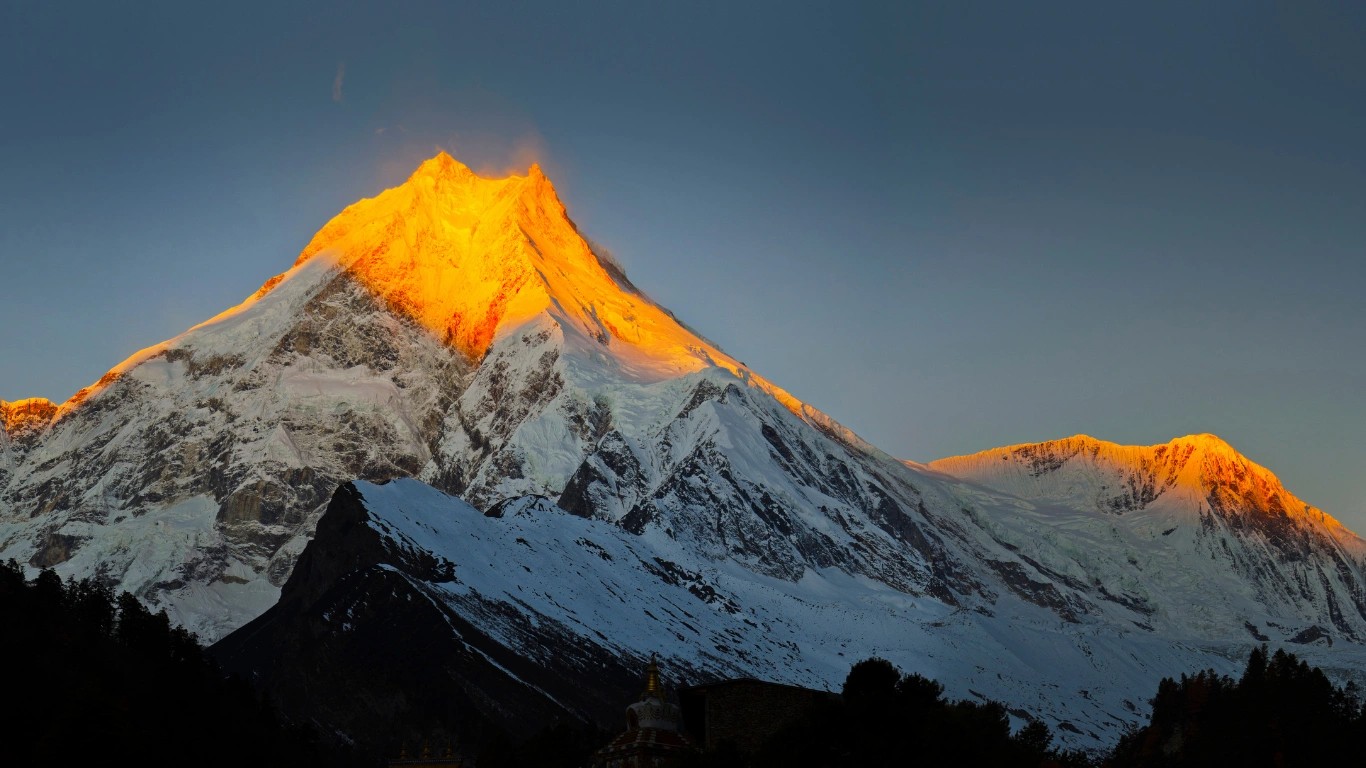
Manaslu, the "Mountain of the Spirit," stands at 8,163 meters in the Mansiri Himal of Gorkha District. The eighth highest peak in the world, it was first summited by a Japanese expedition on May 9, 1956. Manaslu is important in Nepal's climbing history as the first eight-thousander fully organized and led by Nepali climbers.
The Manaslu Circuit Trek goes around the peak in about 14 to 18 days. It crosses the Larkya La Pass at 5,160 meters. It combines high mountain scenery with the real cultural landscape of Tibetan-influenced villages. These villages are less affected by tourism than the Everest or Annapurna regions.
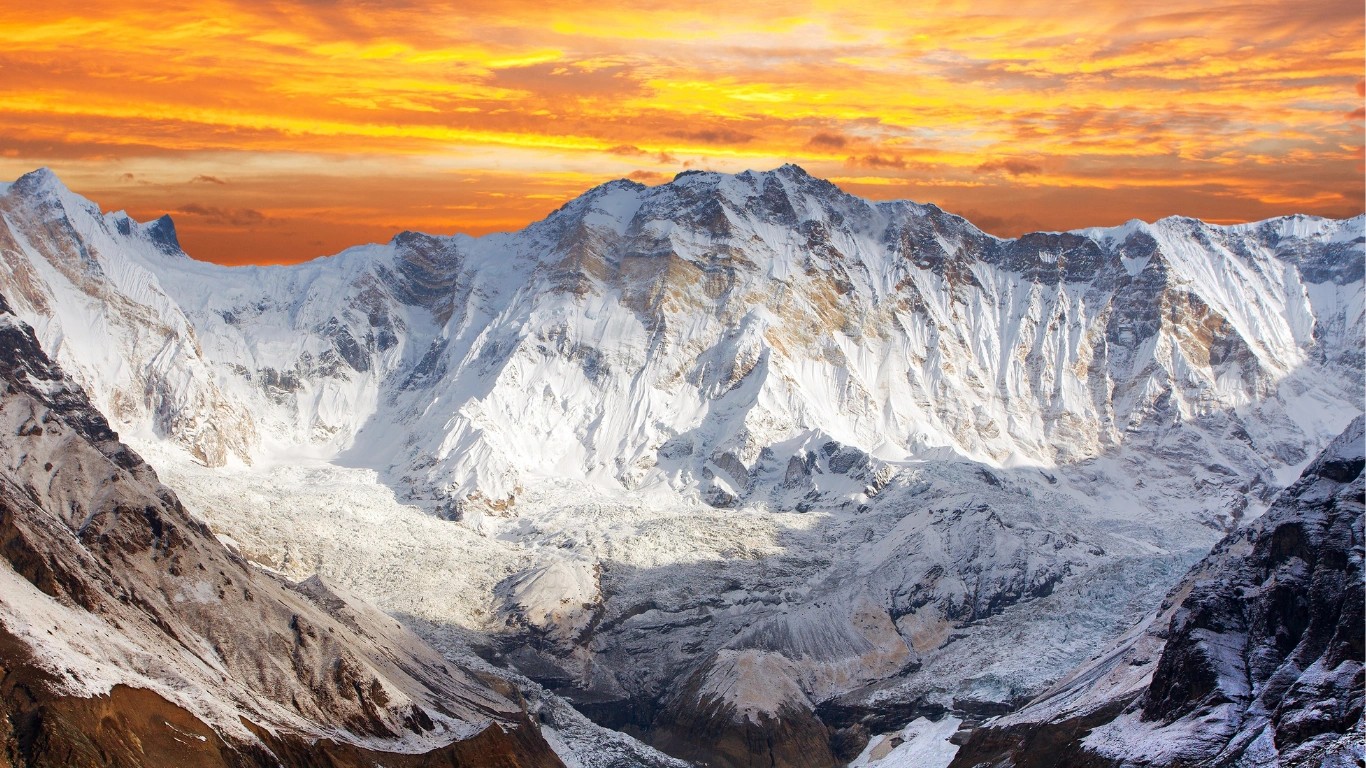
At 8,091 meters, Annapurna I holds a unique place in mountaineering history. It was the first eight-thousander ever summited. On June 3, 1950, French climbers Maurice Herzog and Louis Lachenal reached the summit. It was a milestone in Nepal’s mountain history. It also began the global era of eight-thousanders.
Despite being only the world’s tenth highest mountain, Annapurna I has one of the highest death rates per summit. This is mostly due to dangerous avalanche terrain on its routes. The mountain anchors the massive Annapurna massif, which also includes Annapurna II (7,937 m), Annapurna III (7,555 m), Annapurna IV (7,525 m), and Annapurna South (7,219 m).
Trekkers seeking to experience this region can explore the Annapurna Base Camp Trek, which leads into the natural amphitheater of the Annapurna Sanctuary at 4,130 meters, surrounded by peaks on all sides.
Not every iconic mountain in Nepal is measured purely by height. Some peaks have become legendary because of their shape, their stories, or their place in local life.
Everest needs no further introduction, but its fame extends well beyond the mountaineering world. It appears on Nepal's coat of arms, features in countless films, books, and documentaries, and draws visitors from virtually every country in the world. The Khumbu region that surrounds Everest is one of the most photographed mountain landscapes on the planet. For anyone traveling to Nepal, the sight of Everest from a viewpoint such as Kala Patthar — even without stepping anywhere near a technical route — is a transformative experience.
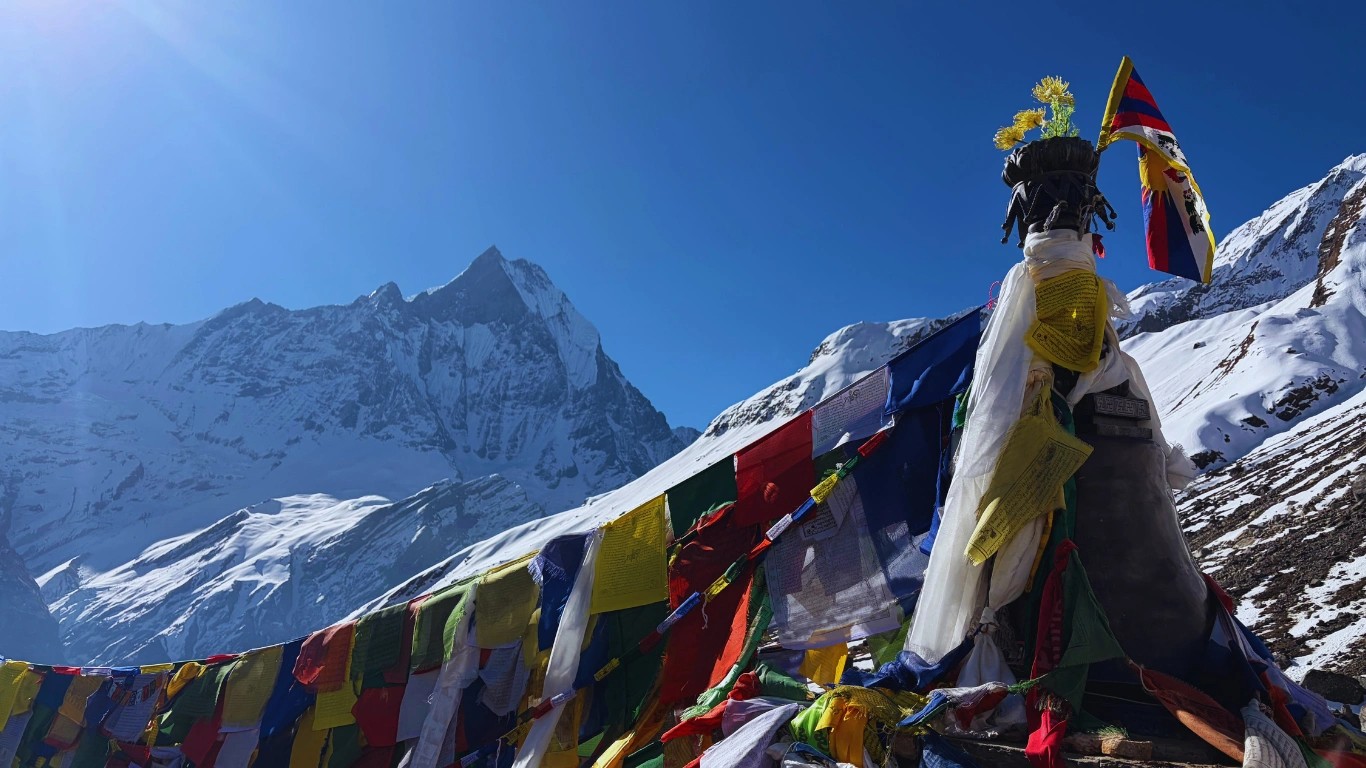
Standing at 6,993 meters (22,943 feet) in the Annapurna massif north of Pokhara, Machhapuchhre is arguably Nepal's most distinctive mountain. Its name means "Fishtail" in Nepali, and the twin summits that give it this name are instantly recognizable from the lakeside city of Pokhara, one of Nepal's most popular tourist destinations.
What truly sets Machhapuchhre apart is its status as an officially unclimbed mountain. The Government of Nepal has prohibited expeditions to the summit, primarily because the mountain is considered sacred — revered as the home of Lord Shiva in Hindu tradition and as a protective deity by the local Gurung community who call it Katasunkli.
The only recorded attempt was in 1957, when a British team led by Wilfrid Noyce climbed to within approximately 50 meters of the top and deliberately stopped, honoring a promise made to King Mahendra. The Nepal government subsequently closed the peak entirely. Today, Machhapuchhre remains the most prominent "virgin peak" in the world — a mountain no one has ever officially stood atop.
Trekkers on the Annapurna Base Camp Trek or the Mardi Himal Trek walk past its base and are rewarded with extraordinary close-up views of this sacred, untouched summit.
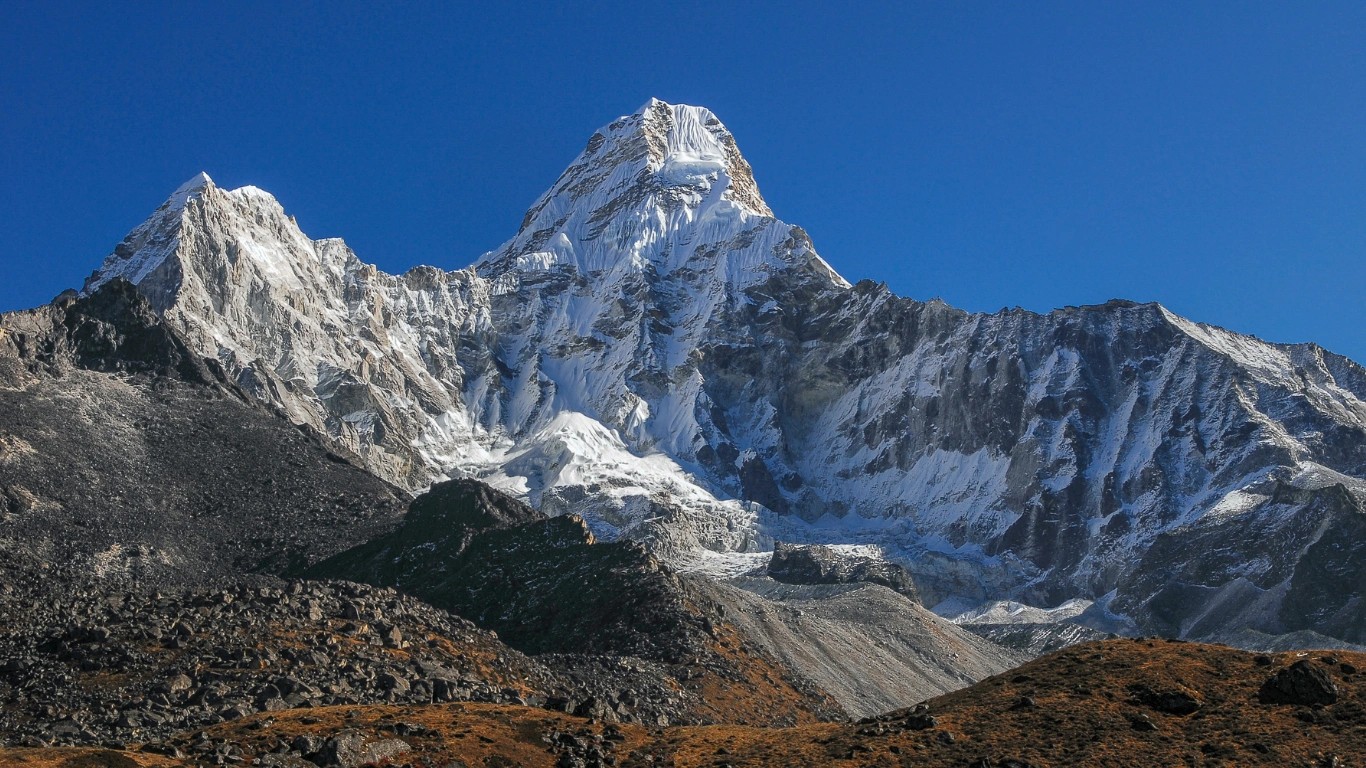
At 6,812 meters (22,349 feet), Ama Dablam is not among the world's highest peaks, but it may be the most visually dramatic mountain in the Khumbu region — possibly in all of Nepal. The name means "Mother's Necklace" in the Sherpa language: the long ridges on either side of the peak suggest the protective arms of a mother, while the hanging glacier near the summit resembles a traditional Sherpa pendant called a dablam.
Its sharp, sculpted profile has made it one of the most photographed mountains in the Himalayas, a constant companion to trekkers on the Everest Base Camp Trek. From the approach to Namche Bazaar onward, Ama Dablam dominates the eastern sky. It is sometimes called "the Matterhorn of the Himalayas" for the way its spire rises in near-perfect isolation above the surrounding terrain.
For technical climbers, Ama Dablam is the third most permitted expedition peak in Nepal. Its southwest ridge demands advanced rock and mixed climbing skills, with exposed ridges and a challenging sequence of camps. It sits within Sagarmatha National Park, a UNESCO World Heritage Site.
Already covered in the eight-thousander section, Annapurna I deserves its reputation as one of the most storied mountain names in the world. The entire Annapurna massif — including its subsidiary peaks, base camp, and the circuit that encircles it — has become a defining pillar of mountain trekking in Nepal. The Annapurna Circuit Trek, one of Nepal's great classic routes, circumambulates the entire massif in 12 to 18 days, crossing the Thorong La pass at 5,416 meters.
Beyond its mountaineering pedigree, Manaslu has emerged as one of the most popular trekking destinations in Nepal over the past decade. The Manaslu Circuit offers a genuine alternative to the more-visited Everest and Annapurna regions, with exceptional scenery and a cultural landscape shaped by Tibetan Buddhism. Villages like Samagaun and Samdo, high in the Budhi Gandaki valley, offer a glimpse into a way of life that feels far removed from the noise of modern tourism.
Nepal's peaks are not scattered randomly across the landscape. They are organized into distinct ranges and sub-ranges, each with its own geographic character.
The Himalayas form Nepal’s main northern backbone, running west-northwest to east-southeast across the whole country. The Nepalese Himalayas are divided into several sub-ranges, each named for a local region or landmark. The range acts as a climatic barrier. It blocks cold Central Asian air from reaching the Indian subcontinent. It also forces the summer monsoon to drop most of its rain on Nepal's southern slopes.
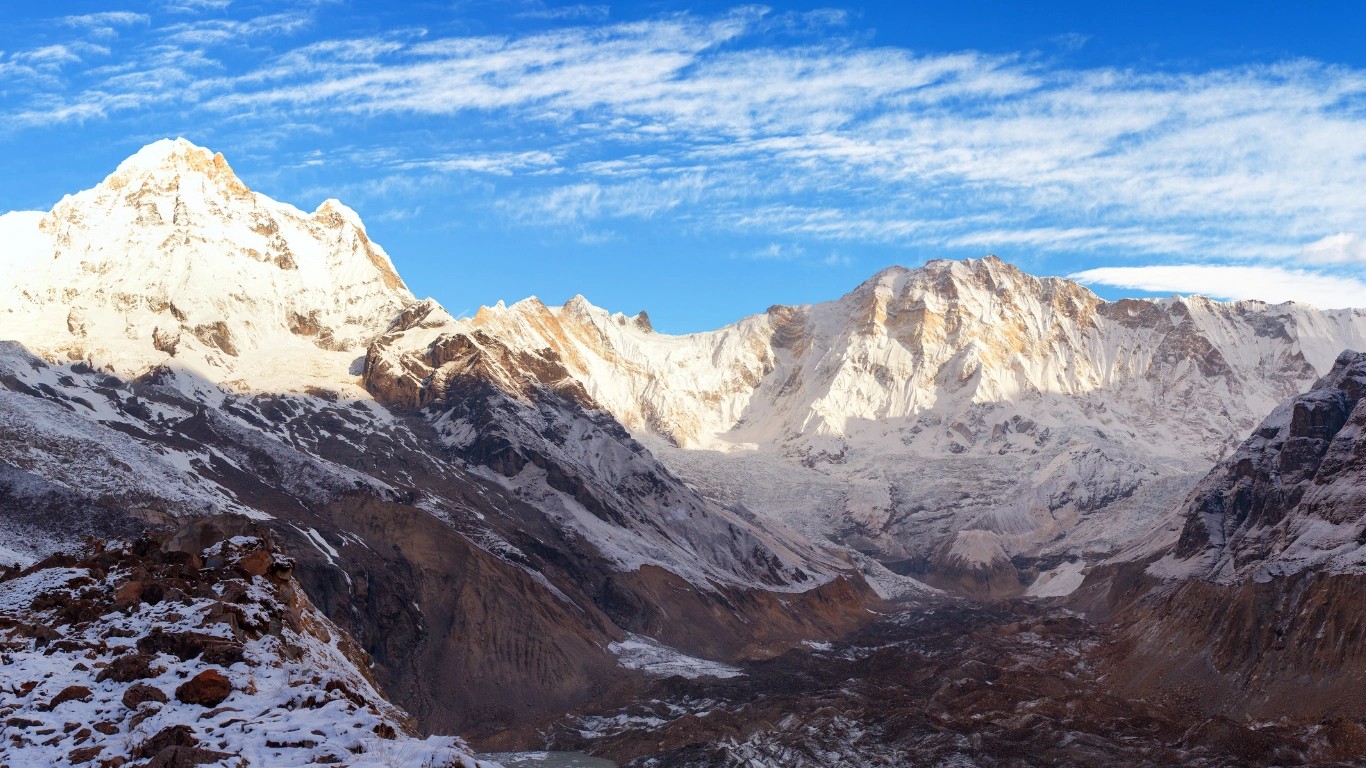
The Annapurna Range sits in north-central Nepal in the Gandaki Province, roughly 200 kilometers west of Kathmandu. It comprises over a dozen named peaks above 6,000 meters, anchored by the main summit of Annapurna I. The range is protected within the Annapurna Conservation Area (ACAP), which at over 7,600 square kilometers is one of the largest protected areas in Nepal and one of the most successful conservation projects in the Himalayan region.
The diversity of ecosystems within this range — from subtropical forest at the foothills to arctic-alpine terrain at high altitude — means the Annapurna region offers some of the most varied trekking landscapes in Nepal.
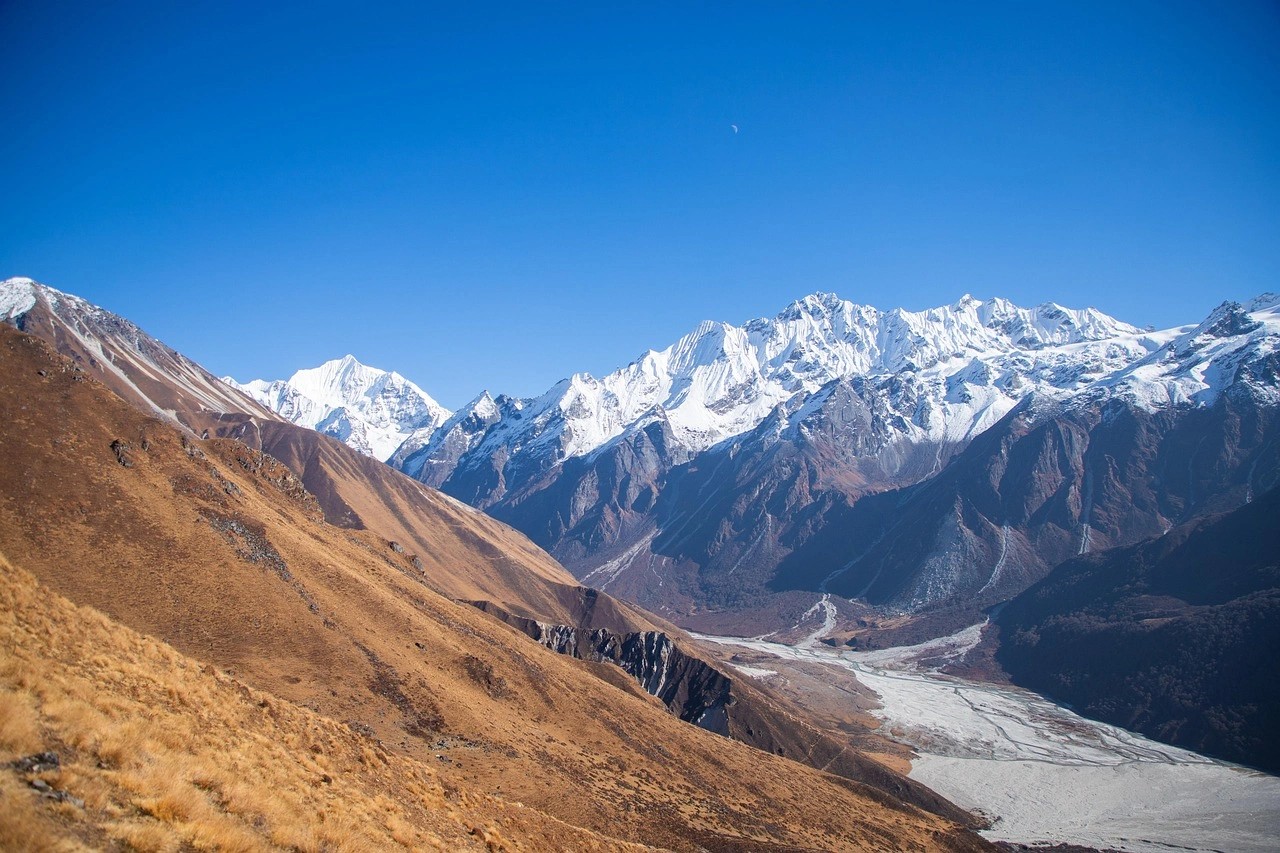
Langtang lies north of Kathmandu, making it the closest major Himalayan range to the capital — reachable by road in around seven hours. The range stretches along the Nepal-Tibet border, with its highest point being Langtang Lirung at 7,227 meters. The Langtang Valley Trek is a classic route through this range, passing through rhododendron forests, yak pastures, and high-altitude glacial terrain. The valley was heavily impacted by the 2015 earthquake and the community has rebuilt over the years since, making trekking here an act of support as much as adventure.
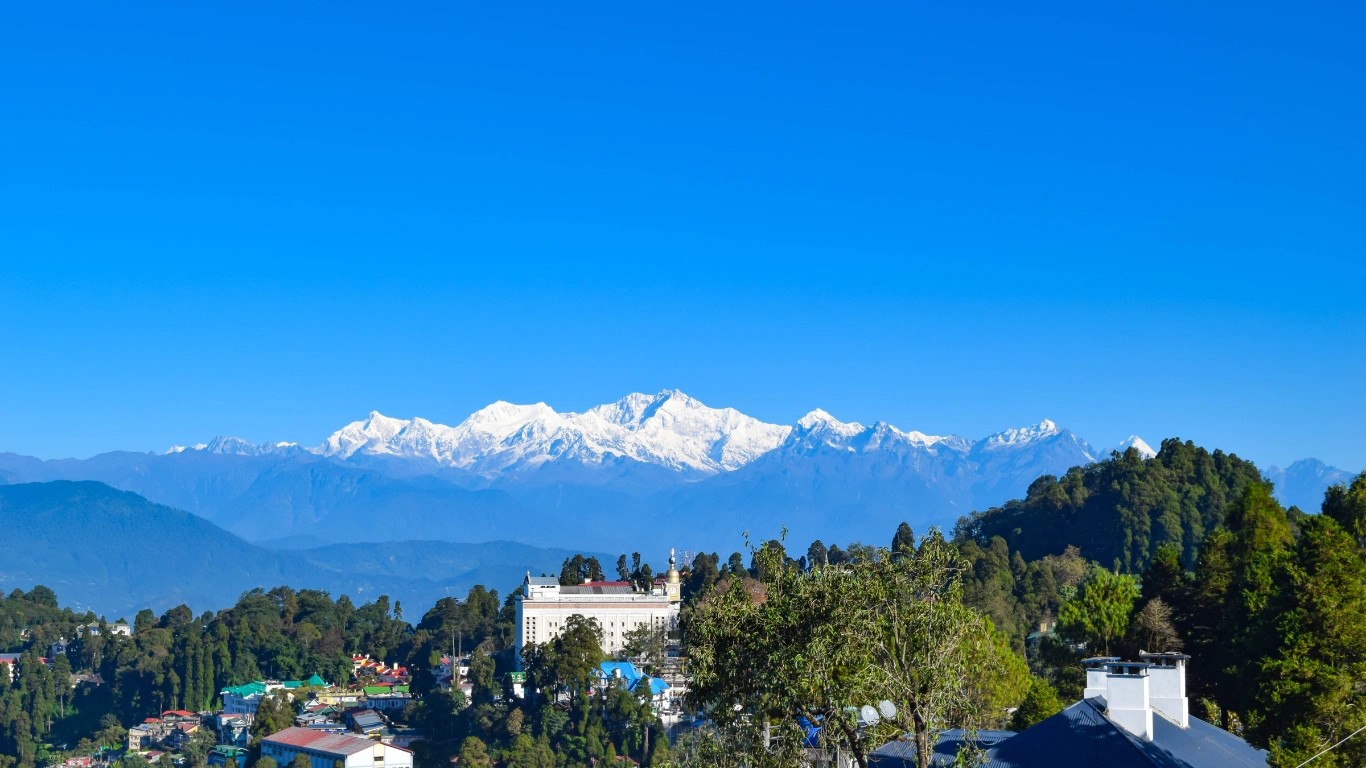
The Kanchenjunga Himal occupies the far eastern corner of Nepal, centered on the massif of the same name. This is among the most remote and least-visited mountain regions in the country, which is precisely what makes it so compelling for those who seek it out. Beyond the main summit, the massif includes several significant peaks: Yalung Kang (8,505 m), Kanchenjunga Central (8,473 m), Kanchenjunga South (8,476 m), and Jannu (7,710 m). The Kanchenjunga Trek to both the north and south base camps is considered one of Nepal's finest wilderness experiences.
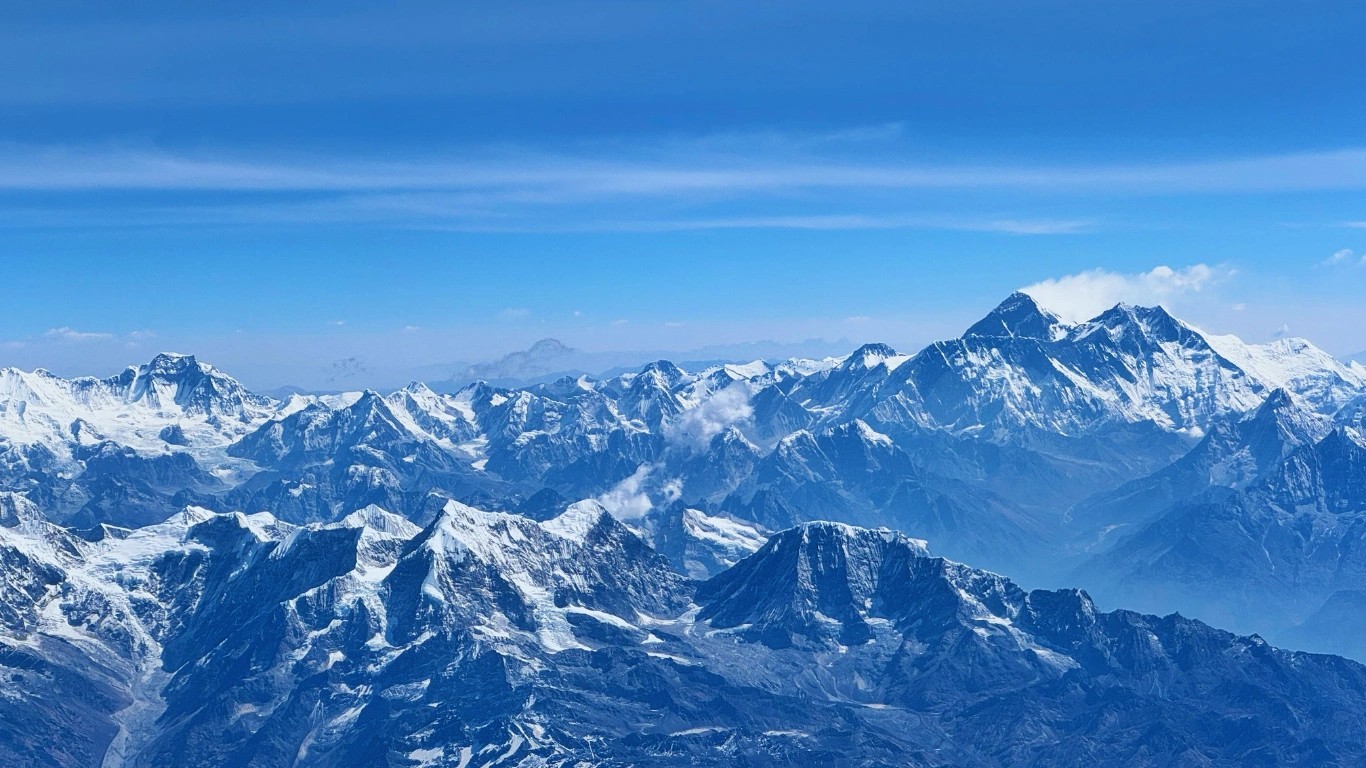
The Mahalangur Himal is the world's most consequential mountain subrange, home to Everest, Lhotse, Makalu, and Cho Oyu — four of the five highest peaks on Earth. The range stretches along the Nepal-Tibet border in the eastern half of the country. Within it, the Khumbu subrange contains the famous Khumbu Glacier, Everest Base Camp, and the Sherpa heartland centered on Namche Bazaar. The entire area is protected within Sagarmatha National Park, Nepal's first national park, established in 1976.
20 Popular Mountain Peaks in Nepal:
| # | Mountain Name | Elevation (m) | Region |
|---|---|---|---|
| 1 | Mount Everest | 8,848.86 | Khumbu |
| 2 | Kanchenjunga | 8,586 | Eastern Nepal |
| 3 | Lhotse | 8,516 | Khumbu |
| 4 | Makalu | 8,485 | Eastern Nepal |
| 5 | Cho Oyu | 8,188 | Khumbu / Tibet border |
| 6 | Dhaulagiri I | 8,167 | Dhaulagiri |
| 7 | Manaslu | 8,163 | Gorkha |
| 8 | Annapurna I | 8,091 | Annapurna |
| 9 | Gyachung Kang | 7,952 | Khumbu |
| 10 | Himalchuli | 7,893 | Manaslu |
| 11 | Makalu II (Kangchungtse) | 7,678 | Makalu |
| 12 | Langtang Lirung | 7,227 | Langtang |
| 13 | Annapurna II | 7,937 | Annapurna |
| 14 | Annapurna III | 7,555 | Annapurna |
| 15 | Gaurishankar | 7,134 | Rolwaling |
| 16 | Pumori | 7,161 | Khumbu |
| 17 | Ama Dablam | 6,812 | Khumbu |
| 18 | Machhapuchhre | 6,993 | Annapurna |
| 19 | Island Peak (Imja Tse) | 6,189 | Khumbu |
| 20 | Mera Peak | 6,476 | Khumbu |
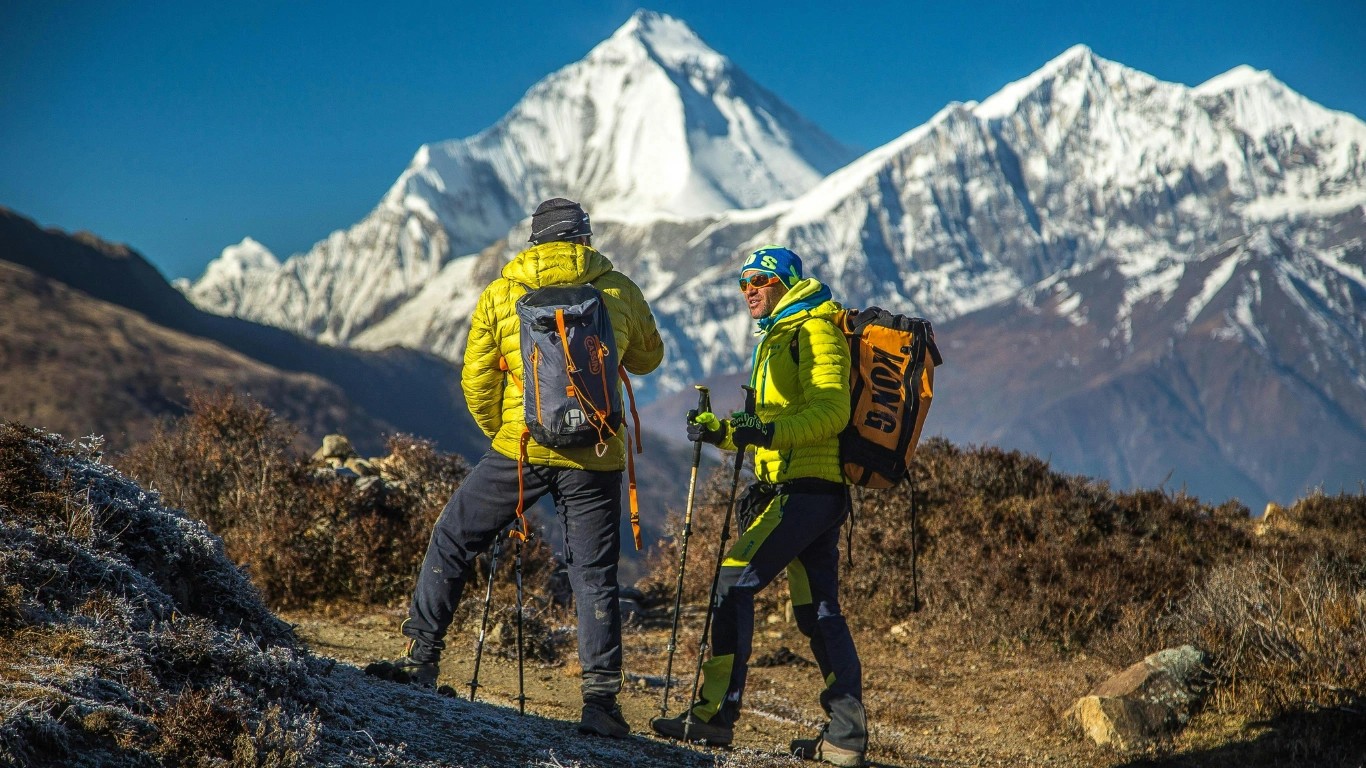
Nepal opened its mountains to foreign climbers in 1949. In the seven decades since, the country has built one of the world’s most advanced mountaineering industries.
The first climb of an eight-thousander was Annapurna I in 1950. It was soon followed by Everest in 1953. Kanchenjunga and Makalu were climbed in 1955. Lhotse and Manaslu were climbed in 1956. Dhaulagiri was climbed in 1960. These early decades were the golden age of first ascents, when climbing teams from Europe, Japan, and the United States competed to claim the world's great summits.
Today, the focus has shifted. Thousands of climbers try to reach Nepal's peaks each year. They are supported by licensed guide companies, Sherpa guides, and strong logistics. This support system has few equals anywhere in the world. The Nepal Mountaineering Association (NMA) and the Department of Tourism jointly oversee expeditions, issuing permits and setting standards for safety and environmental management.
As per 2026 June, Kami Rita Sherpa holds the record for the most summits of Everest, having topped the mountain more than 32 times — a record of extraordinary dedication and acclimatization that illustrates how much of Nepal's mountaineering achievement rests on the Sherpa community.
Permit fees for major peaks have increased in recent years. As of 2026, Everest permits cost USD 11,000 per climber for the main spring season, with separate fee structures for autumn and winter. The government has also introduced mandatory tracking devices for summit climbers and increased insurance requirements for high-altitude guides.
More than 400 peaks are currently open to climbing in Nepal, and in recent years the government has added dozens of new mountains to its open peak list, creating fresh options for those seeking less-congested routes.
Not every mountain experience in Nepal requires technical expertise. The spectrum runs from leisurely multi-day treks to technically demanding expeditions requiring full mountaineering skills.
For trekkers, the great classic routes take you into the shadow of the world's highest mountains without the need for ropes, crampons, or climbing permits:
For those stepping into peak climbing, Nepal's trekking peaks offer a structured entry point into technical mountaineering:
For fully technical expeditions, the eight-thousanders and their neighboring peaks represent the upper tier. Most require prior experience at altitude, the ability to use supplemental oxygen effectively, and ideally a track record on lesser peaks before attempting Everest, Annapurna I, or Kanchenjunga.
Here are some facts that even frequent visitors to Nepal find surprising.
Himalayas refer to the largest mountain ranges found in Nepal, Bhutan, India, and China. The entire length of the Himalayas is about 2,400 kilometers or 1,500 miles and is considered one of the most critical geographical regions in Asia. These gigantic mountain ranges serve as the natural boundary between the Tibetan Plateau and the Indian plains while holding some of the tallest peaks globally.
In Nepal, Himalayas occupy almost all of its northern territories with renowned mountain ranges including Mount Everest, Annapurna, and Kanchenjunga. Next to Nepal, the Himalayas run towards the eastern region in Bhutan and further towards north India until reaching the Tibetan region in China. Each country has its unique cultures, ecosystems, trekking routes, and traditions associated with their mountains.
Several qualities exist in the Himalayas such as spiritual significance, rich biodiversity, snow-covered peaks, adventure tourism, among others, which make this region crucial for people who have an interest in it. Millions of tourists visit this region every year for exploration using trekking and mountaineering techniques.
Understanding Nepal’s mountains is the first step toward experiencing them — whether through panoramic viewpoints, cultural journeys, or carefully planned Himalayan travel guided by local experts. From the world’s highest summits to sacred Himalayan silhouettes rising above remote valleys, Nepal remains Earth’s ultimate mountain country.
Nepal has more than 8,000 named mountains in total, including smaller Himalayan summits. Among them are over 1,300 peaks above 6,000 meters, making Nepal the most densely mountainous country on Earth.
Nepal is home to 8 of the world’s 14 mountains above 8,000 meters, including Mount Everest, Kanchenjunga, Lhotse, Makalu, Cho Oyu, Dhaulagiri I, Manaslu, and Annapurna I.
Mount Everest lies in the Mahalangur Himal Range, which is part of the Greater Himalayan Range in northeastern Nepal, along the Nepal–Tibet border.
Mount Everest (8,848.86 meters) is the highest mountain in Nepal and the highest point on Earth, known locally as Sagarmatha and in Tibet as Chomolungma.
The major mountain ranges in Nepal include:
Each range has its own geological, climatic, and cultural characteristics.
Yes. Many Himalayan peaks in Nepal are visible from hill viewpoints, short hikes, cities like Pokhara, and through mountain flights from Kathmandu, making the mountains accessible even without trekking or climbing.
Nepal sits on the active collision zone between the Indian and Eurasian tectonic plates, which continuously push against each other, lifting the Himalayas higher and creating extreme elevation in a very small geographic area.
Some of the most famous mountains in Nepal include Mount Everest, Machhapuchhre (Fishtail), Ama Dablam, Manaslu, Annapurna I, Dhaulagiri I, and Kanchenjunga.
While beauty is subjective, Ama Dablam, Machhapuchhre, Annapurna South, Gauri Shankar, and Langtang Lirung are widely considered among the most beautiful and photogenic mountains in Nepal.
The Langtang Himal Range is the closest major mountain range to Kathmandu and offers some of the most accessible big-mountain views near the capital.
Yes. Despite its small size, Nepal has more high mountains and extreme elevation density than any other country, making it the world’s most mountainous nation by geography.
Yes. Many mountains in Nepal are considered sacred, such as Machhapuchhre, which remains unclimbed. Himalayan peaks are deeply tied to local religions, legends, and spiritual beliefs.
The best ways include trekking routes, scenic viewpoints, cultural travel, and mountain flights. Nepal allows visitors to experience the Himalayas without technical climbing skills.
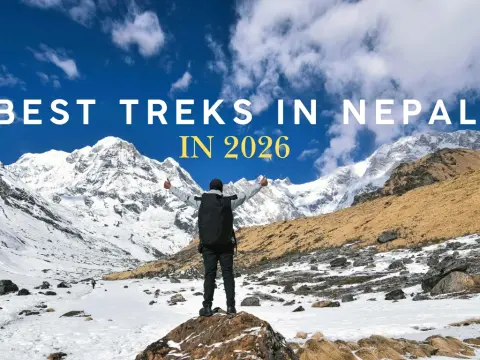
What makes for the best treks in Nepal can vary from person to person. While Everest Base Camp Trek (EBC) at 5545 m is ideal for a trekker wanting the...

Let's cut straight to it. Autumn, specifically September through November, is the best time to trek in Nepal. Spring runs a very close second, coverin...
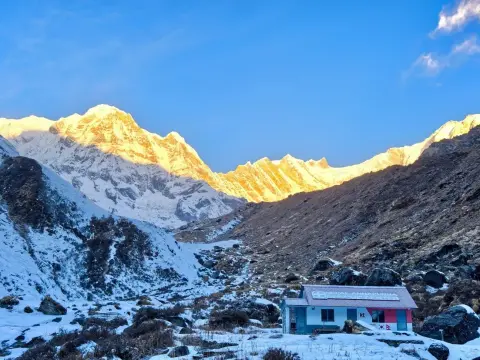
The Annapurna Base Camp trek stands among the world's most iconic Himalayan adventures. Every year, thousands of trekkers from across the globe journe...
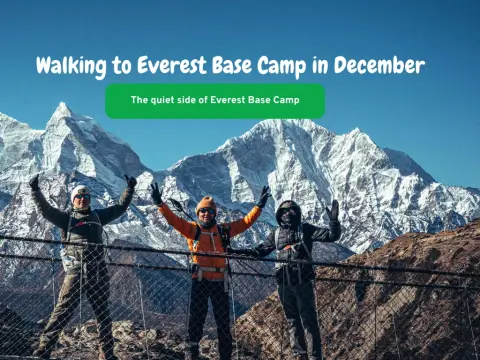
IntroductionNepal — the final destination for every mountaineer. A place where almost everyone dreams of going at least once in their lifetime. To see...
