
Best Time to Trek Annapurna Base Camp – Seasons, Weather, and Expert Tips
28 Dec 2025
The Annapurna Base Camp trek stands among the world's most iconic Himalayan adventures. Every year, thousands of trekkers from across the globe journe...

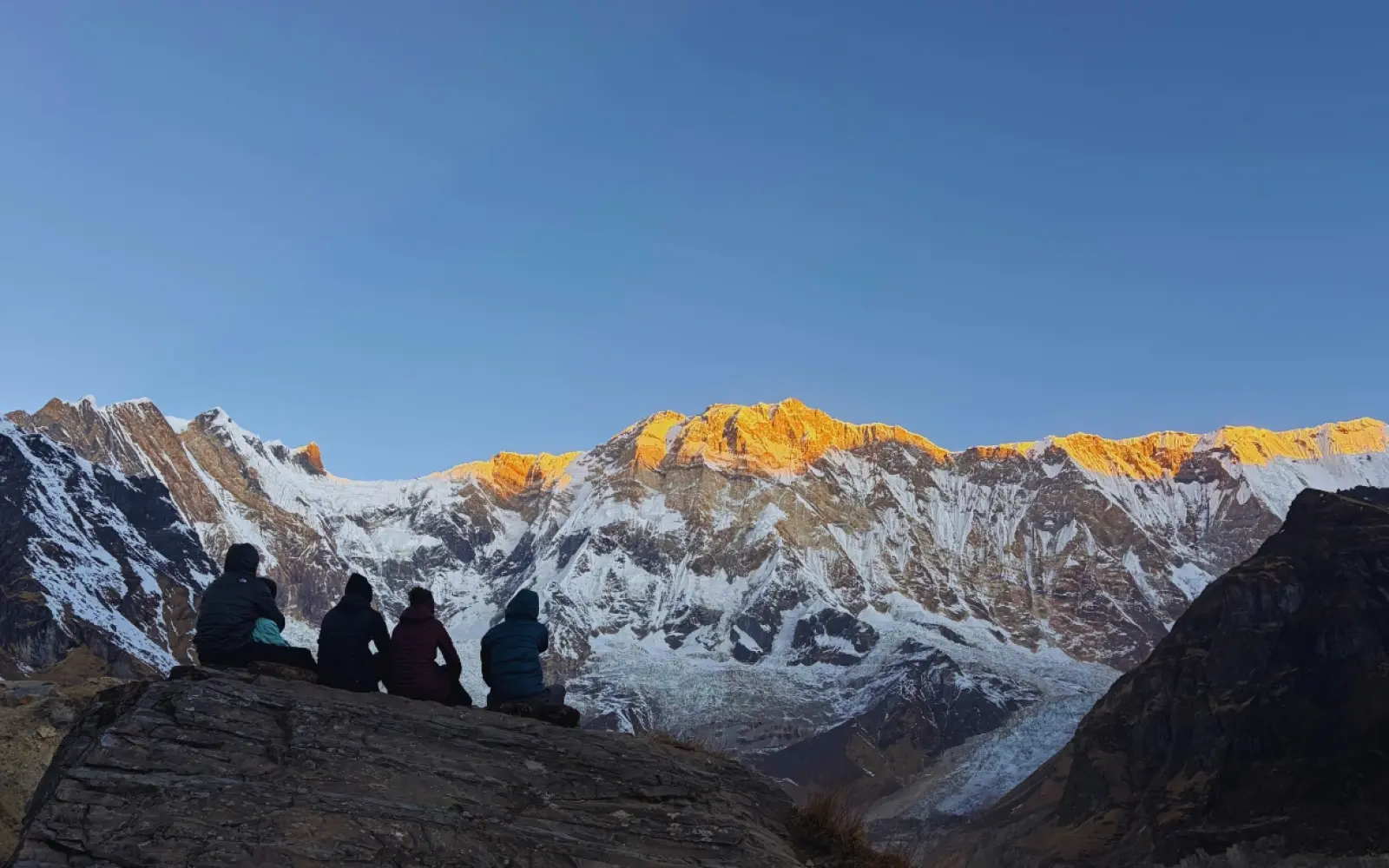

The Annapurna Sanctuary holds a secret that no photograph can truly capture and no words can fully describe. Yet every trekker who has stood at 4,130 meters, watching the world's greatest mountains transform under changing light, carries this secret with them forever.
The sunrise and sunset at Annapurna Base Camp are not simply natural phenomena—they are profound experiences that remind us why we venture into these remote corners of the Earth.
After guiding hundreds of treks through the Annapurna region over the past fifteen years, we have witnessed countless trekkers moved to tears as the first golden rays strike Machapuchare's sacred summit. We have seen seasoned mountaineers fall silent as evening light paints Annapurna I in shades of amber and rose.
These moments transcend the physical challenge of reaching base camp; they become the very reason for the journey itself.
The Annapurna Sanctuary is a natural amphitheater surrounded by towering peaks that rise dramatically in every direction. Standing at base camp, you are encircled by Annapurna I (8,091m), the tenth highest mountain in the world; Machapuchare (6,993m), the sacred fishtail peak that has never been climbed to its summit; Annapurna South (7,219m); Hiunchuli (6,441m); and several other massive Himalayan giants.
When the sun rises and sets, this amphitheater becomes a theater of light, where shadows dance across glaciers and granite walls transform into canvases of impossible color.
In this comprehensive guide, we share our firsthand experiences and insights about watching sunrise at Annapurna Base Camp and witnessing the equally magnificent evening spectacle. Whether you are planning your first Himalayan trek or seeking to understand what awaits you at the end of this legendary trail, we invite you to journey with us through the changing light of the Annapurna Sanctuary.
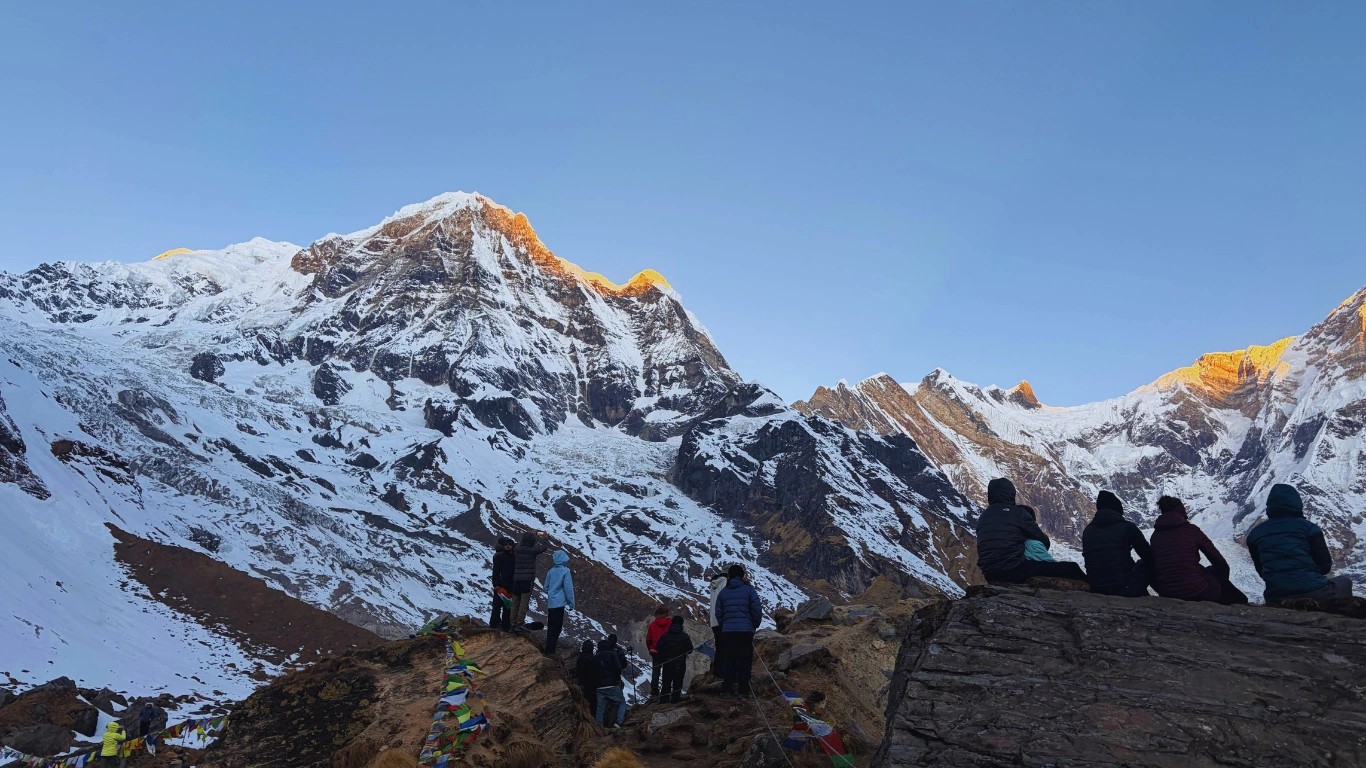
Before we delve into the magic of dawn and dusk, it helps to understand the unique geography that makes these light shows so extraordinary.
The Annapurna Sanctuary is a high glacial basin accessed through a narrow gorge between Machapuchare and Hiunchuli. This natural gateway opens into a vast amphitheater approximately five kilometers in diameter, with massive peaks forming an almost complete circle around the central glacier.
This distinctive bowl-shaped topography means that sunlight enters the sanctuary at specific angles, creating dramatic lighting effects that change by the minute during the golden hours. Unlike many mountain viewpoints where you might observe one or two peaks catching the light, at Annapurna Base Camp you witness an entire panorama of giants illuminating in sequence.
The elevation of 4,130 meters also plays a crucial role. At this altitude, the air is thinner and clearer, allowing light to travel with less atmospheric interference. Colors appear more vivid, shadows more defined, and the contrast between illuminated peaks and shadowed valleys more pronounced.
The combination of geography, altitude, and the sheer scale of the surrounding mountains creates conditions for what many consider the best sunrise at Annapurna Base Camp and equally memorable sunsets. The ABC sunrise view has become legendary among Himalayan trekkers worldwide.
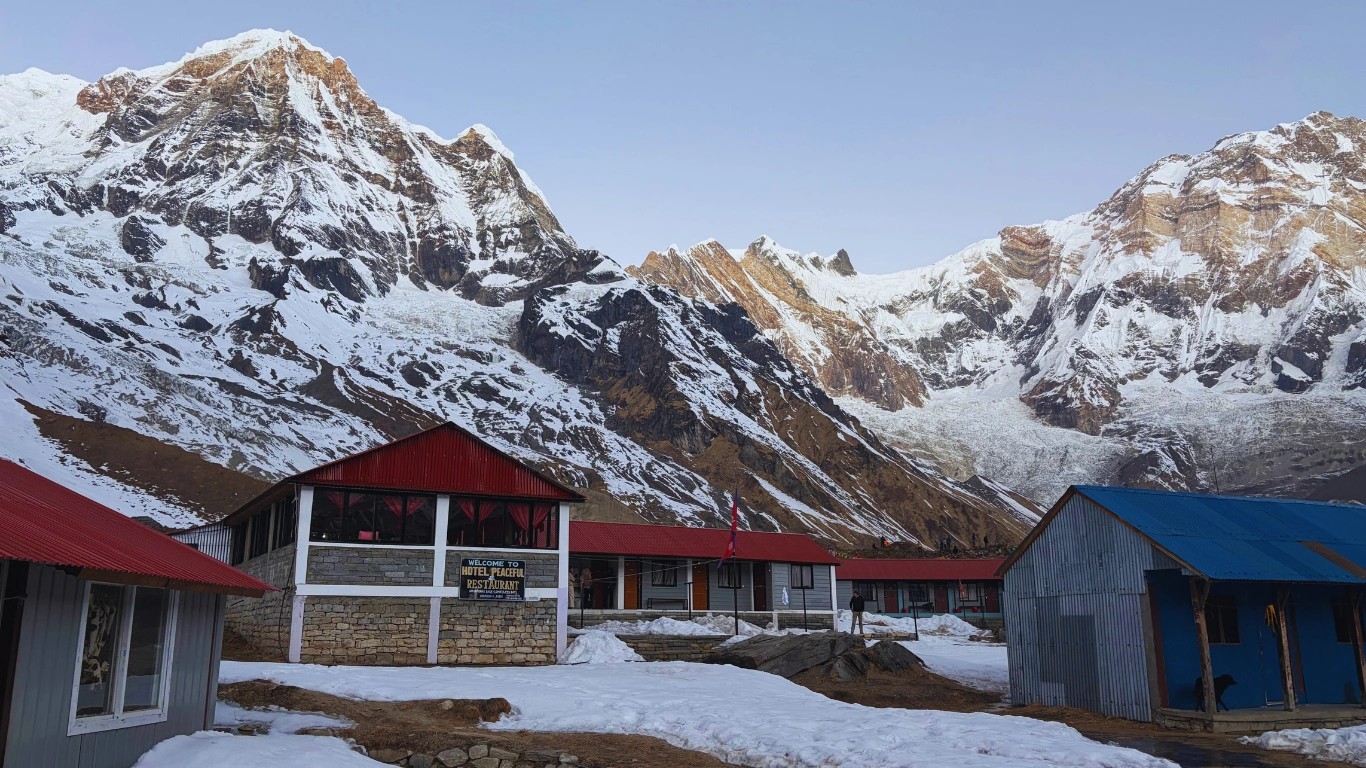
The alarm sounds at 5:00 AM, though calling it an alarm seems too harsh for such a peaceful setting. In the simple teahouse dormitory, headlamps begin flickering on as trekkers stir in their sleeping bags.
The cold is immediate and sharp—temperatures regularly drop to minus fifteen degrees Celsius during clear nights in the peak season. Yet there is no reluctance to leave the warmth of your sleeping bag because everyone knows what awaits outside.
Stepping onto the frozen ground, the first sensation is the absolute silence of the pre-dawn sanctuary. No birds sing at this hour, no wind disturbs the stillness, and even the distant glacial movements seem to pause in anticipation.
Above, the stars remain brilliant in the darkness, the Milky Way stretching across the sky in a display rarely seen from lower elevations. The peaks themselves are massive black silhouettes against the marginally lighter sky, their outlines hinting at the grandeur soon to be revealed.
The cold mountain air at this hour carries a crystalline quality that seems to sharpen every sense. Each breath produces visible clouds of vapor, and the crunch of boots on frost echoes clearly in the silence.
Fellow trekkers gather outside the teahouses, speaking in hushed whispers as if in a sacred space—which, in many ways, it is. The anticipation before the first light at Annapurna Base Camp is palpable, a shared excitement among strangers who have journeyed from different corners of the world.
As the minutes pass, the eastern horizon begins to shift from pure darkness to the faintest hint of deep blue. The stars directly overhead remain bright, but those near the horizon start to fade. This is the liminal time, the threshold between night and day, and there is a meditative quality to waiting in the cold darkness while the universe prepares its daily miracle.
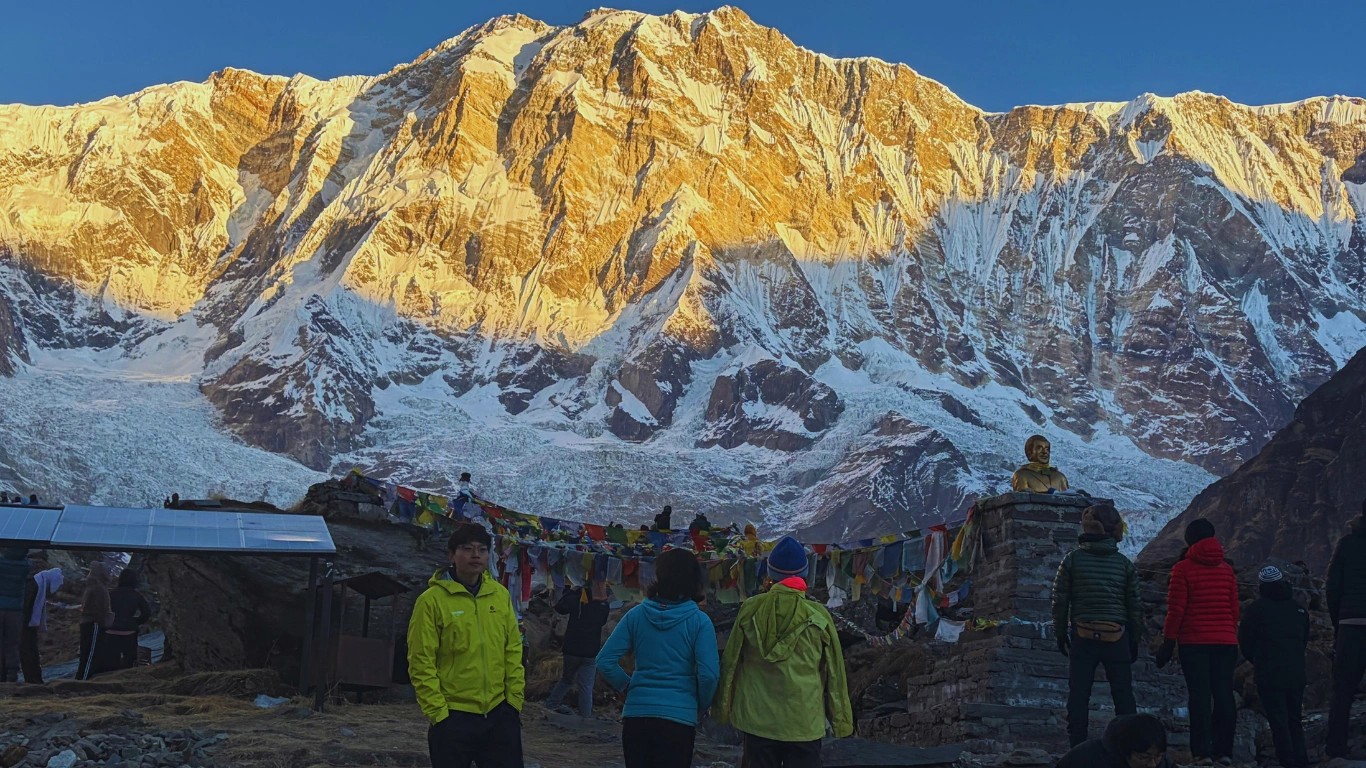
The transformation begins subtly. The sky behind the eastern ridgeline transitions through shades of purple and pink, casting the faintest warm glow onto the highest snowfields. Machapuchare, positioned perfectly to catch the earliest light, remains in shadow while its summit begins to show the promise of what is coming.
Then, in a moment that never fails to cause an audible gasp from the gathered trekkers, the first direct sunlight strikes the tip of Machapuchare. The sacred fishtail summit ignites in brilliant gold against the still-dark blue sky—a beacon of fire at 6,993 meters.
This is the golden sunrise at Annapurna Base Camp that lives in the memory of every trekker who witnesses it. The Himalayan sunrise Nepal offers is unlike anything else on Earth.
The light descends rapidly now, painting Machapuchare's distinctive twin peaks in shades of amber and rose. Within minutes, the golden band widens, illuminating more of the mountain's fluted ice walls and snow-covered ridges.
The contrast between the glowing summit and the shadowed lower slopes creates an almost three-dimensional effect, as if the mountain is emerging from darkness into existence.
As the sun continues to rise, the light spreads to neighboring peaks. Annapurna I catches the golden rays next, its massive bulk glowing with warm light that seems impossible given the mountain's icy reality.
The spectacular sunrise at Annapurna Base Camp unfolds as a sequence of illumination—first Machapuchare, then Annapurna I, followed by Annapurna South and Hiunchuli, until the entire amphitheater of peaks stands glowing against the deep blue morning sky.
The sunrise colors at Annapurna Base Camp shift continuously during this period. What begins as gold deepens to orange, then softens to pink before transitioning to the pure white of full daylight on snow.
The changing hues reflect off the surrounding ice walls, filling the sanctuary with warm ambient light. Shadows retreat down the mountain faces, revealing details of ridges, seracs, and crevasses that were invisible moments before.
This Himalayan sunrise at Annapurna Base Camp typically lasts about thirty minutes from first light to full illumination. Yet those thirty minutes pass both instantly and eternally—instantly because the beauty demands complete attention, making time disappear; eternally because each moment seems to contain a lifetime of wonder.
Trekkers stand transfixed, cameras forgotten in hands, tears occasionally freezing on cheeks, witnessing something that words and images can only approximate. The sunrise Annapurna Sanctuary delivers is truly world-class.
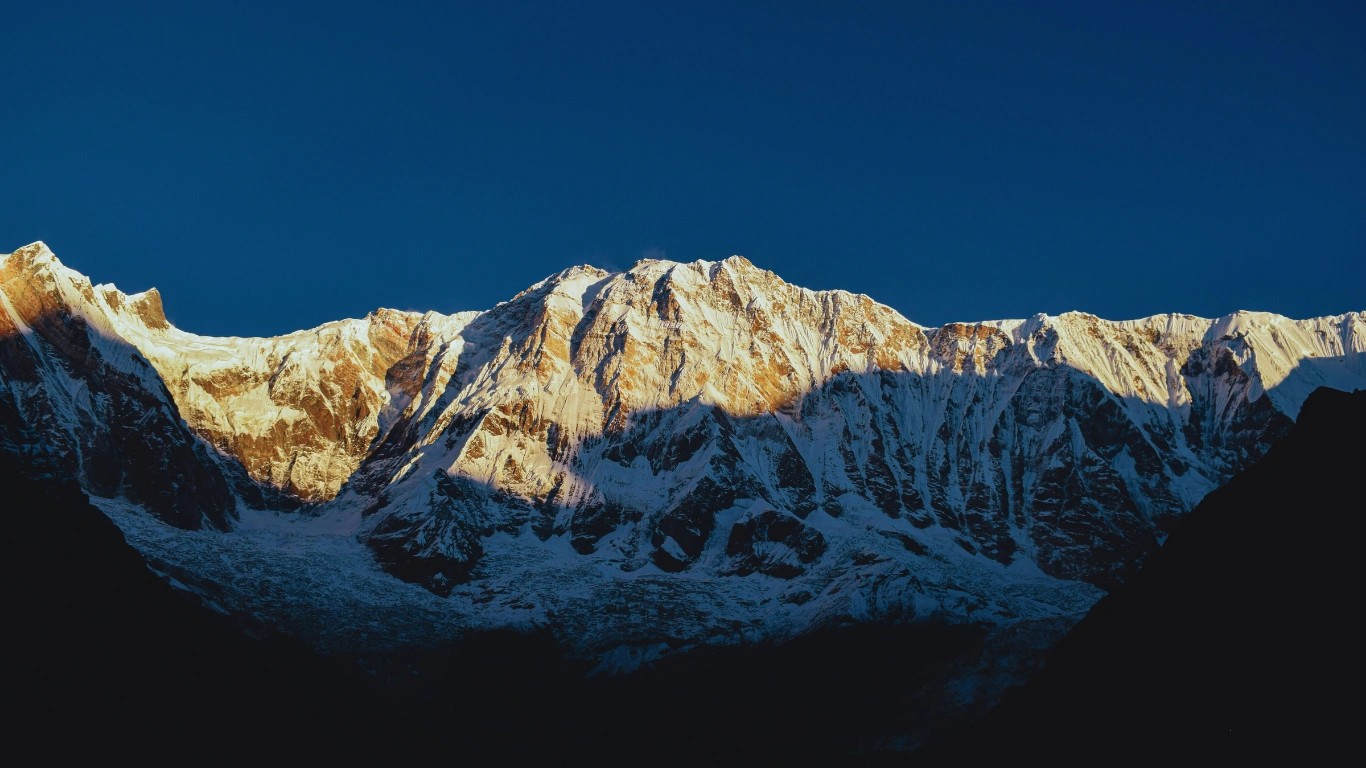
As the sun rises higher, its light floods the sanctuary floor where the teahouses stand. The frozen ground begins to warm, and the biting cold of dawn gives way to more comfortable temperatures.
This is when the full scope of the sunrise panorama at Annapurna Base Camp becomes apparent—not just the illuminated peaks, but the entire landscape revealed in crystal clarity.
The morning light at Annapurna Base Camp has a particular quality that photographers treasure. The air remains stable after the cold night, with none of the haze or clouds that often develop later in the day.
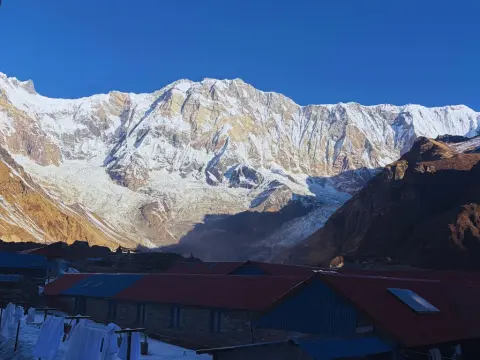
Every detail of the surrounding mountains appears sharp and defined—individual rocks on distant ridges, the texture of hanging glaciers, the precise edges of snow cornices thousands of meters above. The Annapurna Base Camp morning view during these hours is simply extraordinary.
Trekkers gather in the teahouse dining areas for breakfast, but the mountains remain the focus of attention. Large windows frame views of Annapurna I's south face, and conversations inevitably turn to the sunrise experience at Annapurna Base Camp just witnessed.
First-time trekkers struggle to articulate what they have seen, while those who have been here before nod knowingly—some experiences defy description.
The hours following sunrise are ideal for exploring the area around base camp. The original Annapurna Base Camp memorial area, commemorating climbers lost on the mountain, can be visited in the clear morning light.
Walking across the glacier moraine, you can observe the peaks from different angles, each perspective revealing new details of these magnificent mountains.
By mid-morning, clouds often begin to form around the peaks—a common pattern in the Himalayas as the warming earth generates convection. This makes the clear viewing conditions of early morning all the more precious and explains why experienced trekkers always prioritize the early morning sunrise at Annapurna Base Camp regardless of the cold.
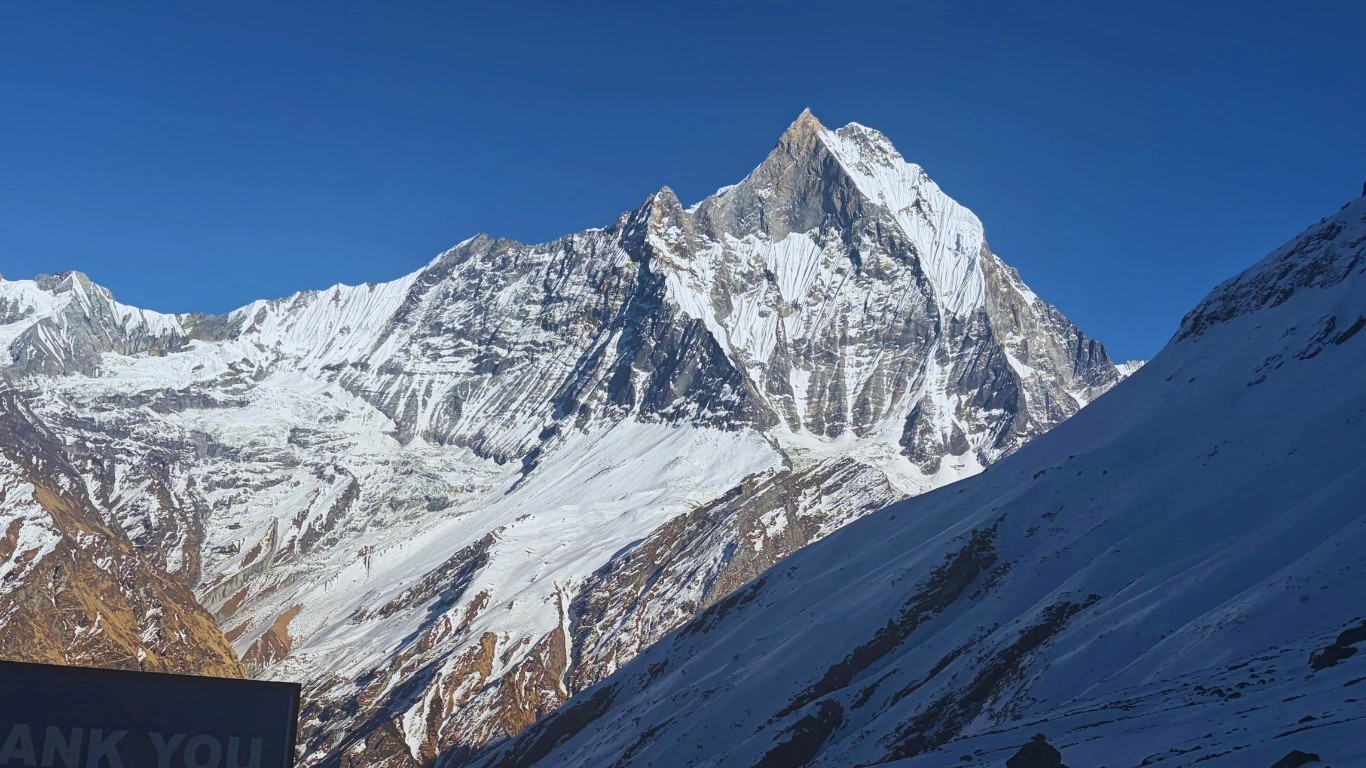
The afternoon at Annapurna Base Camp has its own rhythm. After the intensity of the morning and perhaps some exploration of the surrounding area, many trekkers rest in the teahouses, drink hot tea, and write in journals.
The peaks may be partially obscured by clouds that built up during the day, but experienced observers know that these clouds often clear as temperatures drop in the late afternoon.
Around 4:00 PM, trekkers begin gathering outside once again. The sun is still well above the western ridgeline, but its angle is changing, and the quality of light is shifting. The harsh midday brightness softens, shadows lengthen, and the mountains begin to take on warmer tones.
The atmosphere before the evening sunset at Annapurna Base Camp differs from the pre-dawn vigil. Where morning brought hushed anticipation in freezing darkness, evening brings a relaxed gathering in comfortable temperatures.
Trekkers sit on rocks or lean against teahouse walls, watching the slow transformation begin. Conversation flows more freely, and there is a communal feeling of gratitude—for having reached this place, for the clear weather, for the privilege of witnessing what is about to unfold.
As the sun descends, any remaining clouds often dissipate, revealing the peaks in their full glory once more. The sunset views from Annapurna Base Camp begin to develop as the light angle creates different patterns of shadow and illumination than those seen at sunrise.
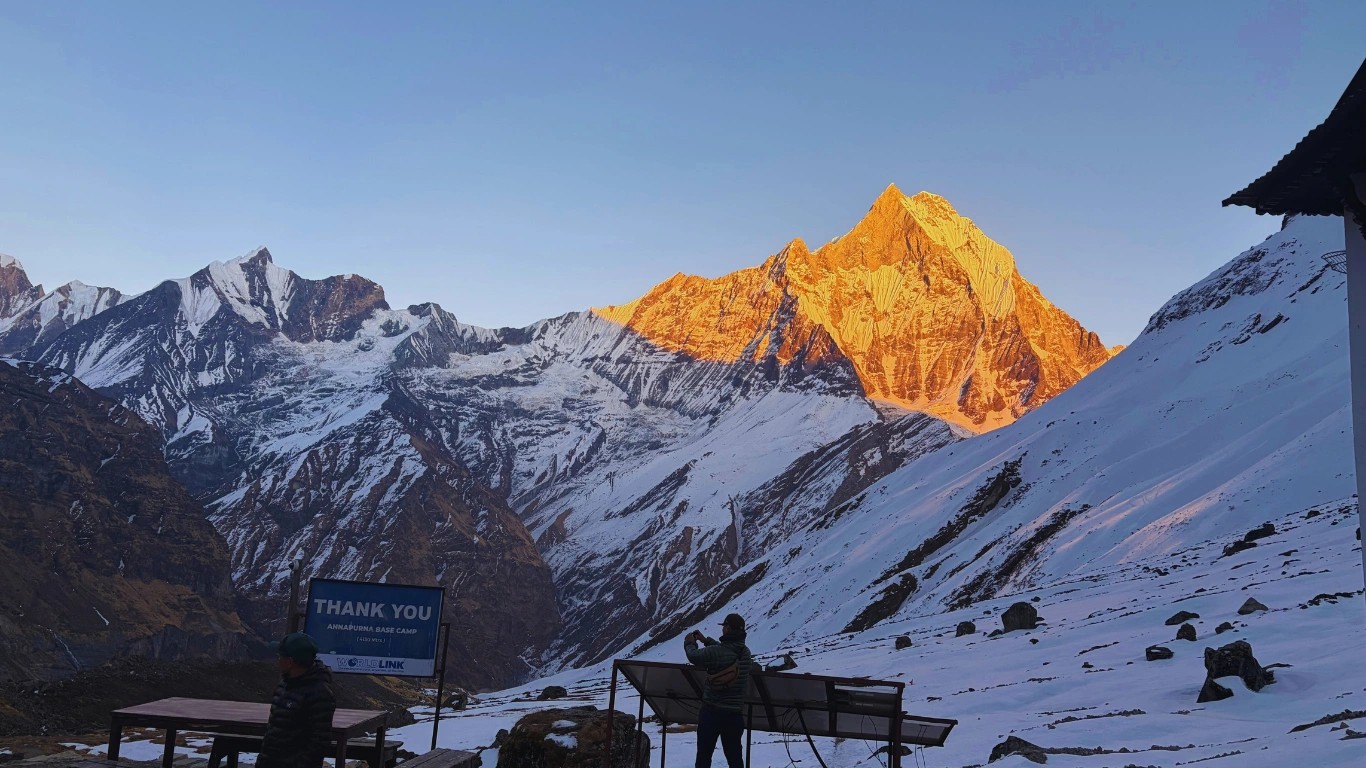
The sunset experience reverses the sequence witnessed at dawn. As the sun drops toward the western horizon, its light strikes the peaks at increasingly low angles, creating long shadows that emphasize the mountains' three-dimensional forms.
The sunset panorama at Annapurna Base Camp is no less impressive than the morning spectacle—simply different, with its own character and beauty.
The first signs of the golden sunset at Annapurna Base Camp appear when the light on the lower slopes begins to warm. The neutral white of midday snow takes on cream and yellow tones, then deepens to gold and orange.
Unlike sunrise, where light descends the peaks, sunset sees the golden band ascending—the lower slopes darkening first while the summits retain their warm glow.
Machapuchare is particularly magnificent during the sunset in the Annapurna Sanctuary at Annapurna Base Camp. The fishtail peak's unique shape catches the setting sun's rays in ways that create constantly changing patterns of light and shadow.
The mountain seems to glow from within, its icy faces reflecting the warm light while its rock bands appear in deep contrast.
The sunset colors at Annapurna Base Camp often surpass those of sunrise in their intensity. As the sun drops lower, the light passes through more atmosphere, filtering out blue wavelengths and allowing reds and oranges to dominate.
The peaks can appear almost impossibly pink or purple, colors that seem painted rather than natural yet are absolutely real. This Annapurna Sanctuary sunset experience is one of the most beautiful sights in all of Nepal.
As with sunrise, the magical sunset at Annapurna Base Camp unfolds over approximately thirty minutes. The golden light retreats up the mountain faces, leaving shadowed blue lower slopes while summits remain illuminated.
Finally, only the highest points catch the last direct rays—Annapurna I's summit, Machapuchare's tips—before they too fall into shadow.
The last light at Annapurna Base Camp fades gradually after the sun has set. The sky in the west remains illuminated, casting a soft alpenglow onto the peaks that can persist for twenty minutes or more.
This afterglow creates some of the most subtle and beautiful colors of the entire day—soft pinks and lavenders that seem to emanate from the mountains themselves rather than from any external source.
As this evening light at Annapurna Base Camp fades, temperatures drop rapidly. The cold that seemed distant during the golden hour returns with force, and trekkers retreat to the teahouses.
But many pause at the door for one last look, watching the mountains transform from glowing giants to dark silhouettes against the deepening sky.
The incredible sunset at Annapurna Base Camp leaves a profound impression that carries into the evening. Dinner conversation centers on what was witnessed, and cameras are passed around showing images that, despite their beauty, fall short of the actual experience.
There is a collective understanding that something special occurred—not just a natural phenomenon, but a connection to something larger than oneself.
The Himalayan night settles over the sanctuary. Stars emerge in numbers impossible to count, the Milky Way so bright it casts faint shadows. The peaks become massive presences felt rather than seen, their outlines barely visible against the sky.
For trekkers spending the night at base camp, sleep comes easily after the long day and the emotional intensity of the light shows. But it is a light sleep, with dreams of mountains and golden light, and an awareness that in a few short hours, the alarm will sound again for another sunrise in the Himalayas at Annapurna Base Camp.
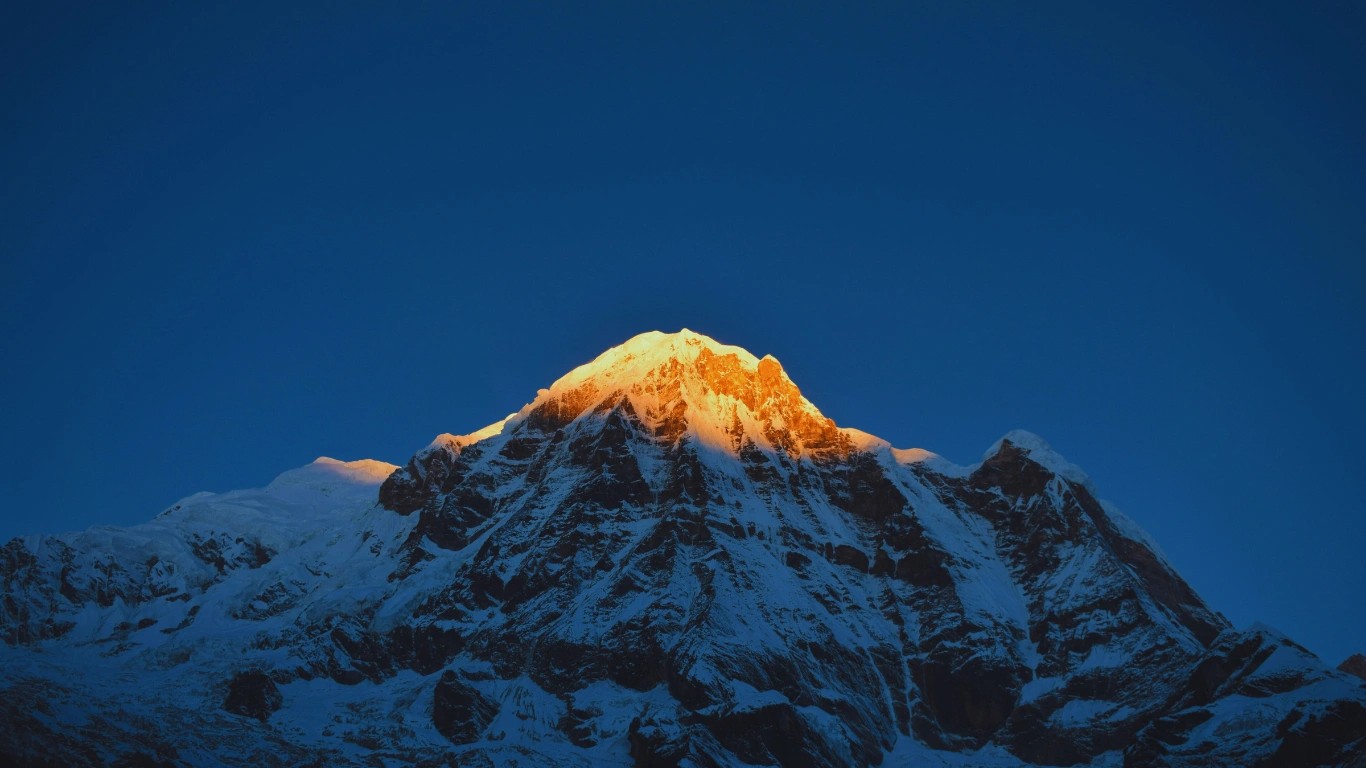
To make the most of your sunrise experience at Annapurna Base Camp, proper preparation is essential. Here are our expert recommendations from years of guiding in the Annapurna Sanctuary.
The sunset experience at Annapurna Base Camp requires different preparation than the morning session.
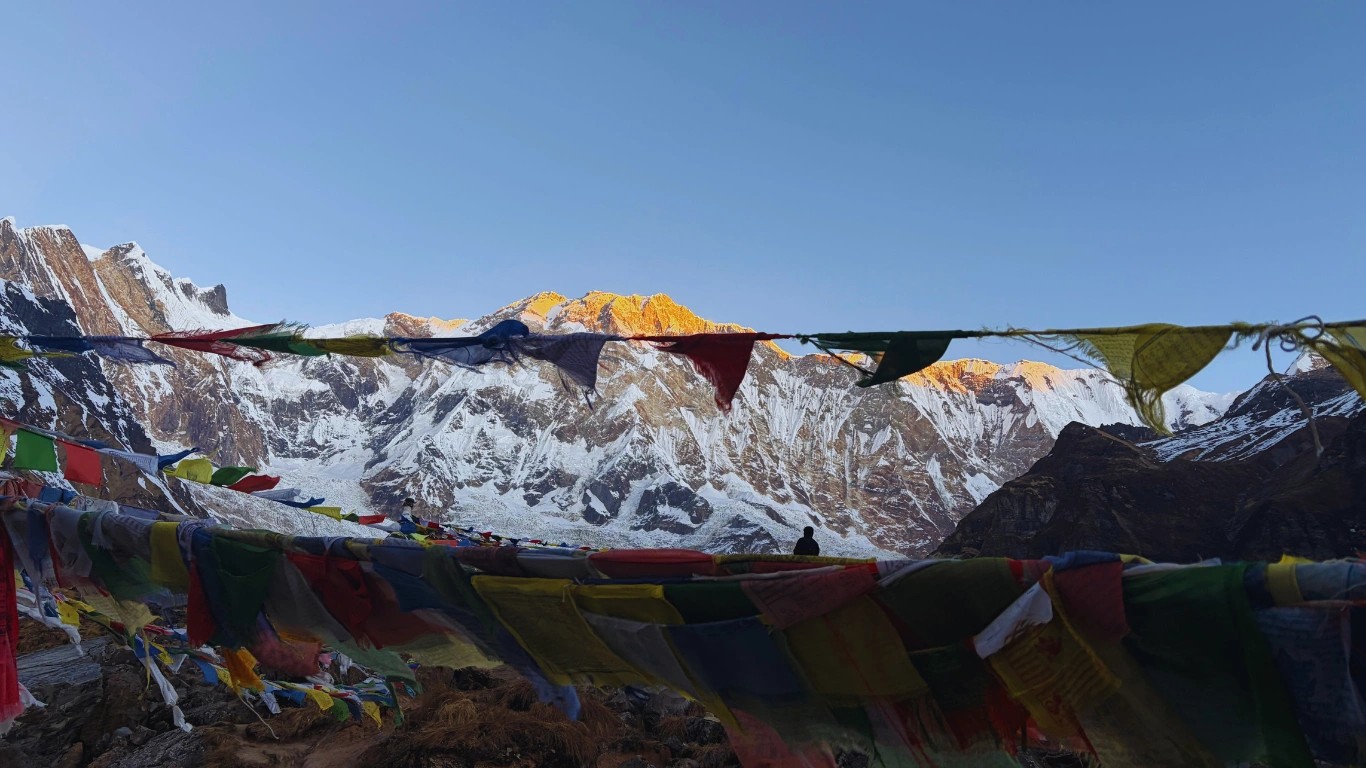
Photography at Annapurna Base Camp presents both incredible opportunities and significant challenges. The sunrise photography at Annapurna Base Camp rewards those who prepare properly and understand the conditions they will face.
The extreme cold at dawn is the first consideration. Camera batteries drain rapidly in sub-zero temperatures, so carrying spare batteries in inner pockets, kept warm by body heat, is essential.
We recommend removing the battery from your camera overnight and keeping it in your sleeping bag, only inserting it immediately before shooting.
The rapidly changing light during the golden hour requires flexibility in camera settings. What works perfectly when light first strikes Machapuchare will be completely wrong five minutes later as the illumination spreads and intensifies.
Shooting in RAW format provides the greatest flexibility for post-processing, allowing you to recover details in both shadows and highlights.
Arrive at your chosen location before first light and scout multiple angles. The sunrise views from Annapurna Base Camp offer numerous possibilities.
Include foreground elements like prayer flags or the teahouse roofs to add depth and scale, or focus purely on the peaks for dramatic mountain portraits. Using a tripod is advisable in the low light conditions of early dawn, though the light intensifies quickly once the sun rises.
The stunning sunrise at Annapurna Base Camp creates perfect conditions for silhouette photography as well. Fellow trekkers standing against the glowing peaks make compelling subjects, capturing the human element of the experience.
The sunset photography at Annapurna Base Camp offers different opportunities than the morning session. The warmer temperatures make extended shooting more comfortable, and the generally more relaxed atmosphere allows for more considered composition choices.
The evening golden hour often lasts longer than the morning equivalent, as the sun's descent is gradual and the afterglow can persist well after the sun has dropped below the horizon.
This extended shooting window allows for experimentation with different perspectives and techniques.
The epic sunset at Annapurna Base Camp creates opportunities for reflection photography if any pools of water have formed from glacial melt during the day.
Though such pools are not always present, when they occur, they offer stunning possibilities for capturing the glowing peaks reflected in still water.
Time-lapse photography is particularly effective during both sunrise and sunset. Setting a camera to capture images at regular intervals throughout the color changes creates compelling video content that conveys the dynamic nature of the experience.
The sunrise and sunset at Annapurna Base Camp represent moments that transcend ordinary experience. Standing in the cold darkness before dawn, watching massive peaks emerge from shadow into brilliant light, or seeing the last golden rays fade from Machapuchare's summit—these are experiences that stay with you forever.
As the team at Majestic Trails Nepal, we have spent over fifteen years guiding trekkers through the Annapurna region. We have witnessed thousands of sunrises and sunsets from base camp, and the magic never fades.
Our experienced local guides understand the best viewpoints, optimal timing, and how to ensure you are properly prepared for these extraordinary moments. We time our itineraries to maximize your chances of clear weather and always include at least one night at base camp to experience both sunrise and sunset.
When you trek with Majestic Trails Nepal, you benefit from our deep local knowledge, strong relationships with teahouse owners throughout the route, and genuine passion for sharing the beauty of our homeland with visitors from around the world.
We handle all logistics—permits, accommodations, meals, and porter services—so you can focus entirely on the experience. Our guides share stories of the mountains, local culture, and the spiritual significance of the Annapurna Sanctuary, enriching your trek far beyond the physical journey.
Contact Majestic Trails Nepal today to begin planning your Annapurna Base Camp trek. Whether you prefer a classic itinerary or a customized adventure, we will create an experience that brings you face to face with the Himalayan light shows that have inspired trekkers for generations.
The mountains are waiting. Let us guide you home to the Annapurna Sanctuary.
The sunrise at Annapurna Base Camp is a profoundly beautiful experience that unfolds over approximately thirty minutes. The first golden light strikes the summit of Machapuchare, then spreads to illuminate Annapurna I, Annapurna South, and the surrounding peaks in sequence. Colors shift from gold to orange to pink before the mountains assume their daytime white appearance. Many trekkers describe it as the highlight of their entire trek.
Sunrise time varies by season. During peak trekking seasons, sunrise occurs between approximately 5:45 AM and 6:30 AM in autumn (October-November) and between 6:00 AM and 6:30 AM in spring (March-May). However, the first light on the peaks appears ten to fifteen minutes before the sun itself becomes visible, so plan to be outside well before the official sunrise time.
The teahouse area at Annapurna Base Camp offers excellent views in all directions. The flat area in front of the main lodges provides unobstructed views of Machapuchare and the surrounding peaks. Some trekkers walk a short distance toward the glacier moraine for a slightly elevated perspective, though the views from the teahouses are already spectacular.
The combination of factors makes sunrise particularly special: the stark contrast between the cold darkness of pre-dawn and the golden warmth of first light; the dramatic scale of the surrounding peaks; the clear, pristine air at altitude; and the sense of being in a truly remote and sacred place. The visual spectacle combined with these emotional elements creates an unforgettable experience.
Yes, trekkers who spend the night at Annapurna Base Camp can experience both. Most itineraries schedule one night at base camp specifically to allow for this. The sunrise and sunset views at Annapurna Base Camp are different experiences, each with their own character and beauty.
October and November offer the clearest conditions, with stable weather and minimal cloud cover. March through May is also excellent, though afternoon clouds are more common in spring. December through February can offer incredibly clear views but with much colder temperatures. The monsoon season (June-September) typically has too much cloud cover for reliable mountain views.
Temperatures at dawn frequently drop to minus ten to minus twenty degrees Celsius during the peak autumn season. Proper cold weather gear including a warm down jacket, insulated gloves, a warm hat, and sturdy boots is essential for comfortably watching the sunrise.
Bring spare camera batteries kept warm in inner pockets, a tripod for low-light conditions, a camera capable of manual settings, and lens cloths (breath can fog cold lenses). Protect your camera from condensation when moving between cold outdoor conditions and warmer teahouse interiors.
The peaceful sunset at Annapurna Base Camp is equally impressive though different in character. Sunset colors are often more intense, with deep oranges, pinks, and purples. The reverse sequence of illumination—light rising up the peaks rather than descending—creates different visual effects. Many experienced trekkers consider the two equally beautiful.
The intense golden light typically lasts twenty to thirty minutes during both sunrise and sunset. However, the overall period of beautiful changing light extends longer—perhaps an hour in total—including the pre-dawn blue hour, the golden hour itself, and the post-sunset alpenglow.
The surrounding amphitheater includes Machapuchare (6,993m), Annapurna I (8,091m), Annapurna South (7,219m), Hiunchuli (6,441m), Annapurna III (7,555m), Gangapurna (7,455m), and several other significant peaks. During clear conditions, all these mountains are visible and illuminated during the sunrise sequence.
Yes, waking before dawn is necessary to witness the first light at Annapurna Base Camp and the full progression of the sunrise. Most teahouses provide early wake-up calls for interested guests. The reward of the experience makes the early rising worthwhile.
Cloud cover is always a possibility in the mountains. If clouds obscure the peaks during your planned sunrise or sunset viewing, you may still see partial views or brief clearings. Some trekkers choose to spend an extra night at base camp when weather permits, hoping for better conditions the following day.
Seeing both requires staying overnight. However, some trekkers who arrive at base camp early in the day can witness the sunset before descending to Machapuchare Base Camp for the night. This approach requires good fitness and careful time management but allows sunset views for those unable to stay at base camp.
The high altitude (4,130m) means less atmospheric interference, resulting in clearer, more vivid colors. The natural amphitheater of surrounding peaks creates a unique lighting environment where mountains illuminate in sequence. The pristine environment, free from pollution, allows light to travel with exceptional clarity.
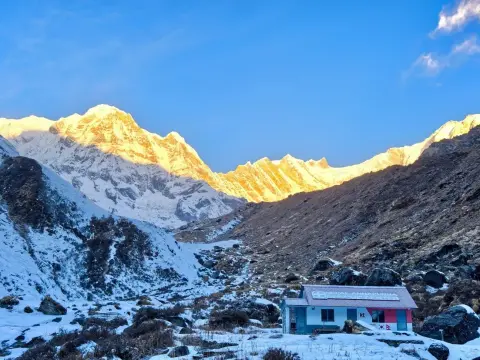
The Annapurna Base Camp trek stands among the world's most iconic Himalayan adventures. Every year, thousands of trekkers from across the globe journe...
Trekking to Annapurna Base Camp Trek is one of Nepal’s most iconic mountain journeys. For mountaineers, the climb begins here, but for trekkers, Annap...
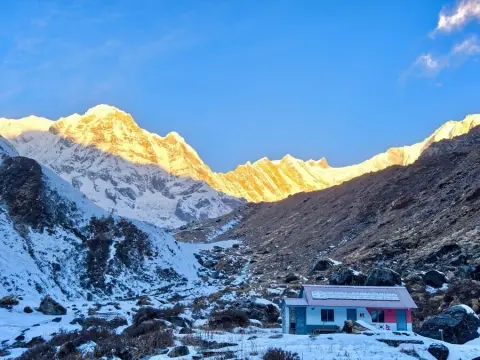
The morning mist lifted slowly from the Modi Khola valley as our trekking group paused near Deurali. Suddenly, movement caught my eye—a Himalayan tahr...
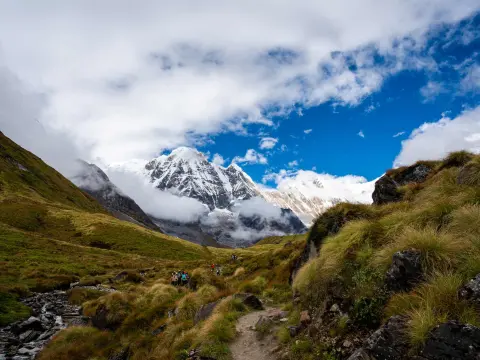
The Annapurna Base Camp trek is a moderate trek, suitable for fit beginners, with no technical climbing required. Its main challenge is not the altitu...
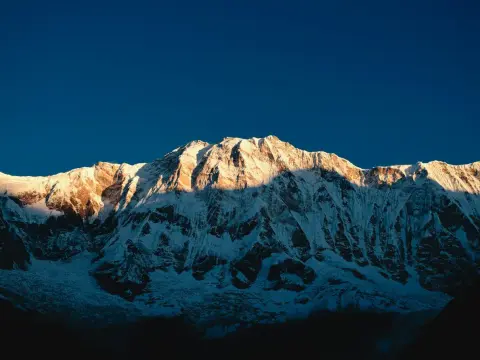
The term "killer mountain" carries a somber weight in mountaineering circles. It refers to peaks with exceptionally high fatality rates relative to su...
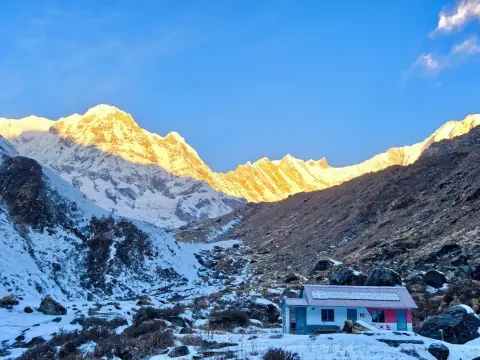
Nestled at 4,130 meters within a dramatic glacial amphitheater, the Annapurna Base Camp (ABC) trek stands among Nepal's most iconic Himalayan journeys...
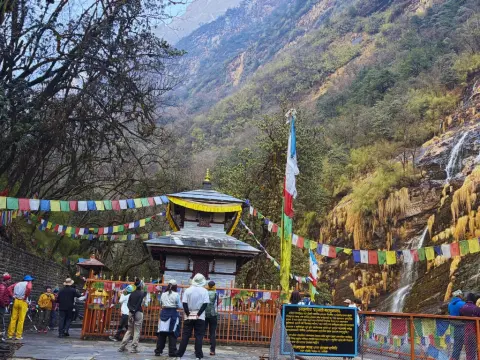
The Annapurna Base Camp trek is celebrated worldwide for its dramatic mountain scenery and diverse landscapes. Yet beyond the towering peaks and rhodo...
When trekkers ask us at Majestic Trails Nepal about the Annapurna Base Camp trek, one question comes up more than any other: "What's the accommodation...
