[{"name":"Langtang Valley Trek \u2014 10 Days","duration":"10","image_url":"https:\/\/www.majestictrailsnepal.com\/storage\/trip-galleries\/1\/thumb_e7907ed736676d12e6ab17328008e746.webp","offer_price":null,"url":"https:\/\/www.majestictrailsnepal.com\/trips\/langtang-valley-trek"},{"name":"Everest Base Camp Trek","duration":"14","image_url":"https:\/\/www.majestictrailsnepal.com\/storage\/trip-galleries\/2\/thumb_4b769c9c4b5b007a61f4ce3b76ff440d.webp","offer_price":null,"url":"https:\/\/www.majestictrailsnepal.com\/trips\/everest-base-camp-trek"},{"name":"Everest Panorama Trek","duration":"9","image_url":"https:\/\/www.majestictrailsnepal.com\/storage\/trip-galleries\/3\/thumb_e6ee74caea3e2900c23ca370b06bab80.webp","offer_price":null,"url":"https:\/\/www.majestictrailsnepal.com\/trips\/everest-panorama-trek"},{"name":"Annapurna Base Camp Trek","duration":"14","image_url":"https:\/\/www.majestictrailsnepal.com\/storage\/trip-galleries\/4\/thumb_3f8d40f9472f701d7c46a827925201bc.webp","offer_price":null,"url":"https:\/\/www.majestictrailsnepal.com\/trips\/annapurna-base-camp-trek"},{"name":"Annapurna Base Camp Express Trek","duration":"9","image_url":"https:\/\/www.majestictrailsnepal.com\/storage\/trip-galleries\/5\/thumb_bac80de2bd257d651fa75d9c8025da1a.webp","offer_price":null,"url":"https:\/\/www.majestictrailsnepal.com\/trips\/annapurna-base-camp-express-trek"},{"name":"Annapurna Circuit Trek","duration":"15","image_url":"https:\/\/www.majestictrailsnepal.com\/storage\/trip-galleries\/6\/thumb_b73bdec74acacaa0d72a2a2a513f3d4a.webp","offer_price":null,"url":"https:\/\/www.majestictrailsnepal.com\/trips\/annapurna-circuit-trek"},{"name":"Ghorepani Poon Hill Trek","duration":"8","image_url":"https:\/\/www.majestictrailsnepal.com\/storage\/trip-galleries\/7\/thumb_aeda9e6388ab2692138cc9c9efa81a7f.webp","offer_price":null,"url":"https:\/\/www.majestictrailsnepal.com\/trips\/ghorepani-poon-hill-trek"},{"name":"Mardi Himal Trek \u2014 9 Days","duration":"9","image_url":"https:\/\/www.majestictrailsnepal.com\/storage\/trip-galleries\/8\/thumb_c511ee87ecab8ff015210dd647392d66.webp","offer_price":null,"url":"https:\/\/www.majestictrailsnepal.com\/trips\/mardi-himal-trek"},{"name":"Manaslu Circuit Trek","duration":"15","image_url":"https:\/\/www.majestictrailsnepal.com\/storage\/trip-galleries\/9\/thumb_7726908390ad6b249f2f6a7856f9dc17.webp","offer_price":null,"url":"https:\/\/www.majestictrailsnepal.com\/trips\/manaslu-circuit-trek"},{"name":"Upper Mustang Trek","duration":"16","image_url":"https:\/\/www.majestictrailsnepal.com\/storage\/trip-galleries\/10\/thumb_6a9b52ecd1d8cda92d594e5351431d6e.webp","offer_price":null,"url":"https:\/\/www.majestictrailsnepal.com\/trips\/upper-mustang-trek"},{"name":"Pokhara City Tour","duration":"1","image_url":"https:\/\/www.majestictrailsnepal.com\/storage\/trip-galleries\/11\/thumb_cf762ba4c20363bd1c0f239db35fcc84.webp","offer_price":null,"url":"https:\/\/www.majestictrailsnepal.com\/trips\/pokhara-city-tour"},{"name":"Paragliding in Pokhara","duration":"1","image_url":"https:\/\/www.majestictrailsnepal.com\/storage\/trip-galleries\/12\/thumb_b896201edf88bbe0f570e876c3c337a3.webp","offer_price":70,"url":"https:\/\/www.majestictrailsnepal.com\/trips\/paragliding-in-pokhara"},{"name":"Kathmandu City Tour","duration":"2","image_url":"https:\/\/www.majestictrailsnepal.com\/storage\/trip-galleries\/13\/thumb_846ad05bd3ce7bebb3843c24c08db6f9.webp","offer_price":null,"url":"https:\/\/www.majestictrailsnepal.com\/trips\/kathmandu-city-tour"},{"name":"Lumbini Buddhist Pilgrimage Tour","duration":"4","image_url":"https:\/\/www.majestictrailsnepal.com\/storage\/trip-galleries\/14\/a2998dca0ce22f28a61c3862dd47f6a3.webp","offer_price":null,"url":"https:\/\/www.majestictrailsnepal.com\/trips\/lumbini-buddhist-pilgrimage-tour"},{"name":"5 days langtang valley trek","duration":"5","image_url":"https:\/\/www.majestictrailsnepal.com\/storage\/trip-galleries\/15\/thumb_7a6c65c139b8085d220ac01913cb1448.webp","offer_price":510,"url":"https:\/\/www.majestictrailsnepal.com\/trips\/5-days-langtang-valley-trek"},{"name":"Leisure Port Nepal Price: Rafting and Camping Adventure","duration":"7","image_url":"https:\/\/www.majestictrailsnepal.com\/storage\/trip-galleries\/17\/thumb_02cb8c3f0697c7c5c4f73d744b47d87f.webp","offer_price":550,"url":"https:\/\/www.majestictrailsnepal.com\/trips\/leisure-port-nepal-price-rafting-and-camping-adventure"},{"name":"10 days spiritual tour in Nepal","duration":"10","image_url":"https:\/\/www.majestictrailsnepal.com\/storage\/trip-galleries\/18\/thumb_b4e7eba000673d1bce6b56abb422fe3b.webp","offer_price":1200,"url":"https:\/\/www.majestictrailsnepal.com\/trips\/10-days-spiritual-tour-in-nepal"},{"name":"Annapurna Circuit Short Trek","duration":"10","image_url":"https:\/\/www.majestictrailsnepal.com\/storage\/trip-galleries\/19\/thumb_769ee8cbe02a510d8db76419c97a2dc9.webp","offer_price":null,"url":"https:\/\/www.majestictrailsnepal.com\/trips\/annapurna-circuit-short-trek"},{"name":"Best Short Manaslu Circuit Trek","duration":"11","image_url":"https:\/\/www.majestictrailsnepal.com\/storage\/trip-galleries\/20\/thumb_ac1b4977a3fce9d11ee68240cad675b6.webp","offer_price":null,"url":"https:\/\/www.majestictrailsnepal.com\/trips\/best-short-manaslu-circuit-trek"},{"name":"Langtang Gosaikunda Trek","duration":"13","image_url":"https:\/\/www.majestictrailsnepal.com\/storage\/trip-galleries\/22\/thumb_577a6402f2ca4b3f12bfd80b96b33a23.webp","offer_price":940,"url":"https:\/\/www.majestictrailsnepal.com\/trips\/langtang-gosaikunda-trek"},{"name":"3 Passes Trek Nepal","duration":"22","image_url":"https:\/\/www.majestictrailsnepal.com\/storage\/trip-galleries\/24\/thumb_8020edea67aefce87e9012dc89a60087.webp","offer_price":null,"url":"https:\/\/www.majestictrailsnepal.com\/trips\/3-passes-trek-nepal"},{"name":"Tsum Valley Trek","duration":"13","image_url":"https:\/\/www.majestictrailsnepal.com\/storage\/trip-galleries\/25\/thumb_194c03e3c3463dff07a3f621a81ef9ea.webp","offer_price":null,"url":"https:\/\/www.majestictrailsnepal.com\/trips\/tsum-valley-trek"},{"name":"Gokyo and Renjo La Pass Trek","duration":"14","image_url":"https:\/\/www.majestictrailsnepal.com\/storage\/trip-galleries\/26\/thumb_7b865f0f0d0d4c6807b625b6e391b56d.webp","offer_price":1490,"url":"https:\/\/www.majestictrailsnepal.com\/trips\/gokyo-and-renjo-la-pass-trek"},{"name":"Honeymoon Tour in Nepal","duration":"9","image_url":"https:\/\/www.majestictrailsnepal.com\/storage\/trip-galleries\/27\/thumb_dabf449c090bb16efd5823c653eb61b3.webp","offer_price":null,"url":"https:\/\/www.majestictrailsnepal.com\/trips\/honeymoon-tour-in-nepal"},{"name":"Pikey Peak Trek","duration":"10","image_url":"https:\/\/www.majestictrailsnepal.com\/storage\/trip-galleries\/28\/thumb_5425e57ce3ea84d31a7b24b83b1af94f.webp","offer_price":1090,"url":"https:\/\/www.majestictrailsnepal.com\/trips\/pikey-peak-trek"},{"name":"Makalu Base Camp Trek","duration":"17","image_url":"https:\/\/www.majestictrailsnepal.com\/storage\/trip-galleries\/29\/thumb_d68c8ec6492540c922045d825a38cd50.webp","offer_price":null,"url":"https:\/\/www.majestictrailsnepal.com\/trips\/makalu-base-camp-trek"},{"name":"Nepal Winter Tour","duration":"8","image_url":"https:\/\/www.majestictrailsnepal.com\/storage\/trip-galleries\/30\/thumb_c8491c0c4b1fb19d8e93630866895799.webp","offer_price":null,"url":"https:\/\/www.majestictrailsnepal.com\/trips\/nepal-winter-tour"},{"name":"Maratika Tour in Nepal","duration":"6","image_url":"https:\/\/www.majestictrailsnepal.com\/storage\/trip-galleries\/31\/thumb_97948560c5a12a486f9ac2b76567cafd.webp","offer_price":null,"url":"https:\/\/www.majestictrailsnepal.com\/trips\/maratika-tour-in-nepal"},{"name":"Nepal Lake Trek","duration":"14","image_url":"https:\/\/www.majestictrailsnepal.com\/storage\/trip-galleries\/32\/thumb_d9b260fe13127816f5b3c25447caf70c.webp","offer_price":null,"url":"https:\/\/www.majestictrailsnepal.com\/trips\/nepal-lake-trek"},{"name":"Taste of Nepal Tour Package","duration":"9","image_url":"https:\/\/www.majestictrailsnepal.com\/storage\/trip-galleries\/33\/thumb_f4b55ab5760a8e057b4c3e208e25ab36.webp","offer_price":null,"url":"https:\/\/www.majestictrailsnepal.com\/trips\/taste-of-nepal-tour-package"},{"name":"Poon Hill Yoga Trek in Nepal","duration":"9","image_url":"https:\/\/www.majestictrailsnepal.com\/storage\/trip-galleries\/34\/thumb_904b238e690107c5c9b1092296880cc9.webp","offer_price":null,"url":"https:\/\/www.majestictrailsnepal.com\/trips\/poon-hill-yoga-trek-in-nepal"},{"name":"Nar Phu Nepal Trek","duration":"10","image_url":"https:\/\/www.majestictrailsnepal.com\/storage\/trip-galleries\/35\/thumb_f959e3e22c260629add0ba61a4038812.webp","offer_price":null,"url":"https:\/\/www.majestictrailsnepal.com\/trips\/nar-phu-nepal-trek"},{"name":"Annapurna Base Camp Helicopter Tour","duration":"1","image_url":"https:\/\/www.majestictrailsnepal.com\/storage\/trip-galleries\/36\/thumb_e81861e8772a9d7fac92ab4a7d43e3bf.webp","offer_price":null,"url":"https:\/\/www.majestictrailsnepal.com\/trips\/annapurna-base-camp-helicopter-tour"},{"name":"Annapurna Circuit with Nar Phu Valley Trek","duration":"16","image_url":"https:\/\/www.majestictrailsnepal.com\/storage\/trip-galleries\/38\/thumb_b70692cbd1c1dd772587c940be2d0bc9.webp","offer_price":null,"url":"https:\/\/www.majestictrailsnepal.com\/trips\/annapurna-circuit-with-nar-phu-valley-trek"}]
Annapurna Base Camp vs Everest Base Camp — Honest 2026 Comparison
If you are deciding between Annapurna Base Camp Trek and Everest Base Camp Trek in 2026, here is the operator answer most websites will not give you: Everest Base Camp is the better trek in 2026 — for almost every type of trekker.
That contradicts most Nepal trekking blogs, which still recommend ABC as the beginner-friendly default. The reality on the ground has changed. After guiding 215 EBC trips and 195 ABC trips over the past 10+ years, our team has watched ABC's popularity surge faster than the trail and tea house infrastructure can handle. The result is documented in the sections below.
Book Everest Base Camp Trek if you want:
The iconic Himalayan bucket list trek
The cultural depth of Namche Bazaar and Tengboche Monastery
The world's tallest mountain base camp experience
Better infrastructure to absorb peak season crowds
Book Annapurna Base Camp Trek if you have:
Less than 10-12 days available in Nepal
A firm refusal to fly to Lukla and inability to tolerate the long Salleri-Surke drive alternative
Age is not a factor in this decision. Our team has guided 70-year-olds to EBC successfully. Fitness training matters — age does not.
ABC vs EBC — Quick Comparison Table
Factor
Annapurna Base Camp Trek
Everest Base Camp Trek
Maximum altitude
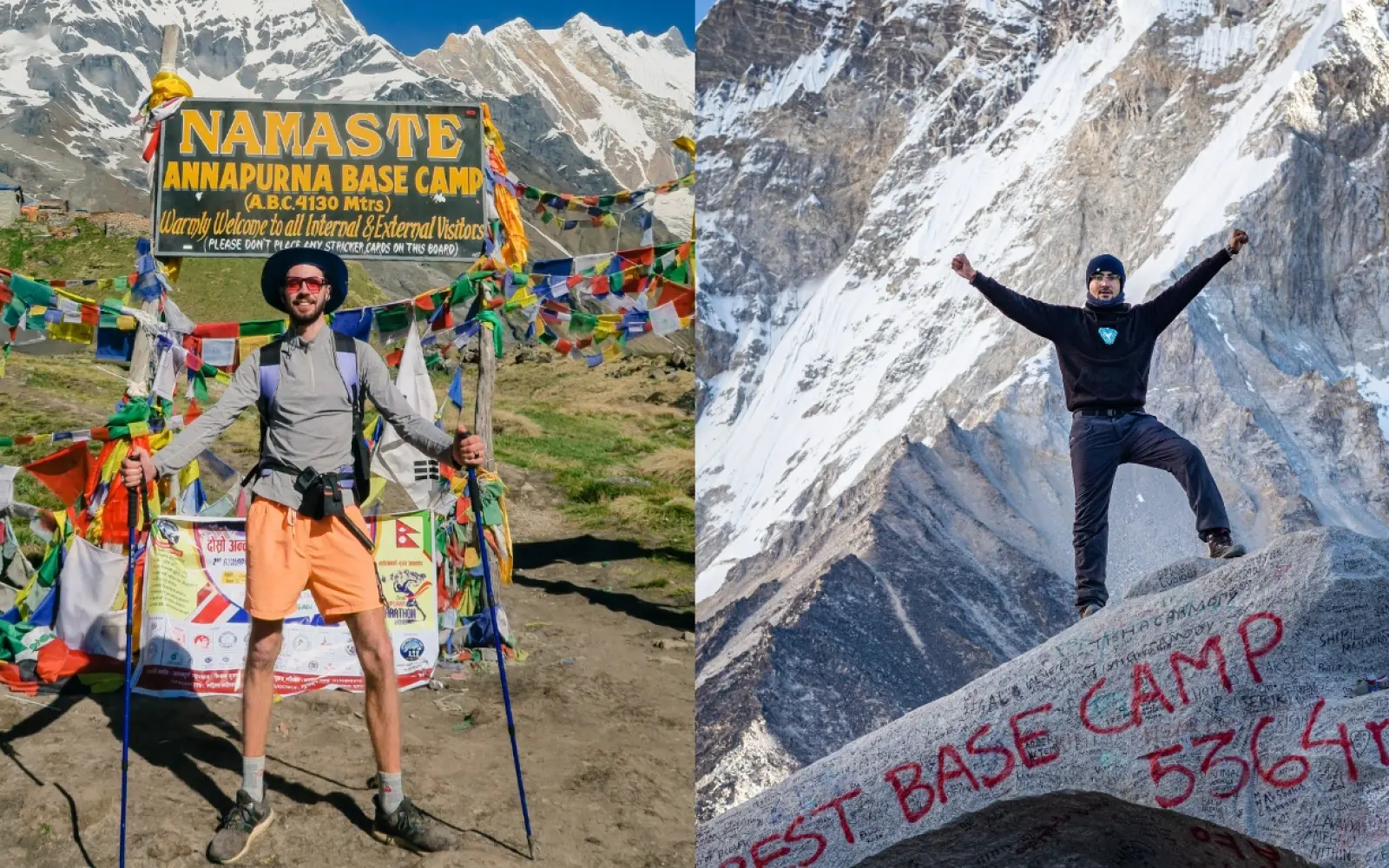
4,130 m
5,364 m (5,545 m at Kala Patthar)
Standard duration
14 days (or 6-7 days short version)
14 days
Difficulty
Moderate — stairs are the main challenge
Strenuous — altitude is the main challenge
Best for beginners
Yes — with current crowding caveat
Yes with proper acclimatization
Trail access
Drive from Pokhara to Birethanti
Mandatory 35-minute flight to Lukla
Cost (Majestic Trails Nepal package)
From USD 940
From USD 1,500
Permits required
ACAP
Sagarmatha National Park + Khumbu Pasang Lhamu
Completion rate (our trips)
95%
85%
Crowding in 2026
Severely overcrowded after Sinuwa
Crowded but manageable infrastructure
Cultural depth
Limited — nature-focused
High — Namche, Tengboche, Sherpa villages
Mountains visible
Annapurna South, Annapurna I, Machhapuchhre, Hiunchuli
Everest, Lhotse, Nuptse, Ama Dablam
Which is Better — Annapurna or Everest Base Camp Trek?
Annapurna base camp or Everest Base Camp
Everest Base Camp Trek is better than Annapurna Base Camp Trek in 2026 for almost every trekker. The reasons are not the ones most websites cite — they are specific 2026 operator observations.
Why ABC Trek has fallen behind in 2026:
ABC was marketed for years as the beginner-friendly base camp. That marketing worked too well. Trekker volume now exceeds what the trail and tea houses can handle.
After Sinuwa, trekkers are routinely forced to share rooms with strangers. Privacy at altitude becomes impossible.
Dining halls are packed to capacity. Solo trekkers struggle to find seats during evening meals.
Tea house quality at ABC has not improved despite the popularity surge. Same basic rooms, same limited facilities.
The 14-day route now passes the new road in two sections — the first three hours from Birethanti, and a short stretch before Ghorepani. The wilderness feeling is broken twice.
Why EBC Trek wins in 2026:
Equally popular but built around a larger trail and lodge network. Rooms remain available even in peak season.
The villages along the way are not just rest stops — they are destinations. Namche Bazaar is one of the most beautiful villages anywhere in Nepal. Tengboche Monastery offers a peaceful cultural experience that has no equivalent on the ABC route.
Dingboche at 4,410 m is the highest-altitude Sherpa village trekkers visit. The cultural immersion continues at altitude, not just at low elevation.
Even monsoon trekking on EBC has its own character — green trails, quieter routes, a completely different mood from peak season.
The honest verdict from running both treks: EBC delivers a richer experience in 2026 because the infrastructure, culture, and trail conditions have aged better than ABC has.
Annapurna vs Everest Height
The two treks reach different altitudes — and the difference matters for how the body responds.
Point
Altitude
Annapurna Base Camp
4,130 m (13,550 ft)
Everest Base Camp
5,364 m (17,598 ft)
Kala Patthar (EBC viewpoint)
5,545 m (18,192 ft)
Difference at base camp
1,234 m higher on EBC
Difference at highest viewpoint
1,415 m higher on EBC
The mountains themselves are also very different in scale:
Mount Everest: 8,849 m — the highest mountain on earth
Annapurna I: 8,091 m — the 10th highest mountain on earth
That 758 m difference between Everest and Annapurna I is important for mountaineers but not for trekkers as both these peaks are not to be climbed. The point is that the elevation to which you are actually walking is what matters and it is 1,400 m higher than ABC is.
There is a predictable rate at which the body adapts to altitude: 300 to 500 m per day is considered safe above 3,000 m. This is why EBC requires proper acclimatization whereas ABC can be done with minimal altitude precaution.
Annapurna vs Everest Difficulty — Which is Harder?
Annapurna Base Camp Trek vs Everest Base Camp Trek difficulty
Everest Base Camp is harder than Annapurna Base Camp. The two treks are difficult in completely different ways, and confusing the two is why some trekkers book the wrong route.
ABC Trek difficulty — stairs:
On ABC, it's not about the height. It is stairs. The vast majority of the trail from Birethanti to Base Camp of Machhapuchhre is made up of stone steps, Ulleri alone has around 3,000 stone stairs. The descent puts even more strain on knees than the ascent. Around 65% of our trekkers suffer knee problems on the descent. The trail is considered medium-grade as there are no steep inclines or declines, but the body will definitely take the beating.
EBC Trek difficulty — altitude:
The primary issue on EBC is the altitude. The path is not difficult (well marked, established, consistent spacing of tea houses). It's the effect of altitude on a human body at more than 4,000 m. Standard is a headache, sleep problems, loss of appetite and slow physical recovery. The journey is tough due to the altitude difficulties: symptoms start to show, and there is no cure for them other than going down.
The numbers from our experience:
ABC completion rate: 95%. The 5% who do not complete are typically affected by food poisoning from Pokhara or struggle with the staircase descent.
EBC completion rate: 85%. The 15% who do not complete turn back due to altitude sickness — most commonly at Lobuche (4,910 m), the night before the final push to base camp.
So which is harder? EBC, statistically. A 10-percentage-point gap in completion rate tells the honest story. ABC is harder on the body. EBC is harder on the body and the lungs.
Can a Beginner Do Annapurna Base Camp Trek?
Beginners trekks at annapurna base camp
Of course, a beginner can do the Annapurna Base Camp Trek with the right preparation. ABC has a maximum elevation of 4130m, the trail is well-developed, tea house facilities are available along the way, and there are no technical skills required. ABC is a hike that is suitable for any hiker who can hike 4-5 hours per day and climb stairs without hurting themselves.
That said, beginners should know what they are signing up for:
The trek is 14 days end-to-end, with 10 days of actual walking
Daily walking averages 4-5 hours, with longer days approaching MBC and ABC
The Ulleri staircase, the Chhomrong descent, and the climb to MBC test the legs more than most beginners expect
In 2026, the dining hall and room-sharing crowding may detract from the experience for solo trekkers and couples wanting privacy
Beginner preparation recommendations:
8-12 weeks of stair-climbing training before departure
Cardiovascular base — walking, hiking, or running 3-4 times per week
Knee strengthening with squats and lunges
Broken-in trekking boots (do not bring brand new boots to Nepal)
ABC is genuinely beginner-friendly in physical terms. The 2026 question is whether the overcrowding experience matches what beginners expect from a Himalayan trek.
Annapurna Base Camp vs Everest Base Camp Cost
Everest Base Camp costs more than Annapurna Base Camp — significantly more. The difference is approximately USD 560 between equivalent guided packages, or roughly 60% more for EBC.
Round-trip Lukla flights cost approximately USD 350-400 per trekker
Higher altitude requires more guide expertise and more rigorous acclimatization protocols
The trekking distance is longer overall when measured in elevation gained and altitude management
Tea house pricing in the Khumbu region runs higher than in the Annapurna region — particularly above Namche
What is included in both packages:
Accommodation throughout the trek
All meals on the trail
Licensed guide (NATHM certified)
Porter (one per two trekkers)
All required permits
Transport from Kathmandu
Equipment (duffle bag, down jacket, sleeping bag, crampons for ABC)
What is not included:
International flights
Travel insurance (mandatory but purchased separately)
Personal trekking gear
Drinks beyond tea and water at meals
Tips for guide and porter
The cost difference is real but proportionate to the trek's scale. EBC delivers more days at altitude, more cultural immersion, and the world's most iconic mountain base camp. For most trekkers the additional USD 560 represents fair value for the experience.
ABC vs EBC Distance
Annapurna Base Camp and Everest Base Camp are approximately 240 km apart in a straight line across Nepal's Himalayan range. There is no trail connection between the two.
Geographic context:
ABC sits in the Annapurna Conservation Area in Gandaki Pradesh, north-central Nepal
EBC sits in the Sagarmatha National Park in Bagmati Pradesh, north-eastern Nepal
The two regions are separated by Manaslu, Langtang, and Rolwaling — vast mountain ranges with no trekker-friendly connection
Why this matters:
It is recommended that the trekkers make it back to Kathmandu between the two treks. This is a realistic combined tour of about 24-28 days with transport. ABC and EBC can not be connected like the Annapurna Circuit and Annapurna Base Camp can be connected. They are two various missions in two different areas.
Travel time between the two trek start points:
Birethanti (ABC trailhead) to Lukla (EBC trailhead): approximately 12-14 hours total via Kathmandu, including flights
The route requires returning from Pokhara to Kathmandu, then flying from Kathmandu to Lukla — there is no direct route
For most trekkers, choosing one trek per Nepal trip is the practical answer.
ABC vs EBC Highlights — What Each Trek Actually Offers
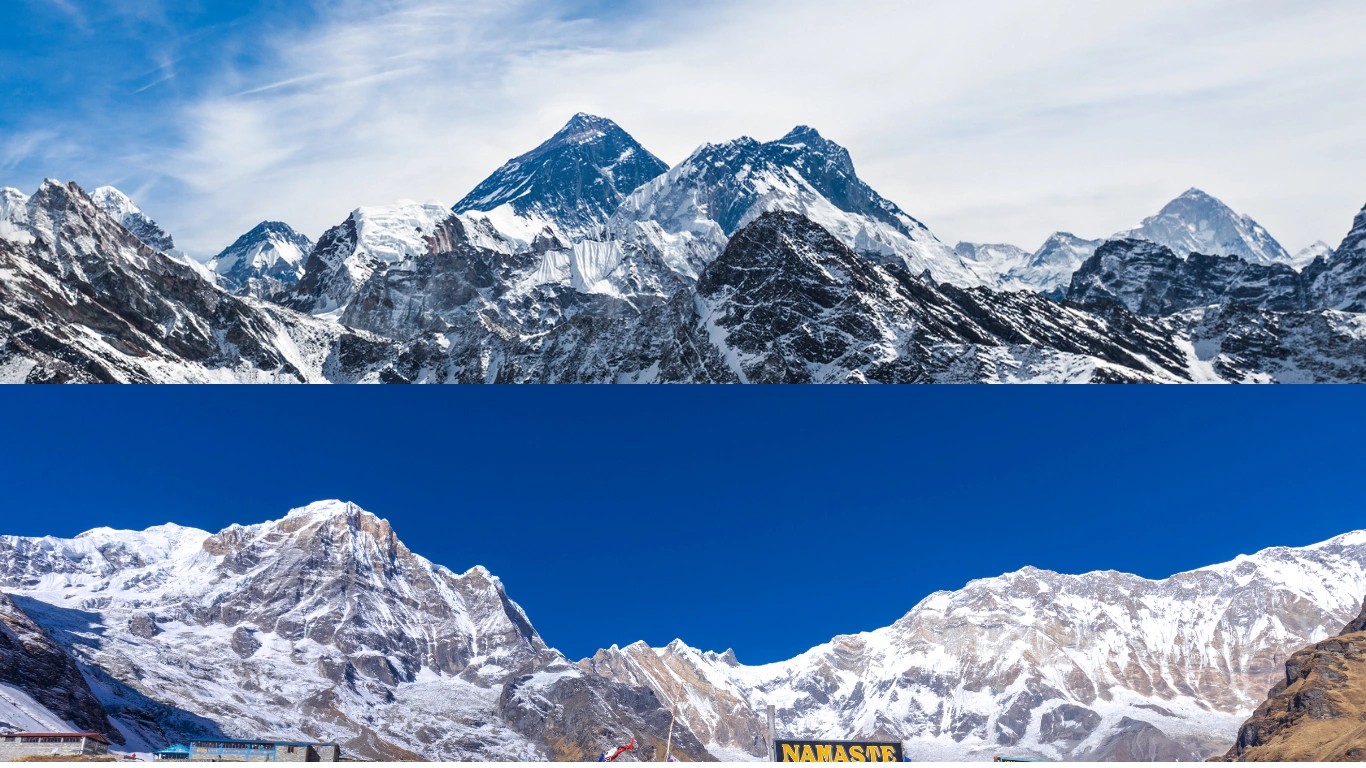
Everest ranges mountain and Annapurna ranges mountain
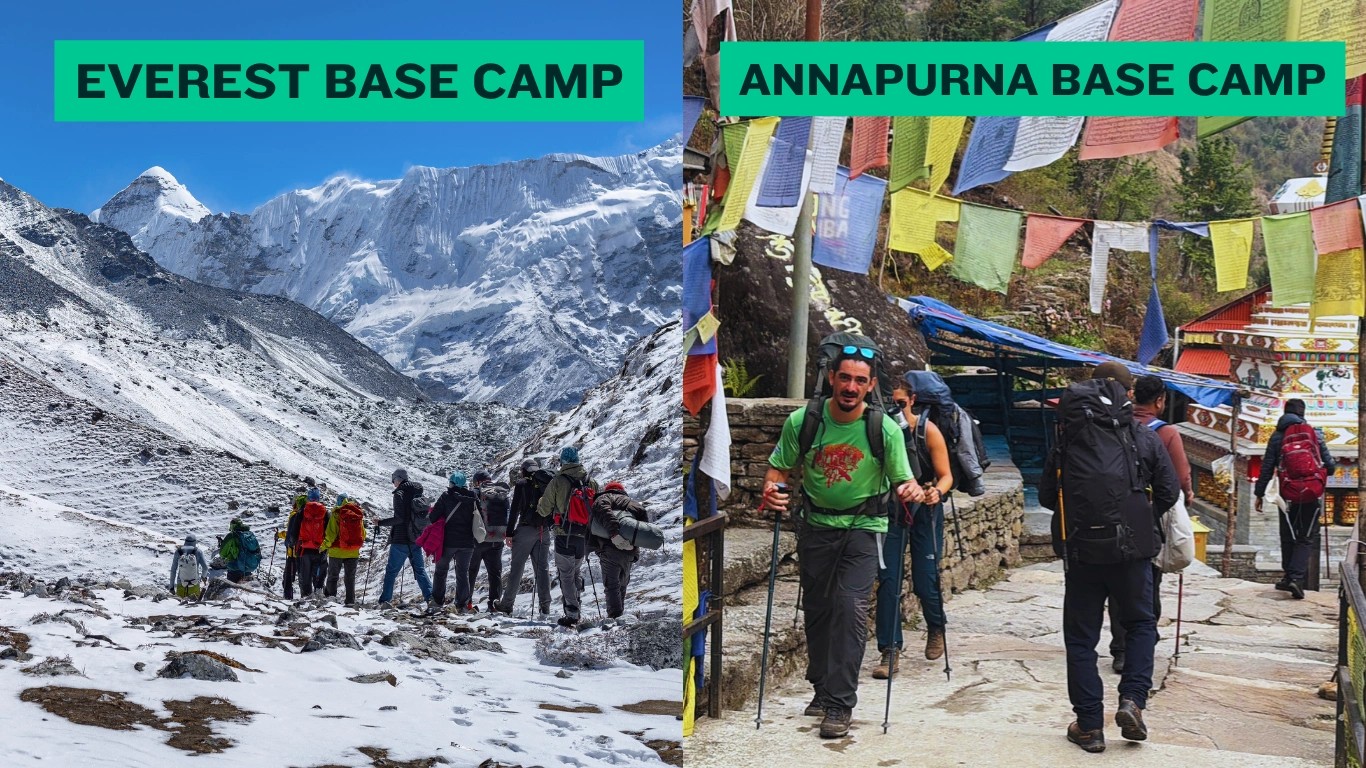
The two treks deliver fundamentally different experiences. ABC is nature-focused — you walk through villages to reach a mountain amphitheatre. EBC is nature plus living culture — the villages and monasteries are destinations in themselves.
Annapurna Base Camp Trek — 7 highlights:
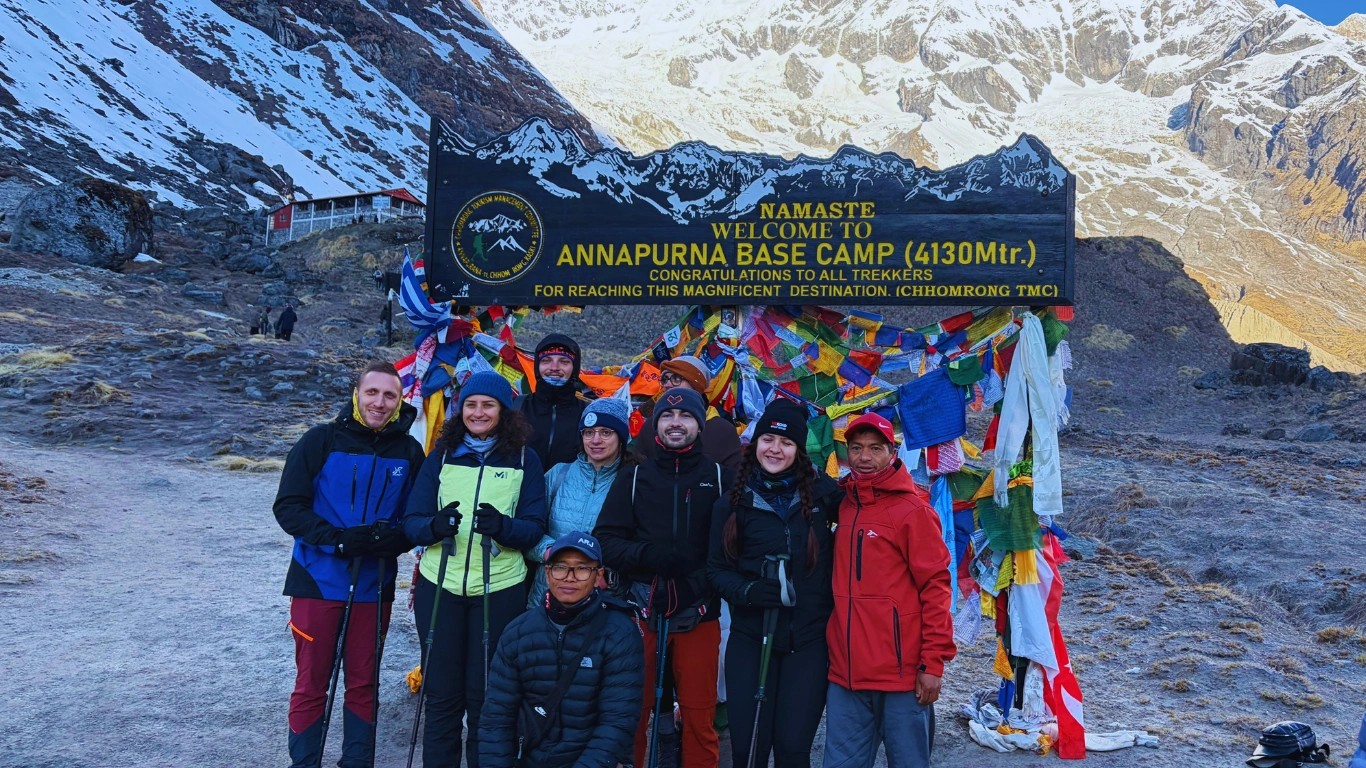
Standing inside the Annapurna Sanctuary amphitheatre at 4,130 m, completely surrounded by Himalayan giants
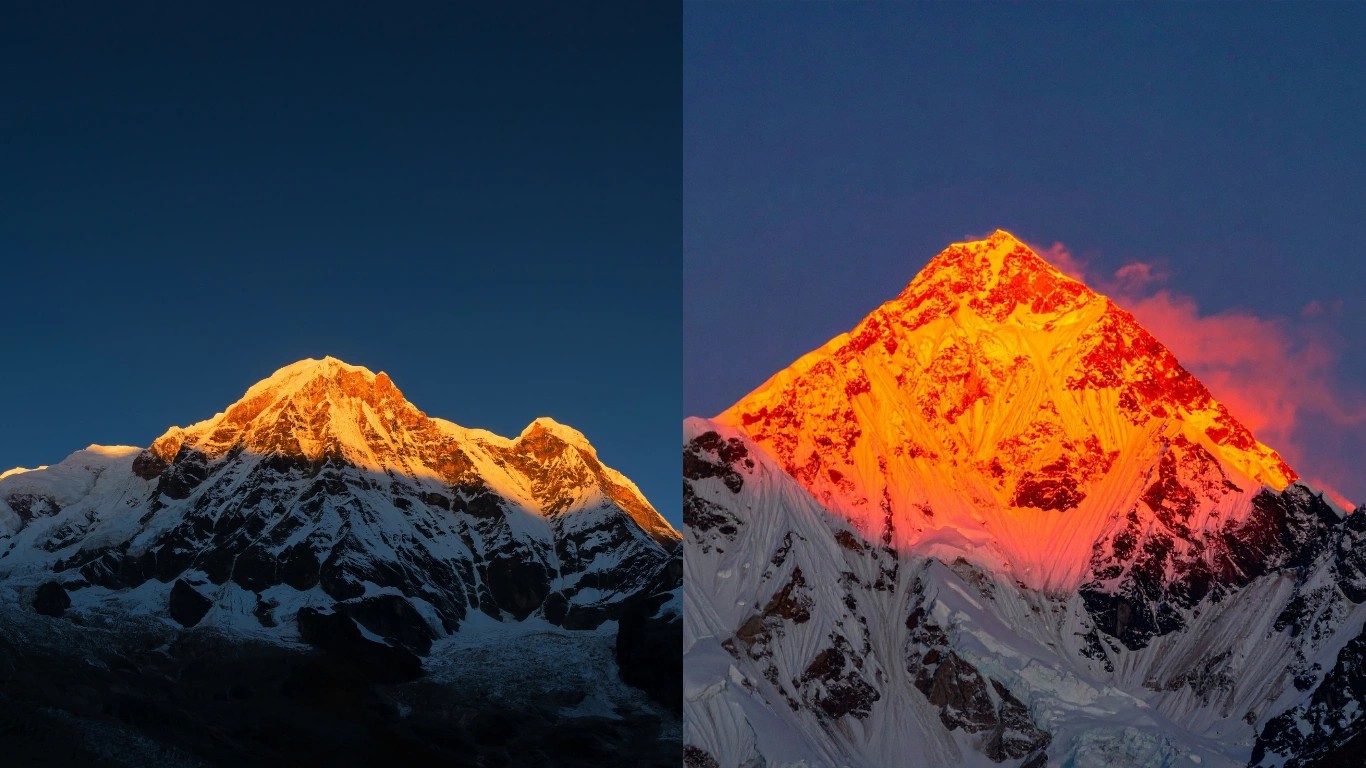
Sunrise at base camp — the sun rises behind Fishtail and hits Annapurna South directly
The world's largest rhododendron forest between Ulleri, Ghorepani, and Tadapani — pink blooms between 2,500 m and 2,880 m
Poon Hill sunrise — Dhaulagiri, Annapurna South, Annapurna Fang, Nilgiri, and Machhapuchhre catching morning light one by one
Tolyong mirror lake at 3,980 m reflecting Fishtail and Annapurna South
Jhinu Danda hot spring — natural geothermal pools beside the Modi Khola on the final evening
Machhapuchhre (Fishtail) — the unclimbed sacred mountain visible from multiple viewpoints throughout the trek
Everest Base Camp Trek — 6 highlights:
The Lukla flight — 35 minutes between Himalayan walls into the world's most dramatic airport
Namche Bazaar — one of the most beautiful villages anywhere in Nepal, the cultural heart of the Khumbu
Tengboche Monastery — peaceful, working Buddhist monastery at 3,860 m with direct views of Ama Dablam
Dingboche at 4,410 m — the highest-altitude Sherpa village trekkers visit, with sweeping views of Ama Dablam and Everest from above
Reaching Everest Base Camp at 5,364 m — standing at the foot of the world's tallest mountain
Kala Patthar sunset at 5,545 m — Everest, Nuptse, and Lho La turn golden in the evening light
An important point to take note of on Kala Patthar is that most websites suggest that you do Kala Patthar at sunrise. We recommend sunset. It is because of the geographical situation that the sun rises behind Everest at sunrise, leaving the mountain in shadow. When the sun is setting, the sun beam falls across the entire face of the summit, making Everest, Nuptse and Lho La gold. The sunset time is more pleasant than the 4 AM hike up, and the trail is far less busy.
Can You See Everest from Annapurna Base Camp?
No, you cannot see Mount Everest from Annapurna Base Camp. The two mountains are separated by approximately 240 km of Himalayan terrain with multiple high ranges in between. From ABC you see Annapurna South (7,219 m) directly above, Annapurna I (8,091 m) across the glacier, plus Hiunchuli, Annapurna Fang, and Machhapuchhre. To see Everest, you must trek the EBC route in the Khumbu region — a separate expedition entirely.
Annapurna vs Everest Death Rate — Climbing vs Trekking Reality
The "Annapurna vs Everest death rate" question is one of the most misunderstood searches in Nepal trekking. The answer depends entirely on whether you are climbing the summit or trekking to base camp.
Climbing the summits (mountaineering expeditions):
Annapurna I summit: Approximately 32% fatality rate — the highest of any 8,000 m peak. Avalanche risk, unpredictable weather, and technical difficulty make this one of the most dangerous mountains on earth.
Everest summit: Approximately 1-3% fatality rate per expedition season — much lower than Annapurna I despite being higher. Better-developed routes and oxygen support contribute to the lower rate.
Trekking to base camp (what 99% of visitors do):
Annapurna Base Camp Trek: Extremely safe. Maximum altitude of 4,130 m is well below the altitude sickness threshold. Majestic Trails Nepal has not recorded a serious altitude sickness incident on ABC in 10+ years of guiding.
Everest Base Camp Trek: Safe with proper acclimatization. The 5,364 m altitude requires the body to adjust correctly. Our 85% completion rate reflects altitude challenges — but altitude sickness on EBC, when properly managed, almost never escalates to dangerous levels.
The critical distinction: When you read "Annapurna is the deadliest mountain," that refers to mountaineers climbing the 8,091 m summit. Trekking to base camp at 4,130 m carries none of those risks. The two activities share a name only.
Annapurna Circuit vs Everest Base Camp
The Annapurna Circuit is a different trek from Annapurna Base Camp. Comparing the Annapurna Circuit to EBC is a different conversation.
Annapurna Circuit overview:
14-21 days circumnavigating the Annapurna massif
Crosses Thorong La Pass at 5,416 m — the highest point
Passes through 7 distinct ecological zones from subtropical forest at 800 m to high alpine desert above 4,000 m
Includes Mustang section after Muktinath — Tibetan-influenced culture, rain shadow geography
Annapurna Circuit vs EBC — key differences:
Factor
Annapurna Circuit
Everest Base Camp
Duration
14-21 days
14 days
Max altitude
5,416 m (Thorong La)
5,545 m (Kala Patthar)
Landscape
7 ecological zones, full diversity
Khumbu valley, Sherpa highlands
Cultural depth
Hindu villages to Tibetan Buddhist Mustang
Sherpa Buddhist throughout
Pass crossing
Yes, single hard day at Thorong La
No high pass — gradual altitude gain
Access
Drive from Pokhara, full road network
Lukla flight required
Which is better — Annapurna Circuit or EBC?
The Annapurna Circuit is the best for variety of landscape. The hike covers a range of habitats, from subtropical forest to alpine desert, in one hike. This is the most diverse trek in Nepal.
A true iconic experience for EBC. There is nothing like the Lukla flight, the villages of the Khumbu, the monastery at Tengboche or standing at the base of Everest.
If you are looking for a variety of trekking experiences, a long trek and the Mustang rain shadow culture, then choose Annapurna Circuit. If you wish to get the world famous trek with rich Sherpa culture, then opt for EBC.
Decision Matrix — Which Should You Book?
Your Profile
Recommended Trek
First Himalayan trek of your life
EBC — once-in-a-lifetime trek deserves the iconic option
Limited time (under 10 days)
ABC — shorter completion possible
Strict budget (under USD 1,200)
ABC — significantly cheaper
Cannot fly to Lukla
ABC — drive-accessible
Want maximum cultural depth
EBC — Namche, Tengboche, Sherpa villages
Want to avoid 2026 crowding
EBC — better infrastructure
Photographer
EBC — more iconic mountains, golden Kala Patthar sunset
Trekking with children
ABC — lower altitude is safer for kids
Older trekker (60+)
EBC if fit, ABC if untrained
Cold-sensitive
ABC — lower altitude means warmer nights
Want a green, quiet trek
EBC in monsoon — different vibe entirely
Bucket list goal
EBC — only one trek qualifies as bucket list
The Final Verdict — Which Trek Should You Book?
If you want the honest answer from operators who have guided both treks 85 times combined over the past decade: book Everest Base Camp in 2026.
EBC delivers the iconic Himalayan experience, the cultural immersion of Namche Bazaar and Tengboche Monastery, the Sherpa highlands at Dingboche, and the unforgettable sunset light on Everest from Kala Patthar. The infrastructure handles the crowds better than ABC currently does, and the trek leaves trekkers with the experience they came to Nepal for.
ABC remains the right choice for trekkers with limited time, strict budgets, or a firm refusal to fly to Lukla. It is not a bad trek — it is simply no longer the better trek for most people in 2026.
We help trekkers choose the trek that matches their reality — not the one a generic blog said they should book.
Frequently Asked Questions
Everest Base Camp is better in 2026 for almost every trekker. ABC has become severely overcrowded after Sinuwa with shared room obligations and packed dining halls. EBC offers equivalent fame with better infrastructure plus Namche Bazaar and Tengboche Monastery cultural depth.
Yes, a complete beginner can finish ABC with 8-12 weeks of stair-climbing and cardio preparation. The trek reaches only 4,130 m, the trail is well-established, and no technical skills are required. The 2026 crowding may impact experience quality for beginners expecting solitude.
Everest Base Camp is harder than Annapurna Base Camp. EBC challenges trekkers with altitude — 5,545 m at Kala Patthar versus 4,130 m at ABC. ABC challenges trekkers with stairs and knee strain on descent. Statistically EBC has a 10-percentage-point lower completion rate (85% vs 95%).
Yes, EBC is harder than ABC primarily because of altitude. The 1,234 m higher base camp altitude on EBC, plus the 5,545 m Kala Patthar viewpoint, demand proper acclimatization that ABC does not. ABC has its own difficulty in stairs but the body recovers faster from physical fatigue than from altitude exposure.
EBC is more expensive than ABC by approximately USD 560 per trekker. ABC packages from Majestic Trails Nepal start at USD 940 while EBC packages start at USD 1,500. The cost difference reflects mandatory Lukla flights, longer logistics, and higher-altitude operating costs.
No, you cannot see Everest from Annapurna Base Camp. The two mountains are 240 km apart with multiple high mountain ranges between them. From ABC you see Annapurna South, Annapurna I, Hiunchuli, Annapurna Fang, and Machhapuchhre — but not Everest.
ABC and EBC are approximately 240 km apart in a straight line. There is no trail connection between the two — they are in separate regions of Nepal (Annapurna in Gandaki Pradesh, Everest in Bagmati Pradesh). Trekkers wanting to do both must return to Kathmandu between them.
EBC first if you have 14 days available. Our 2026 recommendation: do the better trek first while you have the time and energy. ABC remains a strong second-trip option if you return to Nepal.
ABC has a higher completion rate (95% vs 85%) due to lower altitude. Both treks are safe with proper guides and acclimatization. The "Annapurna death rate" statistic refers to mountaineers climbing Annapurna I summit (32% fatality) — not trekkers reaching base camp at 4,130 m.
Yes, the combined ABC and EBC itinerary takes approximately 24-28 days including transport between regions. Most trekkers book this as a single extended expedition with rest days in Kathmandu and Pokhara between the two treks.
Related Travel Blogs
Join our Newsletter
Sign up to stay updated with latest offers, recent events and more news.