[{"name":"Langtang Valley Trek \u2014 10 Days","duration":"10","image_url":"https:\/\/www.majestictrailsnepal.com\/storage\/trip-galleries\/1\/thumb_e7907ed736676d12e6ab17328008e746.webp","offer_price":null,"url":"https:\/\/www.majestictrailsnepal.com\/trips\/langtang-valley-trek"},{"name":"Everest Base Camp Trek","duration":"14","image_url":"https:\/\/www.majestictrailsnepal.com\/storage\/trip-galleries\/2\/thumb_4b769c9c4b5b007a61f4ce3b76ff440d.webp","offer_price":null,"url":"https:\/\/www.majestictrailsnepal.com\/trips\/everest-base-camp-trek"},{"name":"Everest Panorama Trek","duration":"9","image_url":"https:\/\/www.majestictrailsnepal.com\/storage\/trip-galleries\/3\/thumb_e6ee74caea3e2900c23ca370b06bab80.webp","offer_price":null,"url":"https:\/\/www.majestictrailsnepal.com\/trips\/everest-panorama-trek"},{"name":"Annapurna Base Camp Trek","duration":"14","image_url":"https:\/\/www.majestictrailsnepal.com\/storage\/trip-galleries\/4\/thumb_3f8d40f9472f701d7c46a827925201bc.webp","offer_price":null,"url":"https:\/\/www.majestictrailsnepal.com\/trips\/annapurna-base-camp-trek"},{"name":"Annapurna Base Camp Express Trek","duration":"9","image_url":"https:\/\/www.majestictrailsnepal.com\/storage\/trip-galleries\/5\/thumb_bac80de2bd257d651fa75d9c8025da1a.webp","offer_price":null,"url":"https:\/\/www.majestictrailsnepal.com\/trips\/annapurna-base-camp-express-trek"},{"name":"Annapurna Circuit Trek","duration":"15","image_url":"https:\/\/www.majestictrailsnepal.com\/storage\/trip-galleries\/6\/thumb_b73bdec74acacaa0d72a2a2a513f3d4a.webp","offer_price":null,"url":"https:\/\/www.majestictrailsnepal.com\/trips\/annapurna-circuit-trek"},{"name":"Ghorepani Poon Hill Trek","duration":"8","image_url":"https:\/\/www.majestictrailsnepal.com\/storage\/trip-galleries\/7\/thumb_aeda9e6388ab2692138cc9c9efa81a7f.webp","offer_price":null,"url":"https:\/\/www.majestictrailsnepal.com\/trips\/ghorepani-poon-hill-trek"},{"name":"Mardi Himal Trek \u2014 9 Days","duration":"9","image_url":"https:\/\/www.majestictrailsnepal.com\/storage\/trip-galleries\/8\/thumb_c511ee87ecab8ff015210dd647392d66.webp","offer_price":null,"url":"https:\/\/www.majestictrailsnepal.com\/trips\/mardi-himal-trek"},{"name":"Manaslu Circuit Trek","duration":"15","image_url":"https:\/\/www.majestictrailsnepal.com\/storage\/trip-galleries\/9\/thumb_7726908390ad6b249f2f6a7856f9dc17.webp","offer_price":null,"url":"https:\/\/www.majestictrailsnepal.com\/trips\/manaslu-circuit-trek"},{"name":"Upper Mustang Trek","duration":"16","image_url":"https:\/\/www.majestictrailsnepal.com\/storage\/trip-galleries\/10\/thumb_6a9b52ecd1d8cda92d594e5351431d6e.webp","offer_price":null,"url":"https:\/\/www.majestictrailsnepal.com\/trips\/upper-mustang-trek"},{"name":"Pokhara City Tour","duration":"1","image_url":"https:\/\/www.majestictrailsnepal.com\/storage\/trip-galleries\/11\/thumb_cf762ba4c20363bd1c0f239db35fcc84.webp","offer_price":null,"url":"https:\/\/www.majestictrailsnepal.com\/trips\/pokhara-city-tour"},{"name":"Paragliding in Pokhara","duration":"1","image_url":"https:\/\/www.majestictrailsnepal.com\/storage\/trip-galleries\/12\/thumb_b896201edf88bbe0f570e876c3c337a3.webp","offer_price":70,"url":"https:\/\/www.majestictrailsnepal.com\/trips\/paragliding-in-pokhara"},{"name":"Kathmandu City Tour","duration":"2","image_url":"https:\/\/www.majestictrailsnepal.com\/storage\/trip-galleries\/13\/thumb_846ad05bd3ce7bebb3843c24c08db6f9.webp","offer_price":null,"url":"https:\/\/www.majestictrailsnepal.com\/trips\/kathmandu-city-tour"},{"name":"Lumbini Buddhist Pilgrimage Tour","duration":"4","image_url":"https:\/\/www.majestictrailsnepal.com\/storage\/trip-galleries\/14\/a2998dca0ce22f28a61c3862dd47f6a3.webp","offer_price":null,"url":"https:\/\/www.majestictrailsnepal.com\/trips\/lumbini-buddhist-pilgrimage-tour"},{"name":"5 days langtang valley trek","duration":"5","image_url":"https:\/\/www.majestictrailsnepal.com\/storage\/trip-galleries\/15\/thumb_7a6c65c139b8085d220ac01913cb1448.webp","offer_price":510,"url":"https:\/\/www.majestictrailsnepal.com\/trips\/5-days-langtang-valley-trek"},{"name":"Leisure Port Nepal Price: Rafting and Camping Adventure","duration":"7","image_url":"https:\/\/www.majestictrailsnepal.com\/storage\/trip-galleries\/17\/thumb_02cb8c3f0697c7c5c4f73d744b47d87f.webp","offer_price":550,"url":"https:\/\/www.majestictrailsnepal.com\/trips\/leisure-port-nepal-price-rafting-and-camping-adventure"},{"name":"10 days spiritual tour in Nepal","duration":"10","image_url":"https:\/\/www.majestictrailsnepal.com\/storage\/trip-galleries\/18\/thumb_b4e7eba000673d1bce6b56abb422fe3b.webp","offer_price":1200,"url":"https:\/\/www.majestictrailsnepal.com\/trips\/10-days-spiritual-tour-in-nepal"},{"name":"Annapurna Circuit Short Trek","duration":"10","image_url":"https:\/\/www.majestictrailsnepal.com\/storage\/trip-galleries\/19\/thumb_769ee8cbe02a510d8db76419c97a2dc9.webp","offer_price":null,"url":"https:\/\/www.majestictrailsnepal.com\/trips\/annapurna-circuit-short-trek"},{"name":"Best Short Manaslu Circuit Trek","duration":"11","image_url":"https:\/\/www.majestictrailsnepal.com\/storage\/trip-galleries\/20\/thumb_ac1b4977a3fce9d11ee68240cad675b6.webp","offer_price":null,"url":"https:\/\/www.majestictrailsnepal.com\/trips\/best-short-manaslu-circuit-trek"},{"name":"Langtang Gosaikunda Trek","duration":"13","image_url":"https:\/\/www.majestictrailsnepal.com\/storage\/trip-galleries\/22\/thumb_577a6402f2ca4b3f12bfd80b96b33a23.webp","offer_price":940,"url":"https:\/\/www.majestictrailsnepal.com\/trips\/langtang-gosaikunda-trek"},{"name":"3 Passes Trek Nepal","duration":"22","image_url":"https:\/\/www.majestictrailsnepal.com\/storage\/trip-galleries\/24\/thumb_8020edea67aefce87e9012dc89a60087.webp","offer_price":null,"url":"https:\/\/www.majestictrailsnepal.com\/trips\/3-passes-trek-nepal"},{"name":"Tsum Valley Trek","duration":"13","image_url":"https:\/\/www.majestictrailsnepal.com\/storage\/trip-galleries\/25\/thumb_194c03e3c3463dff07a3f621a81ef9ea.webp","offer_price":null,"url":"https:\/\/www.majestictrailsnepal.com\/trips\/tsum-valley-trek"},{"name":"Gokyo and Renjo La Pass Trek","duration":"14","image_url":"https:\/\/www.majestictrailsnepal.com\/storage\/trip-galleries\/26\/thumb_7b865f0f0d0d4c6807b625b6e391b56d.webp","offer_price":1490,"url":"https:\/\/www.majestictrailsnepal.com\/trips\/gokyo-and-renjo-la-pass-trek"},{"name":"Honeymoon Tour in Nepal","duration":"9","image_url":"https:\/\/www.majestictrailsnepal.com\/storage\/trip-galleries\/27\/thumb_dabf449c090bb16efd5823c653eb61b3.webp","offer_price":null,"url":"https:\/\/www.majestictrailsnepal.com\/trips\/honeymoon-tour-in-nepal"},{"name":"Pikey Peak Trek","duration":"10","image_url":"https:\/\/www.majestictrailsnepal.com\/storage\/trip-galleries\/28\/thumb_5425e57ce3ea84d31a7b24b83b1af94f.webp","offer_price":1090,"url":"https:\/\/www.majestictrailsnepal.com\/trips\/pikey-peak-trek"},{"name":"Makalu Base Camp Trek","duration":"17","image_url":"https:\/\/www.majestictrailsnepal.com\/storage\/trip-galleries\/29\/thumb_d68c8ec6492540c922045d825a38cd50.webp","offer_price":null,"url":"https:\/\/www.majestictrailsnepal.com\/trips\/makalu-base-camp-trek"},{"name":"Nepal Winter Tour","duration":"8","image_url":"https:\/\/www.majestictrailsnepal.com\/storage\/trip-galleries\/30\/thumb_c8491c0c4b1fb19d8e93630866895799.webp","offer_price":null,"url":"https:\/\/www.majestictrailsnepal.com\/trips\/nepal-winter-tour"},{"name":"Maratika Tour in Nepal","duration":"6","image_url":"https:\/\/www.majestictrailsnepal.com\/storage\/trip-galleries\/31\/thumb_97948560c5a12a486f9ac2b76567cafd.webp","offer_price":null,"url":"https:\/\/www.majestictrailsnepal.com\/trips\/maratika-tour-in-nepal"},{"name":"Nepal Lake Trek","duration":"14","image_url":"https:\/\/www.majestictrailsnepal.com\/storage\/trip-galleries\/32\/thumb_d9b260fe13127816f5b3c25447caf70c.webp","offer_price":null,"url":"https:\/\/www.majestictrailsnepal.com\/trips\/nepal-lake-trek"},{"name":"Taste of Nepal Tour Package","duration":"9","image_url":"https:\/\/www.majestictrailsnepal.com\/storage\/trip-galleries\/33\/thumb_f4b55ab5760a8e057b4c3e208e25ab36.webp","offer_price":null,"url":"https:\/\/www.majestictrailsnepal.com\/trips\/taste-of-nepal-tour-package"},{"name":"Poon Hill Yoga Trek in Nepal","duration":"9","image_url":"https:\/\/www.majestictrailsnepal.com\/storage\/trip-galleries\/34\/thumb_904b238e690107c5c9b1092296880cc9.webp","offer_price":null,"url":"https:\/\/www.majestictrailsnepal.com\/trips\/poon-hill-yoga-trek-in-nepal"},{"name":"Nar Phu Nepal Trek","duration":"10","image_url":"https:\/\/www.majestictrailsnepal.com\/storage\/trip-galleries\/35\/thumb_f959e3e22c260629add0ba61a4038812.webp","offer_price":null,"url":"https:\/\/www.majestictrailsnepal.com\/trips\/nar-phu-nepal-trek"},{"name":"Annapurna Base Camp Helicopter Tour","duration":"1","image_url":"https:\/\/www.majestictrailsnepal.com\/storage\/trip-galleries\/36\/thumb_e81861e8772a9d7fac92ab4a7d43e3bf.webp","offer_price":null,"url":"https:\/\/www.majestictrailsnepal.com\/trips\/annapurna-base-camp-helicopter-tour"},{"name":"Annapurna Circuit with Nar Phu Valley Trek","duration":"16","image_url":"https:\/\/www.majestictrailsnepal.com\/storage\/trip-galleries\/38\/thumb_b70692cbd1c1dd772587c940be2d0bc9.webp","offer_price":null,"url":"https:\/\/www.majestictrailsnepal.com\/trips\/annapurna-circuit-with-nar-phu-valley-trek"}]
Nepal Flood August 2026: Complete Safety Update for Trekkers and Tourists
Nepal remains safe for most tourism destinations following the August 26, 2026 flood. The Everest Base Camp region, Annapurna region, Kathmandu Valley, Pokhara, and Chitwan are unaffected and operating normally. The Langtang region and Rasuwa district near the Nepal-Tibet border have been directly impacted and are currently not recommended for travel.
If you have a trek booked in Nepal, are planning one, or have a family member currently trekking here — this guide is for you. What follows is the honest, verified situation as of August 27, 2026. Not marketing spin. Not vague reassurances. Just what you need to make informed decisions.
Quick Safety Reference
Region
Current Status
Guidance
Kathmandu Valley
Fully Safe
Travel normally
Everest Region
Fully Safe
All treks operating
Annapurna Region
Fully Safe
All treks operating
Manaslu Region
Fully Safe
All treks operating
Pokhara
Safe (fly instead of drive)
Take domestic flight
Chitwan
Safe (fly instead of drive)
Take domestic flight
Langtang Region
Not Recommended
Postpone treks
Rasuwa District
Do Not Travel
Border area destroyed
Nuwakot (downstream)
Affected
Avoid
Nepal Tourism Board emergency contacts: Toll-free 1234, Hotline 1144, Tourist Police +977 9851289445. If you or someone you know is stranded, call these numbers immediately. As of August 27, Nepal Tourism Board reports 403 tourists still out of contact.
What Happened on August 26, 2026 in Nepal
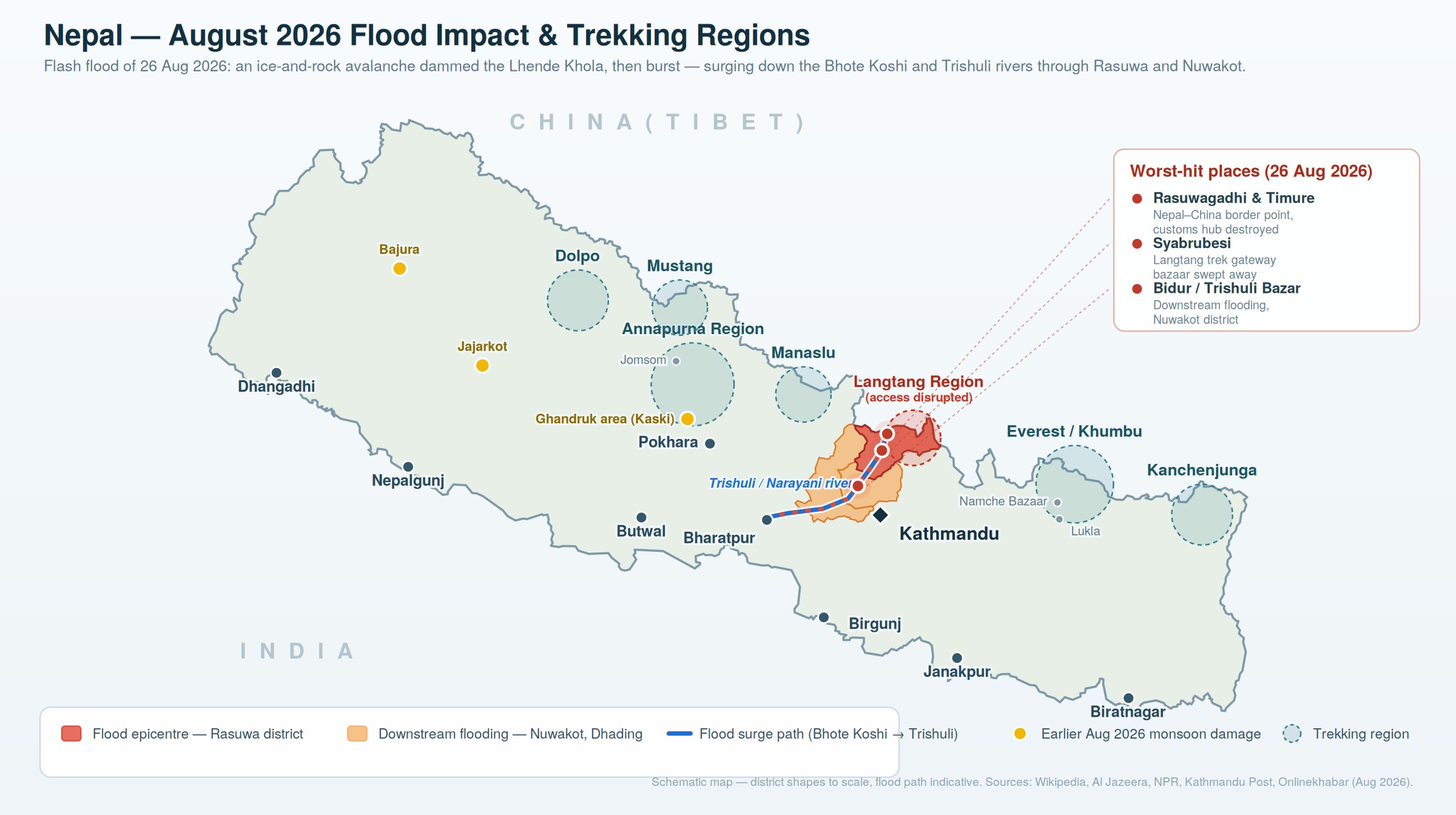
A clear map of Nepal showing the affected places by the flood 2026.
On Wednesday morning at approximately 9:00 AM local time, a massive glacial ice and rock landslide on the Tibetan side of the border collapsed into the Lhende Khola River, a tributary of the Bhotekoshi. The resulting flash flood tore down the gorge with terrifying force, sweeping away the Rasuwagadhi border checkpoint, bridges, hydropower plants, and villages along the Bhotekoshi River corridor in Nepal.
Water levels on the Trishuli River rose by as much as nine meters — 27 feet — in half an hour. The US Geological Survey initially reported the shaking as a 4.4 magnitude earthquake, then later clarified it was the landslide itself, generating shaking equivalent to a 5.2 magnitude earthquake. Climate experts at the Kathmandu-based International Centre for Integrated Mountain Development have said an avalanche from a glacier likely caused the flood wave.
The Scientific Explanation
This was a Glacial Lake Outburst Flood (GLOF) — a phenomenon that occurs when a glacial lake bursts through its natural dam, or when a landslide or avalanche of ice and rock falls into a river system and creates a sudden massive wall of water and debris. The event on August 26 combined elements of both.
Climate change is making these events more frequent in the Himalayas. As glaciers retreat, they leave behind unstable moraines and unstable rock and ice formations. Warmer temperatures accelerate melting and destabilize slopes that were previously frozen year-round. The Bhotekoshi River has now been hit by a major flood event twice in 14 months — a pattern that Himalayan climate scientists have been warning about for years.
Nepal's monsoon season (June through September) also concentrates rainfall in ways that increase flood risk. Combined events like a glacial collapse during monsoon are particularly devastating.
Current Confirmed Impact
As of August 27, 2026, the verified situation is:
162+ confirmed deaths in Nepal (rising as recovery continues)
403 tourists out of contact per Nepal Tourism Board — this is a communication-verification count, not a death toll
Foreign nationals affected include: 105+ Indians, 37 non-resident Indians, 34 Australians, 33 Americans, 12 UK citizens, plus nationals from Malaysia, South Africa, Netherlands, Russia, and South Korea
6 major hydropower and transmission facilities damaged
42-kilometer road linking Betrawati to Rasuwagadhi destroyed
Multiple concrete bridges swept away
Nepal-Tibet border crossing at Rasuwagadhi: destroyed
Rescue operations continue, coordinated by the Nepali Army, Nepal Police, and international support including the Indian Air Force and US Disaster Assistance Response teams. Nepal's Prime Minister has consulted with parliamentarians from the affected districts of Rasuwa, Nuwakot, Dhading, Gorkha, and Chitwan.
Which Nepal Regions Are Completely Safe Right Now
The most important thing to understand is that the flood impact is geographically concentrated. Nepal is a large country with multiple mountain ranges, river systems, and trekking regions. The August 26 event affected one specific river corridor — the Bhotekoshi in Rasuwa district. Most of Nepal is completely unaffected.
Kathmandu Valley — Fully Safe
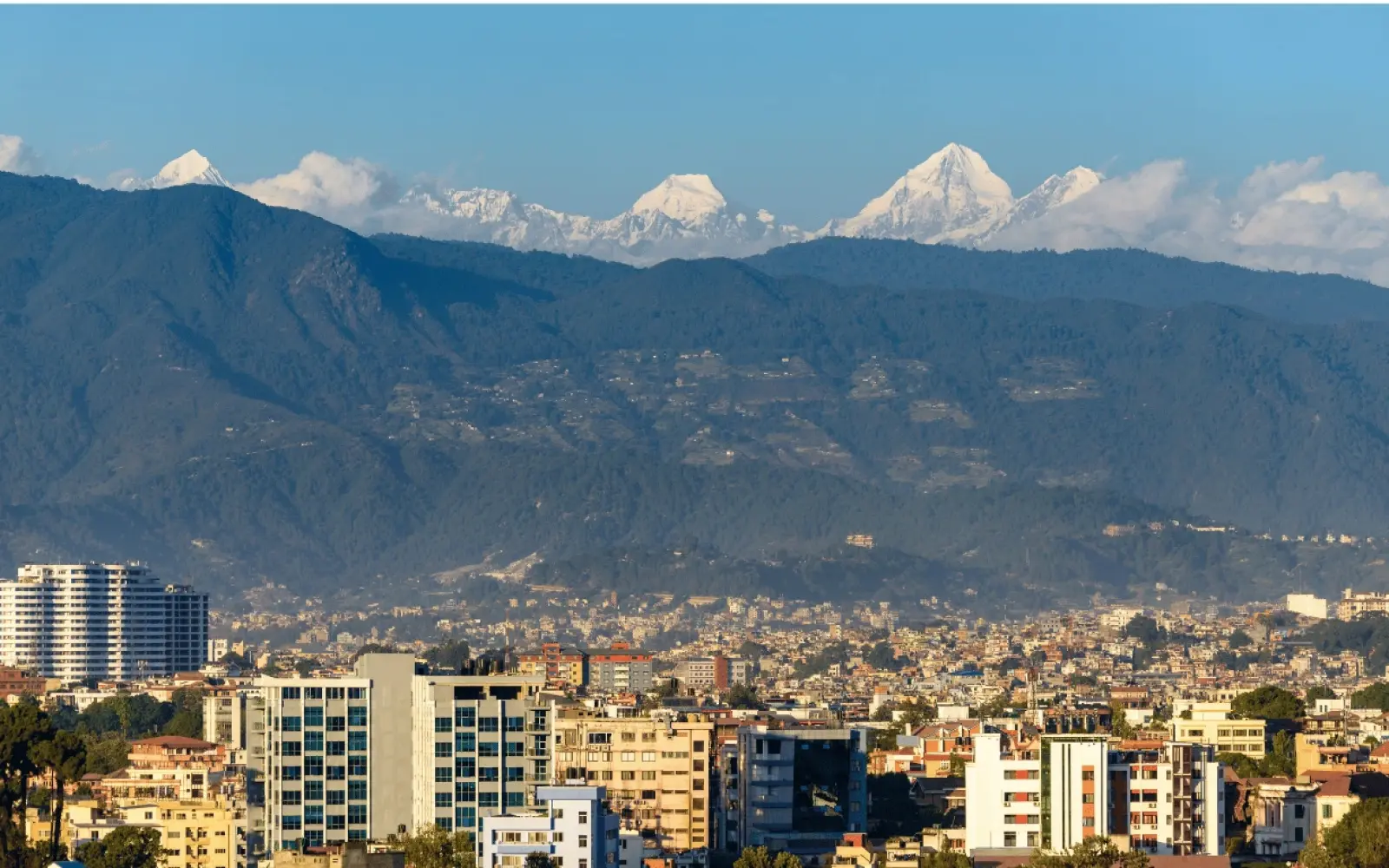
Kathmandu itself is completely safe. The capital sits at 1,400 meters in a valley well away from the flood-affected areas. Tribhuvan International Airport is operating normally with all international flights on schedule. Qatar Airways, Turkish Airlines, Emirates, FlyDubai, and other major carriers are running regular routes without disruption.
All UNESCO World Heritage sites in the valley remain open: Kathmandu Durbar Square, Swayambhunath, Boudhanath, Pashupatinath, Patan Durbar Square, and Bhaktapur Durbar Square. Thamel — the tourist district where our office is located — is fully operational. Hotels, restaurants, and cultural experiences are running normally. Ground transportation within the valley is unaffected.
If you're arriving in Kathmandu for a trek or tour, everything about your Kathmandu experience will be normal. The city is not in crisis.
Everest Base Camp Region — Fully Safe
The Everest region is located over 200 kilometers east of the flood-affected areas, in an entirely different watershed. All trails are unaffected. Flights to Lukla (via Ramechhap during peak season) are operating normally. Every teahouse from Phakding to Everest Base Camp is functioning normally. Namche Bazaar, Dingboche, Lobuche, Gorak Shep — all accessible and operating.
If you have an Everest Base Camp trek booked, it proceeds exactly as scheduled. Our guests currently on the trail have reported no impact whatsoever. The mountains, the teahouses, the local Sherpa communities — everything continues as normal.
Annapurna Region — Fully Safe
The Annapurna region is west of the flood-affected areas. Annapurna Base Camp, Annapurna Circuit, Ghorepani Poon Hill, Mardi Himal — all treks operating normally. Pokhara-Jomsom flights resumed on August 26. Upper Mustang treks are running.
The trails, teahouses, transportation to trailheads, and permit processing are all functioning normally in the Annapurna region.
Manaslu Region — Fully Safe
This is important because people sometimes confuse Manaslu with the affected Rasuwa region since both are in western-central Nepal. They are different. The Manaslu Circuit Trek accesses the trailhead via Arughat in Gorkha district — not via the affected Rasuwa. Trail conditions on the Manaslu Circuit are normal. Restricted-area permit processing continues normally.
Pokhara and Chitwan — Safe as Destinations
The cities and parks themselves are completely unaffected. Pokhara remains beautiful. Phewa Lake, Sarangkot, the World Peace Pagoda, and all Pokhara experiences are operating normally. Chitwan National Park, its jungle safaris, elephant experiences, and Tharu cultural programs are all running.
The complication is road access from Kathmandu. The Prithvi Highway that connects Kathmandu to both Pokhara and Chitwan has been affected by the wider flooding along the Trishuli River corridor. Traffic police halted public transport as a precaution. But domestic flights are operating normally — Kathmandu to Pokhara takes 25 minutes and costs approximately USD 120-140, and Kathmandu to Bharatpur (for Chitwan) is similar.
Our recommendation: if you have Pokhara or Chitwan on your itinerary, take the flight. The road situation should improve within a week or two, but flying is safer and faster right now.
Which Areas Are Currently Affected
We won't sugarcoat this. Some areas were hit hard, and it would be dishonest to pretend otherwise.
Langtang Region — Not Recommended
Syabrubesi, the main gateway town for the entire Langtang region, has suffered significant flood damage. The Pasang Lhamu Highway that connects Kathmandu to Syabrubesi has been damaged at multiple sections. Buses and public transport from Kathmandu to Rasuwa and Nuwakot have been halted.
The upper Langtang Valley trails themselves are largely intact — the flood was concentrated along the Bhotekoshi River corridor. But getting there requires the road access that is currently closed. Trekkers currently in the Langtang Valley are safe if they follow proper alternative exit routes (we've written a separate guide on this).
Nepal Tourism Board has specifically advised postponing all travel to the Galchhi–Nuwakot–Rasuwa–Syabrubesi corridor. Realistic estimates for when normal access might be restored range from several weeks to months for basic road access, and longer for full restoration of Syabrubesi.
If you have a Langtang trek booked in the next 30 days, contact your operator now to arrange postponement or alternatives. If your Langtang trek is booked for October or later, the situation may improve significantly by then — but we're monitoring daily and will provide updates.
Rasuwa District — Do Not Travel
The Rasuwagadhi border checkpoint has been destroyed. The Nepal-Tibet border crossing is closed. Timure village near the border has been heavily damaged. The Bhotekoshi River corridor from Timure through Syabrubesi is not safe or accessible.
Nepal government has restricted access to this area to allow rescue and recovery operations to continue. Do not attempt to travel here under any circumstances.
Nuwakot District — Downstream Damage
The floodwaters flowed downstream through the Bhotekoshi into the Trishuli River system. Visible impacts have been reported at Trishuli Bazaar and Devghat area. Homes were damaged. The situation here is not as severe as in Rasuwa, but the area is still affected and not recommended for travel.
Current Highway and Transportation Status
Here's the honest picture of Nepal's transportation network as of August 27, 2026.
International flights to Kathmandu are operating normally. Tribhuvan International Airport is fully functional. If you have a flight to Nepal booked, it will proceed as scheduled. All major international carriers are on their regular schedules.
Domestic flights are the safest way to move around Nepal right now. Kathmandu-Lukla flights for Everest region trekkers are running normally. Kathmandu-Pokhara is operating with multiple daily departures. Kathmandu-Bharatpur for Chitwan is operating. Pokhara-Jomsom for Upper Mustang resumed on August 26. If you're planning to move between Nepal's tourism cities, fly.
Highway status is where the real disruption is happening. The Prithvi Highway from Kathmandu toward Pokhara and Chitwan is currently restricted. Traffic police have halted public transport as a precaution. The Pasang Lhamu Highway to Rasuwa is destroyed at multiple sections. The BP Highway has nighttime travel bans in effect due to landslide risk from continuing monsoon rains. The Muglin-Narayangadh road section has been affected by flooding.
Nepal Tourism Board has issued official advisories to avoid the Prithvi Highway, the Galchhi-Nuwakot-Rasuwa-Syabrubesi corridor, and the Muglin-Narayangadh road. They advise tourists to postpone travel through these corridors until authorities confirm road safety.
Our Majestic Trails Nepal advisory aligns with this: avoid road travel on the Prithvi Highway for the next several days at minimum. Take domestic flights instead. If you must travel by road, wait for official confirmation that specific routes are clear.
How Majestic Trails Nepal Responded to the August 2026 Flood
I want to be transparent about what we've done since the flood struck. This isn't marketing — it's how we believe a legitimate Nepal operator should respond during a crisis.
Our Immediate Response
Within four hours of the flood on August 26, our team completed an assessment of every trekking region we operate in. By 10:00 AM local time, we had confirmed that all Everest, Annapurna, Manaslu, and Mustang treks were unaffected. Every guest with a trek in our upcoming 30-day window received a direct WhatsApp message from our team before the end of the day.
For guests with Langtang treks scheduled in the coming weeks, we activated our emergency protocol immediately — reaching out personally, explaining the situation honestly, and offering options.
Contacting Every Booked Guest Personally
Every single one of our booked guests received personal WhatsApp or email communication within 24 hours of the flood. Not an automated message, not a generic template — a real message from a real person on our team, with their specific situation assessed.
For guests with treks in unaffected regions, we confirmed their trek would proceed as normal and provided updated flight recommendations to avoid road transport where appropriate. For guests with Langtang bookings, we discussed alternatives individually.
What We Did for Langtang Guests
Direct communication with each affected guest was our first priority. Then we offered options.
We offered free trip postponement for up to 12 months from the original booking date, with no fees. For guests who wanted to still trek in Nepal but not in Langtang, we offered alternative treks at no additional cost — most commonly substituting to Annapurna Base Camp, Everest Panorama, or Mardi Himal depending on the trekker's fitness and preferences. For guests who needed to cancel entirely due to travel timing, we offered full refunds with no cancellation fees applied.
The principle is simple: we would not profit from a disaster. Our guests had planned and paid for something that is now temporarily not possible. Making it easy for them to postpone, substitute, or cancel is the right thing to do.
What We're Doing for Everest and Annapurna Guests
For guests with treks in unaffected regions, we confirmed that their trips proceed as scheduled. We updated our flight recommendations — where their itinerary included Kathmandu-Pokhara ground transport, we recommended switching to domestic flights and covered the difference in cost.
We added additional safety briefings that incorporate current road conditions and the broader situation. And we maintain 24/7 WhatsApp support during trips, which has always been our standard but takes on additional importance during a period of national emergency.
Our Position on Refunds and Postponements
Our position during this crisis is straightforward: free postponement policy for up to 12 months, no cancellation fees during the emergency period, full transparency on partial refunds where they apply, and complete documentation to support insurance claims.
We believe this should be industry standard during a declared emergency. Any Nepal operator refusing to offer reasonable flexibility to guests affected by a natural disaster is failing at basic professional ethics.
Real-Time Monitoring and Daily Updates
Our team is doing daily situation assessments — road conditions, weather updates, rescue operation progress, and the practical realities of getting around Nepal right now. We update our website as conditions change. Booked guests receive direct WhatsApp updates. Prospective travelers can get information from our social media updates and this blog, which will be updated as the situation evolves.
Why We're Sharing This Publicly
We're sharing this because honest, transparent communication is a commitment we've built our company around. It's also because we think other Nepal operators should be doing the same. If publicly sharing our crisis response encourages other operators to raise their standards, that's good for Nepal tourism as a whole.
We're also sharing this to help travelers who might not have booked with us yet make informed decisions. Whether you book with us or with another operator, you deserve honest information about what's happening in Nepal right now.
How to Evaluate a Nepal Trekking Company's Crisis Response
If you have a trip booked with any Nepal operator right now — not necessarily us — here's how to evaluate whether they're responding professionally.
Questions to Ask Your Nepal Operator Right Now
Have they contacted you directly since August 26? Legitimate operators should reach out to every guest with an upcoming booking within 24-48 hours of a major event.
Are they offering free postponement? During a declared emergency, this should be standard.
Do they have alternative trek options for affected regions? A legitimate operator with real relationships across Nepal should be able to substitute Langtang for Annapurna or Everest without complications.
Can they explain the current road situation accurately? Vague answers suggest they're not actually monitoring the situation.
Are they providing daily updates? During a fluid situation, weekly updates are not enough.
Red Flags to Watch For
Silence from your operator is the worst sign. If they haven't contacted you at all, they're either not monitoring the situation or they're avoiding difficult conversations. Neither is acceptable.
Generic "we're monitoring the situation" messages without specifics tell you nothing. Real monitoring produces real information.
Refusing to offer postponements during a natural disaster is a serious ethical failure. Contact Nepal Tourism Board if this happens.
Downplaying real risks or overselling safety in areas that are actually affected — both are red flags. Honest operators tell you the truth even when it's inconvenient for their booking numbers.
What Legitimate Operators Do During Emergencies
Contact every guest personally within 24-48 hours. Provide honest, specific assessments of each booking. Offer flexible rebooking without fees. Share verified information publicly. Support affected communities transparently.
If your operator is doing all of these things, you're in good hands. If they're not, consider whether they're the right operator for you long-term.
What to Do If You Have a Nepal Trip Booked
Depending on where your trip is, your action items differ.
If Your Booked Region Is Safe (Everest, Annapurna, Manaslu, Mustang)
Your trek will proceed as scheduled. No changes needed to your booking. Take domestic flights instead of road transport where recommended — specifically Kathmandu to Pokhara if your itinerary includes that leg. Bring standard travel insurance that includes helicopter evacuation and medical treatment. Contact your operator for the latest specific updates on your trek dates.
If you're feeling anxious despite being in an unaffected region, that's understandable. Reach out to your operator for reassurance. A good operator should be able to explain exactly why your specific trek is safe.
If Your Booked Region Is Affected (Langtang, Rasuwa)
Contact your operator immediately. Ask about free postponement options — 6 to 12 months is reasonable during a declared emergency. Consider alternative trek regions if you still want to trek in Nepal — Annapurna Base Camp and Mardi Himal are common substitutes for Langtang. Verify refund policies in writing before making decisions. Check your travel insurance coverage — most policies cover trip disruption due to natural disaster.
If your operator refuses to offer reasonable flexibility, that's a serious problem. Document their refusal in writing, contact Nepal Tourism Board, and consider filing a formal complaint. Your travel insurance may also cover cancellation in these circumstances.
If You Haven't Booked Yet But Want to Trek Nepal
Nepal is still open for tourism, and most trekking regions are completely unaffected. Book with licensed Nepal-based operators — verify their Company Registration Number, Tourism License, and Head Guide License before paying any deposit. Choose treks in unaffected regions such as Everest Base Camp, Annapurna Base Camp, Annapurna Circuit, Manaslu Circuit, or Upper Mustang. Purchase comprehensive travel insurance that specifically includes helicopter rescue coverage. Build some flexibility into your itinerary — an extra day in Kathmandu at the end of your trip is wise given the current situation.
Contact multiple operators before deciding. How they respond to your inquiries during this crisis period tells you a lot about how they'll treat you throughout your trip.
Alternative Nepal Treks (All Operating Normally)
If your Langtang trek needs an alternative, or you're planning a new Nepal trek and want to avoid the affected region, here are the operating alternatives.
Best Alternatives to Langtang Trek
Mardi Himal Trek (9 days) is our top recommendation as a Langtang substitute. Similar duration, similar difficulty level, but in the Annapurna region rather than the affected north. The views from Mardi Himal Base Camp at 4,500m are some of Nepal's best, and the trek passes through beautiful rhododendron forests. Fewer crowds than Poon Hill, more variety than a strict base camp trek.
Everest Panorama Trek (9 days) offers the Everest region experience without the high altitude of Base Camp. You'll reach Tengboche Monastery and Hotel Everest View at 3,880m, with spectacular views of Everest, Ama Dablam, Lhotse, and Nuptse. Well-suited for trekkers who wanted Langtang's moderate difficulty.
Ghorepani Poon Hill Trek (8 days) is Nepal's most accessible classic trek. Sunrise from Poon Hill viewpoint at 3,210m over the Annapurna and Dhaulagiri ranges is genuinely spectacular. Good for first-time trekkers or those who want a gentler alternative.
Best High-Altitude Alternatives
Everest Base Camp Trek (14 days) is Nepal's iconic high-altitude trek. If you're willing to extend your trip from a 10-day Langtang plan to a 14-day EBC, this substitution gives you the trek most people dream of. Trails, flights, and infrastructure operating completely normally.
Annapurna Base Camp Trek (14 days) is our second-most popular route. Beautiful cultural encounters through Gurung villages, dramatic amphitheater views at Base Camp, natural hot springs at Jhinu Danda on the return.
Manaslu Circuit Trek (15 days) is the remote, culturally rich alternative for experienced trekkers. Restricted area with strong Tibetan Buddhist influence. Less crowded than EBC or Annapurna Circuit. Access is via Arughat in Gorkha district, completely unaffected by the flood.
Best Cultural Tour Alternatives
If you'd prefer to visit Nepal but not trek during the current situation, our cultural tours are all fully operational.
Kathmandu City Tour (2-3 days) covers all seven UNESCO World Heritage sites in the Kathmandu Valley with expert cultural interpretation.
Pokhara City Tour (2 days) includes Phewa Lake, Sarangkot sunrise, World Peace Pagoda, and paragliding options. Reach Pokhara by domestic flight.
Chitwan Safari (2-3 nights) offers jungle safari, elephant experiences, Tharu cultural programs. Reach Chitwan by flight to Bharatpur.
Lumbini Pilgrimage (2-3 days) visits the birthplace of Buddha and the international Buddhist monasteries. Meaningful spiritual experience.
How to Support Affected Nepal Communities
If you want to help beyond your travel decisions, here are verified ways to support the affected communities.
Verified Ways to Help
Nepal Red Cross Society is coordinating disaster response and accepting donations for direct community support.
UNICEF Nepal is providing emergency shelter, clean water, and hygiene supplies to affected families. The US State Department has directed $500,000 through UNICEF and Catholic Relief Services.
Nepal Tourism Board relief coordination — the NTB is coordinating tourism industry response and can direct donations to community rehabilitation.
Local community-based organizations in the Rasuwa and Nuwakot districts are also accepting support, though we recommend donating through established, verified channels rather than social media fundraisers where funds cannot be verified.
How Continued Tourism Helps
The best support many travelers can offer is to continue their Nepal trips in unaffected regions. Tourism represents a significant portion of Nepal's economy, and the tourism industry employs many people from mountain communities including those affected by the flood.
Canceling a Nepal trip entirely because of the Rasuwa flood doesn't help anyone — it hurts the Nepal economy, hurts the guides and porters and hotel workers in unaffected regions who depend on tourism income, and doesn't help the affected communities in any way. Coming to Nepal, spending money in unaffected regions, and directly supporting the industry is a meaningful contribution.
What Not to Do
Don't donate to unverified fundraising campaigns on social media. Well-meaning individuals often share Facebook or GoFundMe links that may or may not actually support the affected communities. Stick to established channels.
Don't cancel your Nepal trip entirely if your booked region is unaffected. The people who depend on tourism income are exactly the people who are hurt when travelers overreact and cancel across the board.
Don't spread unverified information on social media. Nepal is dealing with a rescue operation, communication challenges, and rapidly changing conditions. Sharing inaccurate information — even with good intentions — can add to confusion and make things worse.
Frequently Asked Questions
Is it safe to visit Nepal right now?
Yes for most destinations. Kathmandu, Everest region, Annapurna region, Manaslu region, Upper Mustang, Pokhara, and Chitwan are all unaffected and operating normally. The Langtang region and Rasuwa district near the Tibet border are directly affected and not recommended for travel.
Is Everest Base Camp affected by the flood?
No. EBC is over 200 kilometers east of the flood-affected areas, in an entirely different watershed. Trails, flights, and all infrastructure are operating normally. Guests currently on EBC treks report no impact.
Is Annapurna Base Camp affected?
No. ABC is west of the affected areas. All Annapurna region trekking is operating normally, including the Circuit, Mardi Himal, Poon Hill, and Upper Mustang.
Can I still fly to Kathmandu?
Yes. All international flights are operating normally. Tribhuvan International Airport is fully operational. All major carriers are on their regular schedules.
Should I cancel my Nepal trip?
Not necessarily. If your booking is in an unaffected region — Everest, Annapurna, Manaslu, Mustang — your trip should proceed normally. If your trip is to Langtang or Rasuwa, contact your operator to arrange alternatives or postponement.
What if my operator won't offer a refund or postponement?
This is a legitimate declared emergency. Any reputable operator should offer flexibility. Contact them formally in writing. If they refuse, contact Nepal Tourism Board at 1234 to report. Check your travel insurance coverage — most policies cover natural disaster disruption.
Are the roads from Kathmandu to Pokhara safe?
Currently restricted. Public transport has been halted as a precaution. Take domestic flights instead — Kathmandu to Pokhara is 25 minutes versus 5-6 hours by road. Cost is approximately USD 120-140.
How long until Langtang region reopens?
Uncertain. Damage to Syabrubesi and the Pasang Lhamu Highway is significant. Realistic estimates are weeks to months for basic road access restoration, and longer for full recovery of the affected communities. Trekking may resume in phases starting late 2026 or early 2027.
How can I verify a Nepal operator is legitimate?
Check their Company Registration Number, Tourism License Number, and Head Guide License Number. These can be verified through Nepal government offices — Office of the Company Registrar for company registration, Department of Tourism for tourism license, and Nepal Tourism Board for guide licenses. Read verified reviews on TripAdvisor and Google Business, and verify the operator has a physical office in Nepal (verifiable on Google Maps).
What travel insurance should I have?
Comprehensive travel insurance that specifically includes helicopter evacuation, medical treatment abroad, and trip cancellation due to natural disaster. Confirm coverage specifically includes glacial lake outburst flood scenarios. Recommended providers include World Nomads, Global Rescue, IMG Global, and Allianz.
Is climate change causing these Nepal floods?
Scientific consensus indicates climate change is increasing the frequency and severity of glacial lake outburst floods in the Himalayas. Warming temperatures accelerate glacier retreat and destabilize the rock and ice formations that create these events. Notably, the Bhotekoshi River has now experienced two major flood events in 14 months — a pattern climate scientists have been warning about.
How is Majestic Trails Nepal specifically responding?
Direct WhatsApp contact with every booked guest within 24 hours of the flood. Free trip postponements for up to 12 months. Alternative trek options at no additional cost. Full refunds for those needing to cancel. Daily situation monitoring. Free WhatsApp support for stranded trekkers regardless of whether they booked with us. Transparent public communication through this blog and our social media.
Daily Updates on the Nepal Flood Situation
We will update this section as the situation evolves.
August 26, 2026: Initial flood event. Bhotekoshi River flash flood devastates Rasuwa district. 162+ confirmed deaths in Nepal, 403 tourists out of contact per Nepal Tourism Board. Prithvi Highway public transport halted. Nepal Tourism Board issues emergency contacts 1234, 1144, and Tourist Police 9851289445.
August 27, 2026: This safety update published. Rescue operations continue. Additional international aid arriving including US Disaster Assistance Response teams and Indian Air Force relief flights. Pokhara-Jomsom flights resumed.
Future updates will be added here as conditions change.
How We Verify Information
The information in this guide is drawn from multiple verified sources: direct communication with Nepal Tourism Board, updates from Nepal Police Traffic Division, our on-the-ground team reports from across Nepal's trekking regions, and cross-referencing with major international news sources including Reuters, BBC News, CNN, PBS News, CBS News, TIME Magazine, and the Associated Press. We do not publish information we cannot verify.
Get Real-Time Updates and Personal Support
If you have a trip booked, are planning one, or have a family member in Nepal, we're here to help — regardless of whether you booked with us.
WhatsApp: +977 9700937981 (I personally respond within 30 minutes when possible, 24/7 during this crisis period) Email:info@majestictrailsnepal.com Office: Thamel, Kathmandu, Nepal (visits welcome anytime)
Our Commitment to You
Personal WhatsApp response within 2 hours during normal periods, within 30 minutes during this crisis. Free trip postponement with a 12-month window. Alternative trek options at no additional cost. Honest daily updates as the situation evolves. No hidden fees, no hidden information.
Written by
Bibek Dhamala
Founder & Trekking Guide
Founder & Head Guide of Majestic Trails Nepal, Government License No. 19911. Bibek is currently in Kathmandu monitoring the August 2026 flood situation and providing free emergency support to stranded trekkers. He grew up in Dhading district, has personally guided in the Everest, Annapurna, and Langtang regions, and in the Manaslu Region, and completed formal Travel and Tourism studies before entering the industry as a porter.
Related Travel Blogs
Join our Newsletter
Sign up to stay updated with latest offers, recent events and more news.