[{"name":"Langtang Valley Trek \u2014 10 Days","duration":"10","image_url":"https:\/\/www.majestictrailsnepal.com\/storage\/trip-galleries\/1\/thumb_e7907ed736676d12e6ab17328008e746.webp","offer_price":null,"url":"https:\/\/www.majestictrailsnepal.com\/trips\/langtang-valley-trek"},{"name":"Everest Base Camp Trek","duration":"14","image_url":"https:\/\/www.majestictrailsnepal.com\/storage\/trip-galleries\/2\/thumb_4b769c9c4b5b007a61f4ce3b76ff440d.webp","offer_price":null,"url":"https:\/\/www.majestictrailsnepal.com\/trips\/everest-base-camp-trek"},{"name":"Everest Panorama Trek","duration":"9","image_url":"https:\/\/www.majestictrailsnepal.com\/storage\/trip-galleries\/3\/thumb_e6ee74caea3e2900c23ca370b06bab80.webp","offer_price":null,"url":"https:\/\/www.majestictrailsnepal.com\/trips\/everest-panorama-trek"},{"name":"Annapurna Base Camp Trek","duration":"14","image_url":"https:\/\/www.majestictrailsnepal.com\/storage\/trip-galleries\/4\/thumb_3f8d40f9472f701d7c46a827925201bc.webp","offer_price":null,"url":"https:\/\/www.majestictrailsnepal.com\/trips\/annapurna-base-camp-trek"},{"name":"Annapurna Base Camp Express Trek","duration":"9","image_url":"https:\/\/www.majestictrailsnepal.com\/storage\/trip-galleries\/5\/thumb_bac80de2bd257d651fa75d9c8025da1a.webp","offer_price":null,"url":"https:\/\/www.majestictrailsnepal.com\/trips\/annapurna-base-camp-express-trek"},{"name":"Annapurna Circuit Trek","duration":"15","image_url":"https:\/\/www.majestictrailsnepal.com\/storage\/trip-galleries\/6\/thumb_b73bdec74acacaa0d72a2a2a513f3d4a.webp","offer_price":null,"url":"https:\/\/www.majestictrailsnepal.com\/trips\/annapurna-circuit-trek"},{"name":"Ghorepani Poon Hill Trek","duration":"8","image_url":"https:\/\/www.majestictrailsnepal.com\/storage\/trip-galleries\/7\/thumb_aeda9e6388ab2692138cc9c9efa81a7f.webp","offer_price":null,"url":"https:\/\/www.majestictrailsnepal.com\/trips\/ghorepani-poon-hill-trek"},{"name":"Mardi Himal Trek \u2014 9 Days","duration":"9","image_url":"https:\/\/www.majestictrailsnepal.com\/storage\/trip-galleries\/8\/thumb_c511ee87ecab8ff015210dd647392d66.webp","offer_price":null,"url":"https:\/\/www.majestictrailsnepal.com\/trips\/mardi-himal-trek"},{"name":"Manaslu Circuit Trek","duration":"15","image_url":"https:\/\/www.majestictrailsnepal.com\/storage\/trip-galleries\/9\/thumb_7726908390ad6b249f2f6a7856f9dc17.webp","offer_price":null,"url":"https:\/\/www.majestictrailsnepal.com\/trips\/manaslu-circuit-trek"},{"name":"Upper Mustang Trek","duration":"16","image_url":"https:\/\/www.majestictrailsnepal.com\/storage\/trip-galleries\/10\/thumb_6a9b52ecd1d8cda92d594e5351431d6e.webp","offer_price":null,"url":"https:\/\/www.majestictrailsnepal.com\/trips\/upper-mustang-trek"},{"name":"Pokhara City Tour","duration":"1","image_url":"https:\/\/www.majestictrailsnepal.com\/storage\/trip-galleries\/11\/thumb_cf762ba4c20363bd1c0f239db35fcc84.webp","offer_price":null,"url":"https:\/\/www.majestictrailsnepal.com\/trips\/pokhara-city-tour"},{"name":"Paragliding in Pokhara","duration":"1","image_url":"https:\/\/www.majestictrailsnepal.com\/storage\/trip-galleries\/12\/thumb_b896201edf88bbe0f570e876c3c337a3.webp","offer_price":70,"url":"https:\/\/www.majestictrailsnepal.com\/trips\/paragliding-in-pokhara"},{"name":"Kathmandu City Tour","duration":"2","image_url":"https:\/\/www.majestictrailsnepal.com\/storage\/trip-galleries\/13\/thumb_846ad05bd3ce7bebb3843c24c08db6f9.webp","offer_price":null,"url":"https:\/\/www.majestictrailsnepal.com\/trips\/kathmandu-city-tour"},{"name":"Lumbini Buddhist Pilgrimage Tour","duration":"4","image_url":"https:\/\/www.majestictrailsnepal.com\/storage\/trip-galleries\/14\/a2998dca0ce22f28a61c3862dd47f6a3.webp","offer_price":null,"url":"https:\/\/www.majestictrailsnepal.com\/trips\/lumbini-buddhist-pilgrimage-tour"},{"name":"5 days langtang valley trek","duration":"5","image_url":"https:\/\/www.majestictrailsnepal.com\/storage\/trip-galleries\/15\/thumb_7a6c65c139b8085d220ac01913cb1448.webp","offer_price":510,"url":"https:\/\/www.majestictrailsnepal.com\/trips\/5-days-langtang-valley-trek"},{"name":"Leisure Port Nepal Price: Rafting and Camping Adventure","duration":"7","image_url":"https:\/\/www.majestictrailsnepal.com\/storage\/trip-galleries\/17\/thumb_02cb8c3f0697c7c5c4f73d744b47d87f.webp","offer_price":550,"url":"https:\/\/www.majestictrailsnepal.com\/trips\/leisure-port-nepal-price-rafting-and-camping-adventure"},{"name":"10 days spiritual tour in Nepal","duration":"10","image_url":"https:\/\/www.majestictrailsnepal.com\/storage\/trip-galleries\/18\/thumb_b4e7eba000673d1bce6b56abb422fe3b.webp","offer_price":1200,"url":"https:\/\/www.majestictrailsnepal.com\/trips\/10-days-spiritual-tour-in-nepal"},{"name":"Annapurna Circuit Short Trek","duration":"10","image_url":"https:\/\/www.majestictrailsnepal.com\/storage\/trip-galleries\/19\/thumb_769ee8cbe02a510d8db76419c97a2dc9.webp","offer_price":null,"url":"https:\/\/www.majestictrailsnepal.com\/trips\/annapurna-circuit-short-trek"},{"name":"Best Short Manaslu Circuit Trek","duration":"11","image_url":"https:\/\/www.majestictrailsnepal.com\/storage\/trip-galleries\/20\/thumb_ac1b4977a3fce9d11ee68240cad675b6.webp","offer_price":null,"url":"https:\/\/www.majestictrailsnepal.com\/trips\/best-short-manaslu-circuit-trek"},{"name":"Langtang Gosaikunda Trek","duration":"13","image_url":"https:\/\/www.majestictrailsnepal.com\/storage\/trip-galleries\/22\/thumb_577a6402f2ca4b3f12bfd80b96b33a23.webp","offer_price":940,"url":"https:\/\/www.majestictrailsnepal.com\/trips\/langtang-gosaikunda-trek"},{"name":"3 Passes Trek Nepal","duration":"22","image_url":"https:\/\/www.majestictrailsnepal.com\/storage\/trip-galleries\/24\/thumb_8020edea67aefce87e9012dc89a60087.webp","offer_price":null,"url":"https:\/\/www.majestictrailsnepal.com\/trips\/3-passes-trek-nepal"},{"name":"Tsum Valley Trek","duration":"13","image_url":"https:\/\/www.majestictrailsnepal.com\/storage\/trip-galleries\/25\/thumb_194c03e3c3463dff07a3f621a81ef9ea.webp","offer_price":null,"url":"https:\/\/www.majestictrailsnepal.com\/trips\/tsum-valley-trek"},{"name":"Gokyo and Renjo La Pass Trek","duration":"14","image_url":"https:\/\/www.majestictrailsnepal.com\/storage\/trip-galleries\/26\/thumb_7b865f0f0d0d4c6807b625b6e391b56d.webp","offer_price":1490,"url":"https:\/\/www.majestictrailsnepal.com\/trips\/gokyo-and-renjo-la-pass-trek"},{"name":"Honeymoon Tour in Nepal","duration":"9","image_url":"https:\/\/www.majestictrailsnepal.com\/storage\/trip-galleries\/27\/thumb_dabf449c090bb16efd5823c653eb61b3.webp","offer_price":null,"url":"https:\/\/www.majestictrailsnepal.com\/trips\/honeymoon-tour-in-nepal"},{"name":"Pikey Peak Trek","duration":"10","image_url":"https:\/\/www.majestictrailsnepal.com\/storage\/trip-galleries\/28\/thumb_5425e57ce3ea84d31a7b24b83b1af94f.webp","offer_price":1090,"url":"https:\/\/www.majestictrailsnepal.com\/trips\/pikey-peak-trek"},{"name":"Makalu Base Camp Trek","duration":"17","image_url":"https:\/\/www.majestictrailsnepal.com\/storage\/trip-galleries\/29\/thumb_d68c8ec6492540c922045d825a38cd50.webp","offer_price":null,"url":"https:\/\/www.majestictrailsnepal.com\/trips\/makalu-base-camp-trek"},{"name":"Nepal Winter Tour","duration":"8","image_url":"https:\/\/www.majestictrailsnepal.com\/storage\/trip-galleries\/30\/thumb_c8491c0c4b1fb19d8e93630866895799.webp","offer_price":null,"url":"https:\/\/www.majestictrailsnepal.com\/trips\/nepal-winter-tour"},{"name":"Maratika Tour in Nepal","duration":"6","image_url":"https:\/\/www.majestictrailsnepal.com\/storage\/trip-galleries\/31\/thumb_97948560c5a12a486f9ac2b76567cafd.webp","offer_price":null,"url":"https:\/\/www.majestictrailsnepal.com\/trips\/maratika-tour-in-nepal"},{"name":"Nepal Lake Trek","duration":"14","image_url":"https:\/\/www.majestictrailsnepal.com\/storage\/trip-galleries\/32\/thumb_d9b260fe13127816f5b3c25447caf70c.webp","offer_price":null,"url":"https:\/\/www.majestictrailsnepal.com\/trips\/nepal-lake-trek"},{"name":"Taste of Nepal Tour Package","duration":"9","image_url":"https:\/\/www.majestictrailsnepal.com\/storage\/trip-galleries\/33\/thumb_f4b55ab5760a8e057b4c3e208e25ab36.webp","offer_price":null,"url":"https:\/\/www.majestictrailsnepal.com\/trips\/taste-of-nepal-tour-package"},{"name":"Poon Hill Yoga Trek in Nepal","duration":"9","image_url":"https:\/\/www.majestictrailsnepal.com\/storage\/trip-galleries\/34\/thumb_904b238e690107c5c9b1092296880cc9.webp","offer_price":null,"url":"https:\/\/www.majestictrailsnepal.com\/trips\/poon-hill-yoga-trek-in-nepal"},{"name":"Nar Phu Nepal Trek","duration":"10","image_url":"https:\/\/www.majestictrailsnepal.com\/storage\/trip-galleries\/35\/thumb_f959e3e22c260629add0ba61a4038812.webp","offer_price":null,"url":"https:\/\/www.majestictrailsnepal.com\/trips\/nar-phu-nepal-trek"},{"name":"Annapurna Base Camp Helicopter Tour","duration":"1","image_url":"https:\/\/www.majestictrailsnepal.com\/storage\/trip-galleries\/36\/thumb_e81861e8772a9d7fac92ab4a7d43e3bf.webp","offer_price":null,"url":"https:\/\/www.majestictrailsnepal.com\/trips\/annapurna-base-camp-helicopter-tour"},{"name":"Annapurna Circuit with Nar Phu Valley Trek","duration":"16","image_url":"https:\/\/www.majestictrailsnepal.com\/storage\/trip-galleries\/38\/thumb_b70692cbd1c1dd772587c940be2d0bc9.webp","offer_price":null,"url":"https:\/\/www.majestictrailsnepal.com\/trips\/annapurna-circuit-with-nar-phu-valley-trek"}]
Sleeping Beauty of Mount Everest: The True Story of Francys Arsentiev
Every climber ascending Everest's Northeast Ridge carries two burdens — their own body weight and the weight of knowing what lies along the route.
For nearly a decade, one of those landmarks was a woman lying peacefully on her side in the snow, still clipped to a guide rope, still dressed in her purple climbing jacket. She looked, to those who passed her, like she was simply sleeping.
Her name was Francys Arsentiev. The mountain called her the Sleeping Beauty of Everest.
This is her complete story.
Who Is the Sleeping Beauty of Mount Everest?
The Sleeping Beauty of Mount Everest is Francys Arsentiev, an American mountaineer who died on May 24, 1998, during her descent from the summit. She earned the nickname because her frozen body was found lying in a serene, sleep-like position on Everest's Northeast Ridge at approximately 8,600 meters (28,200 feet).
Francys made history as the first American woman to summit Mount Everest without supplemental oxygen — but she never made it back down alive.
Her body remained on the mountain for 9 years, visible to every climber passing along the main North Col route, until 2007 when a dedicated expedition finally gave her a dignified burial.
Why Is She Called Sleeping Beauty on Mount Everest?
The nickname "Sleeping Beauty" was given to Francys Arsentiev because of the eerily peaceful way her body appeared to those who encountered her.
When climbers Cathy O'Dowd and Ian Woodall found her in 1998, they were struck by her appearance. O'Dowd later wrote in her book Just for the Love of It that Francys looked so still, so wax-like, that she reminded her of Sleeping Beauty from a fairytale — beautiful, frozen in time, seemingly at peace despite the chaos that had led to that moment.
What Made Her Appearance So Distinctive?
Her face — pale, hardened, almost translucent from the extreme cold
Her clothing — a faded purple jacket, black trousers, and brown boots
Her position — lying on her side, still clipped onto the guide rope, as if she had simply laid down to rest
Her location — right beside the main climbing trail, visible to hundreds of climbers for years
The contrast between the violence of dying at 8,600 meters and the stillness of her final pose is what made the image so haunting — and unforgettable.
"I had never encountered anything like this. I had passed bodies, I had friends not come back, but I had never watched anyone die." — Cathy O'Dowd, Just for the Love of It
Francys Arsentiev — Who Was She Before Everest?
Before she became a legend of Everest, Francys Arsentiev was simply a woman who loved mountains more than almost anything else in the world.
Fast Facts: Francys Arsentiev
Detail
Information
Full Name
Francys Distefano-Arsentiev (born Francys Yarbro)
Date of Birth
January 18, 1958
Place of Birth
Honolulu, Hawaii, USA
Education
Master's degree in Business Management
Profession
Accountant, Telluride, Colorado
Nationality
American
Date of Death
May 24, 1998
Age at Death
40 years old
Son
Paul Arsentiev
Her Early Life
Francys grew up in Hawaii — a landscape shaped by nature, volcanic peaks, and wide open skies. From childhood, she was drawn to the outdoors: hiking, climbing trees, exploring every hill she could find.
She was not, by any conventional measure, a typical mountaineer. She held a business degree, worked as an accountant, and built a quiet professional life in Telluride, Colorado. But she always carved out time for the mountains.
It wasn't until her late 30s that high-altitude climbing became her true passion — and it was her husband who opened that door.
Sergei Arsentiev — The Husband Who Died Trying to Save Her
No story about Francys is complete without understanding Sergei.
Sergei Arsentiev was a legendary Russian mountaineer who held the coveted title of "Snow Leopard" — an honour given only to climbers who have summited all five Soviet peaks above 7,000 meters. He was, by any measure, one of the most experienced high-altitude climbers of his generation.
Their Relationship
When Francys met Sergei, everything changed. He introduced her to the world of extreme altitude climbing, and together they became a formidable team.
Their climbing résumé together included:
First ascent of Peak 5800m in Russia (which they named Peak Goodwill)
Summit of Denali via the West Buttress
Francys became the first American woman to ski down Mount Elbrus
Multiple peaks across the USA and Russia ranging from 3,000m to 6,000m+
By 1998, they had one shared goal: Everest, without oxygen, together.
What Happened to Sergei on Everest?
Sergei and Francys became separated during their descent from the summit on the night of May 22–23, 1998.
Despite the danger, Sergei turned back up the mountain — into the Death Zone, alone — to find his wife.
He was never seen alive again.
In 1999, Jake Norton, a member of the Mallory and Irvine expedition, discovered Sergei's body lower on the mountain face. The evidence suggested he had died from a fatal fall — most likely while attempting to climb back up to reach Francys.
He died trying to save her.
The 1998 Everest Expedition — Chasing the Summit Without Oxygen
Why No Supplemental Oxygen?
Climbing Everest without supplemental oxygen is one of mountaineering's most extreme challenges.
At 8,849 meters, the air contains roughly one-third of the oxygen available at sea level. Most climbers rely on bottled oxygen above Camp III to function, think clearly, and survive. Without it, the human body enters a state of rapid deterioration — judgment fails, muscles give out, and hypoxia sets in.
Only a small number of climbers have ever summited Everest without supplemental oxygen. For Francys, doing so would make her the first American woman to achieve it.
The 1998 Season
The 1998 climbing season on Everest was characterized by:
Unpredictable weather windows — storms came and went without warning
Multiple summit attempts — Francys and Sergei made several attempts before their final push
Cumulative exhaustion — each failed attempt depleted their physical reserves
Growing delays — their timeline stretched far beyond original plans
Before leaving base camp, Francys and Sergei befriended two other climbers: Ian Woodall and Cathy O'Dowd, a South African-Irish climbing couple. The four bonded before beginning their separate summit pushes.
That friendship would become one of the most tragic details of the story.
6. The Final Descent — What Happened on May 22–23, 1998
This is the night everything went wrong.
The Summit — A Historic Achievement
Francys Arsentiev reached the summit of Mount Everest on May 22, 1998.
She had done it. First American woman. No supplemental oxygen. The top of the world.
But the summit is only the halfway point. And the descent was already going wrong.
Separation in the Dark
Somewhere during the descent from the summit, Francys and Sergei became separated in the darkness and exhaustion. Neither could locate the other on the ridge.
Sergei, apparently believing Francys had made it to a lower camp, descended. Francys did not.
The Uzbek Team
On the morning of May 23, a team of Uzbek climbers ascending toward the summit encountered Francys at approximately 8,600 meters. She was:
Half-conscious
Unable to move independently
Suffering from severe oxygen deprivation and frostbite
Confused but still alive
The Uzbek team made a heroic effort. They administered their own supplemental oxygen to her and carried her as far down the mountain as they physically could. But they eventually exhausted their oxygen supply and their own strength.
They left her with a few spare oxygen bottles and descended — passing Sergei on his way back up to find her. It was the last time Sergei Arsentiev was seen alive.
Woodall and O'Dowd Find Their Friend
Later that same morning, Ian Woodall and Cathy O'Dowd were ascending toward the summit when they spotted what they initially thought was a frozen body in the snow.
Then the body began to spasm.
They recognized her immediately. It was Francys — their friend from base camp.
The couple immediately abandoned their summit attempt and spent over an hour in temperatures of minus 30°C trying to help her. They administered oxygen. They tried to warm her. They talked to her.
But Francys was too far gone. She could not stand. She could not walk. Moving her down the mountain without additional help was impossible in those conditions.
Faced with an impossible choice — stay and likely die themselves, or descend and send help — Woodall and O'Dowd made the agonizing decision to go down.
As they left, Francys spoke her final words.
What Were Sleeping Beauty's Last Words on Mount Everest?
Francys Arsentiev's last known words were:
"Don't leave me.""Why are you doing this to me?"
These words were spoken to Ian Woodall and Cathy O'Dowd as they were forced to descend without her on May 23, 1998.
Woodall and O'Dowd promised they would return with help. They kept that promise — but by the time they came back, Francys was gone.
She died on May 24, 1998, still on the slope, still clipped to the guide rope.
She was 40 years old. She had one son, Paul.
Those last words — "Don't leave me" — have haunted the mountaineering community ever since, and they became the emotional core of O'Dowd's book about the experience.
How Did Sleeping Beauty Die on Mount Everest?
Francys Arsentiev died from a combination of hypoxia (oxygen deprivation), severe frostbite, and hypothermia after spending approximately two nights exposed in the Death Zone at 8,600 meters without adequate oxygen or shelter.
What the Death Zone Does to the Human Body
The "Death Zone" refers to any altitude above 8,000 meters where the oxygen level is insufficient to sustain human life indefinitely.
Condition
Effect at 8,600m
Hypoxia
Confusion, hallucinations, loss of muscle control
Frostbite
Tissue death in extremities — fingers, toes, nose, ears
Hypothermia
Core body temperature drops, organs begin to fail
Exhaustion
Muscles cannot recover without rest and nutrition
Wind exposure
Wind chill at summit altitudes can reach -60°C or lower
The Specific Cause
Francys had already spent far more time in the Death Zone than the human body can tolerate — weakened by multiple summit attempts, depleted of oxygen, and separated from her support.
By the time help reached her, her body had crossed the point of no return.
The exact sequence of her final hours remains uncertain, as it often is on Everest. But the combination of factors was unsurvivable given the circumstances.
Where Was Sleeping Beauty Located on Mount Everest?
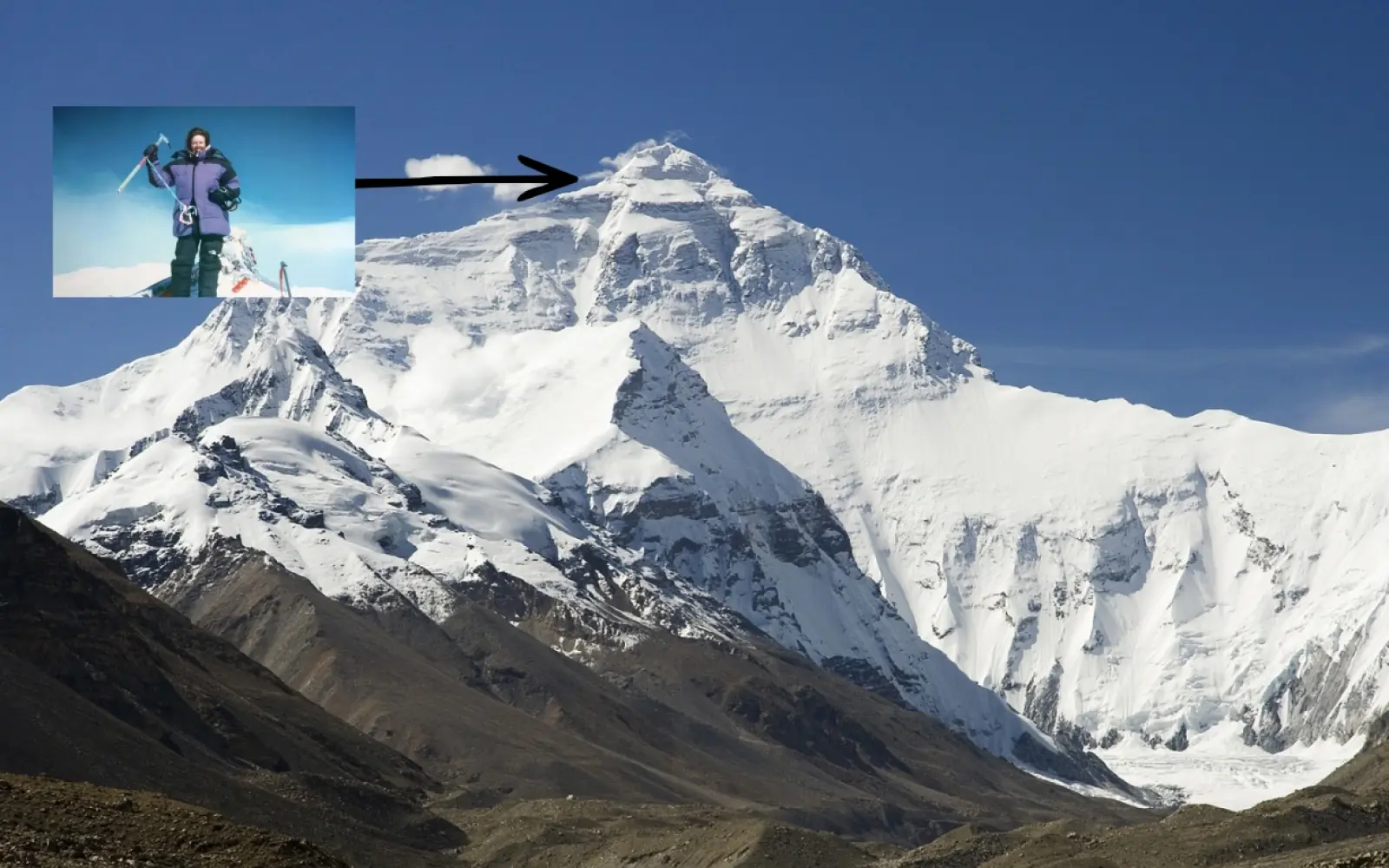
Francys Arsentiev's body lay at approximately 8,600 meters (28,200 feet) on Everest's Northeast Ridge, along the North Col route on the Tibetan (northern) side of the mountain.
Key Location Details
Route: North Col / Northeast Ridge — the main route from the Tibetan side
Altitude: ~8,600 meters (28,200 feet)
Area: Known among climbers as part of Rainbow Valley — a grim stretch of the upper mountain where the colourful down suits of deceased climbers are visible against the snow
Visibility: Her body lay directly beside the main climbing trail, meaning every climber on the North Col route passed within feet of her for 9 years
This is what made her presence so significant — and so ethically complicated. She was not hidden. She was not out of sight. She was a daily, unavoidable reminder of what Everest can take.
Sleeping Beauty and Green Boots — Everest's Two Most Famous Bodies
For years, two landmarks defined the upper section of Everest's North Col route:
Who Is Green Boots?
Green Boots is the nickname given to an unidentified climber — widely believed to be Tsewang Paljor, an Indian mountaineer who died during the 1996 Everest disaster. He earned his name from the neon green mountaineering boots visible on his frozen body, which lay in a limestone cave near 8,500 meters.
The Connection Between Sleeping Beauty and Green Boots
Francys Arsentiev (Sleeping Beauty)
Green Boots
Died
May 24, 1998
May 11, 1996
Location
~8,600m, North Col route
~8,500m, limestone cave, North Col route
Years visible
9 years (1998–2007)
~18 years (1996–2014)
Moved/buried
2007, Tao of Everest expedition
2014, Chinese team
Current status
Undisclosed location, off main route
Believed moved or buried
Both bodies became involuntary waypoints for climbers on the North Col route — grim but undeniable landmarks that guided and haunted those who passed them.
The 2007 Tao of Everest expedition, led by Ian Woodall, was specifically launched to move both Francys Arsentiev and Green Boots out of sight. Due to bad weather, the team was only able to recover Francys. Green Boots was eventually moved by a Chinese team in 2014.
The Ethical Weight
The presence of these bodies raises a question the mountaineering community has never fully resolved:
Is it right to leave the dead where they fell, visible to all who pass?
Some argue the mountain is their tomb — moving bodies is dangerous, expensive, and arguably disrespectful to where they chose to die. Others argue that dignity demands action.
The story of Francys Arsentiev forced that debate into the open in a way no other Everest death had before.
How Long Was Sleeping Beauty on Mount Everest?
Francys Arsentiev's body remained on Mount Everest for exactly 9 years — from her death on May 24, 1998, until May 23, 2007, when Ian Woodall and Phuri Sherpa moved her body during the Tao of Everest expedition.
The Timeline
Year
Event
May 22, 1998
Francys summits Everest without supplemental oxygen
May 23–24, 1998
Francys dies on the Northeast Ridge at ~8,600m
1999
Sergei's body found by Jake Norton on the mountain face
1998–2007
Francys's body visible on the North Col route for 9 climbing seasons
May 23, 2007
Ian Woodall and Phuri Sherpa move her body — Tao of Everest expedition
The Tao of Everest — Ian Woodall's 2007 Mission
Nine years after being forced to leave Francys on the mountain, Ian Woodall could not let it rest.
He organized and led an expedition called "The Tao of Everest" with one explicit purpose: to return to the mountain and give Francys Arsentiev — and Green Boots — a proper burial.
On May 23, 2007 — the 9th anniversary of the day they had found her — Woodall and Phuri Sherpa located Francys's body.
They performed a brief ceremony. Then they:
Wrapped her in an American flag
Placed a note from her son Paul Arsentiev on her body
Moved her body to a lower location on the face, out of sight from the main climbing route
The specific location of her burial has been kept private — a deliberate act of respect, ensuring her final resting place is not turned into a curiosity or a photograph opportunity.
Is Sleeping Beauty's Body Still on Mount Everest?
Yes — but she is no longer visible.
Francys Arsentiev's body remains on Mount Everest, but since 2007 it has been in an undisclosed location away from the main climbing route. She is no longer the "Sleeping Beauty" that climbers pass and photograph. She has been given, at last, a measure of peace and dignity.
The Ethical Question Everest Refuses to Answer
The story of Francys Arsentiev does not end with her death. It continues in every climber who passes through the Death Zone and has to ask themselves an impossible question:
If you encounter someone dying on Everest, do you have a moral obligation to save them — even if it means risking your own life?
The Arguments
Those who say yes:
Human life takes precedence over a summit
The mountaineering community has a duty of care to its own
Woodall and O'Dowd's attempt — even though it failed — represents the standard all climbers should aspire to
Those who say no — or "it depends":
In the Death Zone, a rescue attempt can easily become two deaths instead of one
No climber can be expected to sacrifice their life for a stranger they cannot save
The Uzbek team tried, exhausted themselves, and still couldn't save her
What We Know From Experience on Everest
From our perspective as a Nepal-based trekking and expedition company, we have seen this debate play out repeatedly in the Everest community.
The mountain does not offer clean moral answers. What it offers is this: the decisions made in the Death Zone define who we are, even when — especially when — every option is a bad one.
Francys Arsentiev did not die because people were cruel. She died because humans have limits. And Everest, at 8,600 meters, is where those limits become absolute.
The most honest lesson her story teaches is not about blame. It is about preparation, honesty about risk, and the humility to turn back before the mountain makes the decision for you.
What Francys Arsentiev's Story Teaches Every Everest Climber
Her story is not just a tragedy. It is a manual — written in the hardest possible ink — for anyone who dreams of high-altitude climbing.
Key Lessons
1. The summit is only half the climb Most Everest deaths happen during descent. Francys reached the top — the achievement she had worked years for — and the mountain still claimed her on the way down. Turnaround discipline and descent planning are not optional.
2. Oxygen decisions are life decisions Climbing without supplemental oxygen is a legitimate choice for elite, well-prepared mountaineers. But it reduces your margin for error to near zero. Any delay, any deterioration in conditions, any unexpected event becomes exponentially more dangerous.
3. Multiple failed attempts accumulate fatigue Francys and Sergei made several attempts before their final summit push. Each failed attempt depleted their reserves — physical, psychological, and logistical. Knowing when to call off an expedition entirely is one of the hardest and most important skills on Everest.
4. Partnerships matter more than ambition Sergei and Francys were separated in the darkness. That separation was fatal. On Everest, maintaining contact with your partner, your team, and your guides is not a formality — it is survival.
5. The Death Zone has a time limit Every hour above 8,000 meters shortens your window of survival. The human body cannot acclimatise to the Death Zone — it can only tolerate it briefly. Francys spent too long there, and the mountain did not forgive the delay.
Planning an Everest Base Camp Trek? At Majestic Trails Nepal, we bring decades of local expertise to every climb. Contact us to learn how we keep our Trekkers safe — on every step.
Frequently Asked Questions
Francys Arsentiev earned the nickname "Sleeping Beauty" because her frozen body was found lying peacefully on her side in the snow on Everest's Northeast Ridge, still clipped to a guide rope. Her pale, wax-like appearance and still position gave her the look of someone sleeping rather than someone who had died in one of the world's harshest environments.
Francys Arsentiev's last known words were "Don't leave me" and "Why are you doing this to me?" — spoken to Ian Woodall and Cathy O'Dowd as they were forced to descend without her on May 23, 1998. Woodall and O'Dowd promised to return with help. By the time they did, Francys had died.
How long was Sleeping Beauty on Mount Everest? Francys Arsentiev's body remained on Mount Everest for 9 years — from her death on May 24, 1998, until May 23, 2007, when Ian Woodall and Phuri Sherpa moved her body during the Tao of Everest expedition and gave her a burial wrapped in an American flag.
Yes, but she is no longer visible. Since the 2007 Tao of Everest expedition, Francys Arsentiev's body has been in an undisclosed location away from the main climbing route. She is no longer the landmark she once was — she has been given a private, dignified resting place on the mountain.
Sergei Arsentiev was a legendary Russian mountaineer and Francys's husband. He held the title of "Snow Leopard" — awarded for summiting all five Soviet peaks above 7,000 meters. He died in 1998 on Everest while attempting to climb back up the mountain to rescue Francys. His body was found in 1999 by Jake Norton.
Francys Arsentiev's body lay at approximately 8,600 meters (28,200 feet) on the Northeast Ridge, along the North Col route on the Tibetan (northern) side of Everest — an area known as Rainbow Valley. Her body was directly beside the main climbing trail.
Yes. Hillary Dawa Sherpa, a 52-year-old Nepali climbing guide who went missing on May 29, 2026 near Camp IV on Everest, was found alive on June 4, 2026 — crawling down the Khumbu Icefall after 6 days without food, water, or oxygen. He was treated for frostbite and exhaustion at HAMS Hospital in Kathmandu. His survival has been called a miracle by the mountaineering community.
Green Boots is the nickname for an unidentified climber (believed to be Tsewang Paljor) who died in the 1996 Everest disaster. Like Francys Arsentiev, his body lay visible on the North Col route for years — becoming an involuntary waypoint for climbers. Both were targets of the 2007 Tao of Everest expedition, though only Francys was successfully moved that year. Green Boots was moved by a Chinese team in 2014.
Related Travel Blogs
Join our Newsletter
Sign up to stay updated with latest offers, recent events and more news.