[{"name":"Langtang Valley Trek \u2014 10 Days","duration":"10","image_url":"https:\/\/www.majestictrailsnepal.com\/storage\/trip-galleries\/1\/thumb_e7907ed736676d12e6ab17328008e746.webp","offer_price":null,"url":"https:\/\/www.majestictrailsnepal.com\/trips\/langtang-valley-trek"},{"name":"Everest Base Camp Trek","duration":"14","image_url":"https:\/\/www.majestictrailsnepal.com\/storage\/trip-galleries\/2\/thumb_4b769c9c4b5b007a61f4ce3b76ff440d.webp","offer_price":null,"url":"https:\/\/www.majestictrailsnepal.com\/trips\/everest-base-camp-trek"},{"name":"Everest Panorama Trek","duration":"9","image_url":"https:\/\/www.majestictrailsnepal.com\/storage\/trip-galleries\/3\/thumb_e6ee74caea3e2900c23ca370b06bab80.webp","offer_price":null,"url":"https:\/\/www.majestictrailsnepal.com\/trips\/everest-panorama-trek"},{"name":"Annapurna Base Camp Trek","duration":"14","image_url":"https:\/\/www.majestictrailsnepal.com\/storage\/trip-galleries\/4\/thumb_3f8d40f9472f701d7c46a827925201bc.webp","offer_price":null,"url":"https:\/\/www.majestictrailsnepal.com\/trips\/annapurna-base-camp-trek"},{"name":"Annapurna Base Camp Express Trek","duration":"9","image_url":"https:\/\/www.majestictrailsnepal.com\/storage\/trip-galleries\/5\/thumb_bac80de2bd257d651fa75d9c8025da1a.webp","offer_price":null,"url":"https:\/\/www.majestictrailsnepal.com\/trips\/annapurna-base-camp-express-trek"},{"name":"Annapurna Circuit Trek","duration":"15","image_url":"https:\/\/www.majestictrailsnepal.com\/storage\/trip-galleries\/6\/thumb_b73bdec74acacaa0d72a2a2a513f3d4a.webp","offer_price":null,"url":"https:\/\/www.majestictrailsnepal.com\/trips\/annapurna-circuit-trek"},{"name":"Ghorepani Poon Hill Trek","duration":"8","image_url":"https:\/\/www.majestictrailsnepal.com\/storage\/trip-galleries\/7\/thumb_aeda9e6388ab2692138cc9c9efa81a7f.webp","offer_price":null,"url":"https:\/\/www.majestictrailsnepal.com\/trips\/ghorepani-poon-hill-trek"},{"name":"Mardi Himal Trek \u2014 9 Days","duration":"9","image_url":"https:\/\/www.majestictrailsnepal.com\/storage\/trip-galleries\/8\/thumb_c511ee87ecab8ff015210dd647392d66.webp","offer_price":null,"url":"https:\/\/www.majestictrailsnepal.com\/trips\/mardi-himal-trek"},{"name":"Manaslu Circuit Trek","duration":"15","image_url":"https:\/\/www.majestictrailsnepal.com\/storage\/trip-galleries\/9\/thumb_7726908390ad6b249f2f6a7856f9dc17.webp","offer_price":null,"url":"https:\/\/www.majestictrailsnepal.com\/trips\/manaslu-circuit-trek"},{"name":"Upper Mustang Trek","duration":"16","image_url":"https:\/\/www.majestictrailsnepal.com\/storage\/trip-galleries\/10\/thumb_6a9b52ecd1d8cda92d594e5351431d6e.webp","offer_price":null,"url":"https:\/\/www.majestictrailsnepal.com\/trips\/upper-mustang-trek"},{"name":"Pokhara City Tour","duration":"1","image_url":"https:\/\/www.majestictrailsnepal.com\/storage\/trip-galleries\/11\/thumb_cf762ba4c20363bd1c0f239db35fcc84.webp","offer_price":null,"url":"https:\/\/www.majestictrailsnepal.com\/trips\/pokhara-city-tour"},{"name":"Paragliding in Pokhara","duration":"1","image_url":"https:\/\/www.majestictrailsnepal.com\/storage\/trip-galleries\/12\/thumb_b896201edf88bbe0f570e876c3c337a3.webp","offer_price":70,"url":"https:\/\/www.majestictrailsnepal.com\/trips\/paragliding-in-pokhara"},{"name":"Kathmandu City Tour","duration":"2","image_url":"https:\/\/www.majestictrailsnepal.com\/storage\/trip-galleries\/13\/thumb_846ad05bd3ce7bebb3843c24c08db6f9.webp","offer_price":null,"url":"https:\/\/www.majestictrailsnepal.com\/trips\/kathmandu-city-tour"},{"name":"Lumbini Buddhist Pilgrimage Tour","duration":"4","image_url":"https:\/\/www.majestictrailsnepal.com\/storage\/trip-galleries\/14\/a2998dca0ce22f28a61c3862dd47f6a3.webp","offer_price":null,"url":"https:\/\/www.majestictrailsnepal.com\/trips\/lumbini-buddhist-pilgrimage-tour"},{"name":"5 days langtang valley trek","duration":"5","image_url":"https:\/\/www.majestictrailsnepal.com\/storage\/trip-galleries\/15\/thumb_7a6c65c139b8085d220ac01913cb1448.webp","offer_price":510,"url":"https:\/\/www.majestictrailsnepal.com\/trips\/5-days-langtang-valley-trek"},{"name":"Leisure Port Nepal Price: Rafting and Camping Adventure","duration":"7","image_url":"https:\/\/www.majestictrailsnepal.com\/storage\/trip-galleries\/17\/thumb_02cb8c3f0697c7c5c4f73d744b47d87f.webp","offer_price":550,"url":"https:\/\/www.majestictrailsnepal.com\/trips\/leisure-port-nepal-price-rafting-and-camping-adventure"},{"name":"10 days spiritual tour in Nepal","duration":"10","image_url":"https:\/\/www.majestictrailsnepal.com\/storage\/trip-galleries\/18\/thumb_b4e7eba000673d1bce6b56abb422fe3b.webp","offer_price":1200,"url":"https:\/\/www.majestictrailsnepal.com\/trips\/10-days-spiritual-tour-in-nepal"},{"name":"Annapurna Circuit Short Trek","duration":"10","image_url":"https:\/\/www.majestictrailsnepal.com\/storage\/trip-galleries\/19\/thumb_769ee8cbe02a510d8db76419c97a2dc9.webp","offer_price":null,"url":"https:\/\/www.majestictrailsnepal.com\/trips\/annapurna-circuit-short-trek"},{"name":"Best Short Manaslu Circuit Trek","duration":"11","image_url":"https:\/\/www.majestictrailsnepal.com\/storage\/trip-galleries\/20\/thumb_ac1b4977a3fce9d11ee68240cad675b6.webp","offer_price":null,"url":"https:\/\/www.majestictrailsnepal.com\/trips\/best-short-manaslu-circuit-trek"},{"name":"Langtang Gosaikunda Trek","duration":"13","image_url":"https:\/\/www.majestictrailsnepal.com\/storage\/trip-galleries\/22\/thumb_577a6402f2ca4b3f12bfd80b96b33a23.webp","offer_price":940,"url":"https:\/\/www.majestictrailsnepal.com\/trips\/langtang-gosaikunda-trek"},{"name":"3 Passes Trek Nepal","duration":"22","image_url":"https:\/\/www.majestictrailsnepal.com\/storage\/trip-galleries\/24\/thumb_8020edea67aefce87e9012dc89a60087.webp","offer_price":null,"url":"https:\/\/www.majestictrailsnepal.com\/trips\/3-passes-trek-nepal"},{"name":"Tsum Valley Trek","duration":"13","image_url":"https:\/\/www.majestictrailsnepal.com\/storage\/trip-galleries\/25\/thumb_194c03e3c3463dff07a3f621a81ef9ea.webp","offer_price":null,"url":"https:\/\/www.majestictrailsnepal.com\/trips\/tsum-valley-trek"},{"name":"Gokyo and Renjo La Pass Trek","duration":"14","image_url":"https:\/\/www.majestictrailsnepal.com\/storage\/trip-galleries\/26\/thumb_7b865f0f0d0d4c6807b625b6e391b56d.webp","offer_price":1490,"url":"https:\/\/www.majestictrailsnepal.com\/trips\/gokyo-and-renjo-la-pass-trek"},{"name":"Honeymoon Tour in Nepal","duration":"9","image_url":"https:\/\/www.majestictrailsnepal.com\/storage\/trip-galleries\/27\/thumb_dabf449c090bb16efd5823c653eb61b3.webp","offer_price":null,"url":"https:\/\/www.majestictrailsnepal.com\/trips\/honeymoon-tour-in-nepal"},{"name":"Pikey Peak Trek","duration":"10","image_url":"https:\/\/www.majestictrailsnepal.com\/storage\/trip-galleries\/28\/thumb_5425e57ce3ea84d31a7b24b83b1af94f.webp","offer_price":1090,"url":"https:\/\/www.majestictrailsnepal.com\/trips\/pikey-peak-trek"},{"name":"Makalu Base Camp Trek","duration":"17","image_url":"https:\/\/www.majestictrailsnepal.com\/storage\/trip-galleries\/29\/thumb_d68c8ec6492540c922045d825a38cd50.webp","offer_price":null,"url":"https:\/\/www.majestictrailsnepal.com\/trips\/makalu-base-camp-trek"},{"name":"Nepal Winter Tour","duration":"8","image_url":"https:\/\/www.majestictrailsnepal.com\/storage\/trip-galleries\/30\/thumb_c8491c0c4b1fb19d8e93630866895799.webp","offer_price":null,"url":"https:\/\/www.majestictrailsnepal.com\/trips\/nepal-winter-tour"},{"name":"Maratika Tour in Nepal","duration":"6","image_url":"https:\/\/www.majestictrailsnepal.com\/storage\/trip-galleries\/31\/thumb_97948560c5a12a486f9ac2b76567cafd.webp","offer_price":null,"url":"https:\/\/www.majestictrailsnepal.com\/trips\/maratika-tour-in-nepal"},{"name":"Nepal Lake Trek","duration":"14","image_url":"https:\/\/www.majestictrailsnepal.com\/storage\/trip-galleries\/32\/thumb_d9b260fe13127816f5b3c25447caf70c.webp","offer_price":null,"url":"https:\/\/www.majestictrailsnepal.com\/trips\/nepal-lake-trek"},{"name":"Taste of Nepal Tour Package","duration":"9","image_url":"https:\/\/www.majestictrailsnepal.com\/storage\/trip-galleries\/33\/thumb_f4b55ab5760a8e057b4c3e208e25ab36.webp","offer_price":null,"url":"https:\/\/www.majestictrailsnepal.com\/trips\/taste-of-nepal-tour-package"},{"name":"Poon Hill Yoga Trek in Nepal","duration":"9","image_url":"https:\/\/www.majestictrailsnepal.com\/storage\/trip-galleries\/34\/thumb_904b238e690107c5c9b1092296880cc9.webp","offer_price":null,"url":"https:\/\/www.majestictrailsnepal.com\/trips\/poon-hill-yoga-trek-in-nepal"},{"name":"Nar Phu Nepal Trek","duration":"10","image_url":"https:\/\/www.majestictrailsnepal.com\/storage\/trip-galleries\/35\/thumb_f959e3e22c260629add0ba61a4038812.webp","offer_price":null,"url":"https:\/\/www.majestictrailsnepal.com\/trips\/nar-phu-nepal-trek"},{"name":"Annapurna Base Camp Helicopter Tour","duration":"1","image_url":"https:\/\/www.majestictrailsnepal.com\/storage\/trip-galleries\/36\/thumb_e81861e8772a9d7fac92ab4a7d43e3bf.webp","offer_price":null,"url":"https:\/\/www.majestictrailsnepal.com\/trips\/annapurna-base-camp-helicopter-tour"},{"name":"Annapurna Circuit with Nar Phu Valley Trek","duration":"16","image_url":"https:\/\/www.majestictrailsnepal.com\/storage\/trip-galleries\/38\/thumb_b70692cbd1c1dd772587c940be2d0bc9.webp","offer_price":null,"url":"https:\/\/www.majestictrailsnepal.com\/trips\/annapurna-circuit-with-nar-phu-valley-trek"}]
The Mardi Himal Trek is a short, beginner-friendly trek in the Annapurna region of Nepal that reaches Mardi Himal Base Camp at 4,500 m, beneath the towering wall of Machhapuchhre (Fishtail). It typically takes 4 to 5 days from Pokhara, covers around 40-45 km, and is known as one of the most beautiful and least crowded treks in Nepal — a hidden ridge trail that only officially opened to trekkers in 2012. For anyone wanting real Himalayan scenery without the long, high days of Everest or Annapurna Base Camp, Mardi Himal is often the perfect choice.
After 10+ years guiding treks across the Annapurna region, Majestic Trails Nepal recommends Mardi Himal as our top pick for first-time trekkers. This complete 2026 guide covers everything you need: the itinerary, how long it takes, the cost, difficulty, permits, the route and map, altitude, and honest answers to every common question — from "can you do it in 3 days" to "is it harder than ABC."
Key Takeaways:
Mardi Himal Base Camp sits at 4,500 m; the popular viewpoint is around 4,200 m and the highest sleeping point (High Camp) is about 3,550 m.
The trek usually takes 4-5 days from Pokhara and covers roughly 40-45 km — one of the shortest base camp treks in Nepal.
It is a moderate trek suitable for fit beginners, with no technical climbing required.
The best seasons are spring (March-May) and autumn (September-November).
In 2026, only the ACAP permit is required (no TIMS), and a licensed guide is not mandatory.
Mardi Himal is quieter than Annapurna Base Camp and Everest Base Camp, making it ideal for trekkers who want solitude.
Quick Facts — Mardi Himal Trek
Detail
Information
Max altitude
4,500 m (Base Camp)
Viewpoint altitude
~4,200 m
Highest sleeping point
~3,550 m (High Camp)
Duration
4-5 days (3-day and longer options available)
Distance
~40-45 km
Difficulty
Moderate — good for beginners
Start point
Near Pokhara (Kande / Phedi / Dhampus)
Permit (2026)
ACAP only — NPR 3,000 foreigners
Guide
Not Mandatory
Best seasons
Spring (Mar-May), Autumn (Sep-Nov)
What Is the Mardi Himal Trek?
Mardi Himal Trek Nepal
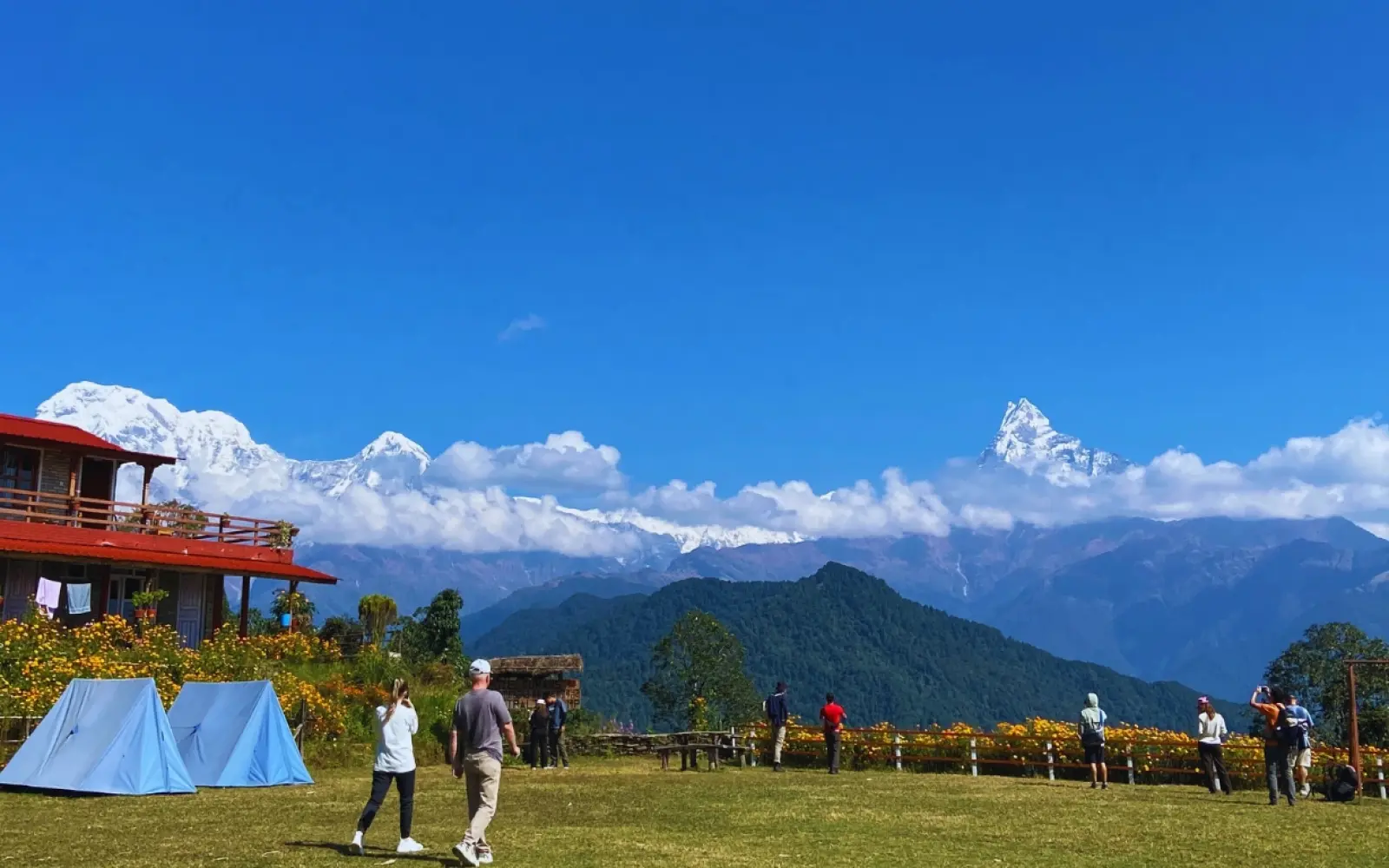
The Mardi Himal Trek is a short ridge trek in the Annapurna region that climbs to Mardi Himal Base Camp at 4,500 m, hidden beneath the sacred peak of Machhapuchhre (Fishtail). Despite being one of the shortest base camp treks in Nepal, it delivers extraordinarily close-up mountain views, passing through rhododendron forest, traditional Gurung villages, and open alpine ridges.
What makes Mardi Himal special is that it stays quiet. The trail only officially opened for tea house trekking in 2012, so it remains far less crowded than the nearby Annapurna Base Camp and Ghorepani Poon Hill routes. You walk a high, scenic ridge with the Annapurna range and Fishtail rising directly ahead — arguably some of the best mountain-view-to-effort value of any trek in Nepal.
The trek suits a wide range of people: fit first-time trekkers, families with older children, and experienced hikers short on time. It combines forest, ridge, and high alpine terrain in just a few days, without the crowds or the long expedition feel of the bigger treks.
Where Is Mardi Himal and How High Is It?
Mardi Himal is located in the Annapurna region of central Nepal, just east of the popular Annapurna Base Camp trail, and is accessed from the city of Pokhara. Mardi Himal Base Camp sits at 4,500 m (14,763 ft), making it the highest point of the trek.
Here are the key altitudes along the route:
Point
Altitude
Pokhara (start city)
~820 m
Kande (common trailhead)
~1,770 m
Forest Camp
~2,600 m
Low Camp
~2,970 m
Badal Danda
~3,210 m
High Camp (highest sleeping point)
~3,550 m
Mardi Himal Viewpoint
~4,200 m
Mardi Himal Base Camp (highest point)
4,500 m
An important distinction many trekkers ask about: the viewpoint versus the base camp. Many trekkers stop at the Upper Viewpoint (around 4,200 m) for sunrise, while others continue the extra 1.5 hours to the true Base Camp at 4,500 m. Both offer spectacular views of Machhapuchhre, Annapurna South, and Hiunchuli — the base camp simply takes you closer and higher.
Because the highest point you sleep at is only around 3,550 m, and the 4,500 m base camp is reached as a day walk, altitude sickness is less common on Mardi Himal than on higher treks — though it should still be respected.
How Long Is the Mardi Himal Trek?
The Mardi Himal Trek typically takes 4 to 5 days of trekking from Pokhara, covering approximately 40 to 45 km. This makes it one of the shortest base camp treks in Nepal in terms of distance, though the trail gains altitude quickly, so the days still feel rewarding.
The duration is flexible depending on your time and fitness:
3 days — the fast option for fit trekkers with limited time (more demanding)
4 days — a comfortable short itinerary, the most popular quick option
5 days — the relaxed standard, with better acclimatization and time to enjoy the ridge
7+ days — extended versions combining Mardi with Ghandruk, Poon Hill, or Annapurna Base Camp
At Majestic Trails Nepal, we customize the number of days to match your schedule and fitness. First-time trekkers usually enjoy the 4-5 day version most, since it allows better acclimatization and time to soak in the scenery rather than rushing the climb and descent.
Mardi Himal Trek Itinerary (5-Day Standard)
The classic Mardi Himal itinerary runs over 5 days from Pokhara, ascending gradually through forest to the high ridge and Base Camp, then descending to Sidhing for the drive back. Here is the standard day-by-day route.
Day 1 — Pokhara to Forest Camp (2,600 m) Drive from Pokhara to the trailhead at Kande (about 1 hour), then trek up through Australian Camp and Pitam Deurali into dense rhododendron forest to Forest Camp. A gentle first day easing you onto the trail.
Day 2 — Forest Camp to High Camp (3,550 m) Climb steadily through thinning forest to Low Camp, then up the open ridge with expanding views of Machhapuchhre and Annapurna South, reaching High Camp for the night. This is where the panorama truly opens up.
Day 3 — High Camp to Base Camp (4,500 m) and back An early pre-dawn start for sunrise. Ascend the narrow ridge to the Viewpoint (~4,200 m) and on to Mardi Himal Base Camp (4,500 m), surrounded by a 360-degree wall of peaks. Descend back to Badal Danda or Low Camp for the night.
Day 4 — Descend to Sidhing A long, knee-testing descent through forest and terraced farmland to the village of Sidhing (Siding).
Day 5 — Sidhing to Pokhara A jeep drive back to Pokhara (2-3 hours), completing the loop.
Shorter 3-4 day versions compress this by starting higher, skipping Forest Camp, or descending faster; longer versions add rest days or extend toward Ghandruk and the Annapurna Base Camp trail.
Can You Do the Mardi Himal Trek in 3 Days?
Yes, you can complete the Mardi Himal Trek in 3 days, but it is a demanding schedule best suited to fit, experienced trekkers. The 3-day version compresses the ascent and descent into long days, giving your body less time to acclimatize, so it is not the ideal choice for a complete beginner.
A typical 3-day Mardi Himal itinerary looks like this:
Day 1: Drive from Pokhara to the trailhead, trek up to Low Camp or Forest Camp
Day 2: Long climb to High Camp, then push to the Viewpoint/Base Camp and back down
Day 3: Descend to Sidhing and drive back to Pokhara
The honest trade-off: the 3-day route saves time but means longer, harder days and faster altitude gain. If you are reasonably fit and short on time, it is genuinely doable and still spectacular. If it is your first Himalayan trek, we recommend the 4 or 5-day version instead — it is far more comfortable, safer for acclimatization, and lets you actually enjoy the ridge rather than racing it.
Mardi Himal Trek from Ghandruk
The Mardi Himal Trek can also be started or finished from Ghandruk, a beautiful traditional Gurung village, instead of the usual Kande trailhead. This route is popular with trekkers who want to combine Mardi Himal with the Ghorepani Poon Hill trek or the Annapurna Base Camp trail, since Ghandruk connects them all.
The Ghandruk variation works in two main ways:
As an extension — trekkers finishing Poon Hill or Annapurna Base Camp can continue on foot via Ghandruk and Landruk to join the Mardi Himal trail at Forest Camp, rather than returning to Pokhara
As a standalone start — begin at Ghandruk (reached by bus or jeep from Pokhara via Kimche), trek to Forest Camp, Low Camp, High Camp, and Base Camp, then descend to Sidhing
To reach Ghandruk from Pokhara independently, buses leave Baglung bus park for Kimche (a 3-5 hour journey), from where it is about a 1.5-hour walk to Ghandruk. A faster option is a bus to Nayapul and then a jeep toward Kimche.
At Majestic Trails Nepal, we can customize a Ghandruk-based Mardi Himal route for you, whether you want to combine it with Poon Hill for a longer cultural trek or use it as a scenic alternative start. This is one of the real advantages of Mardi Himal — the trail connects flexibly to the wider Annapurna region.
Mardi Himal Trek Map & Route
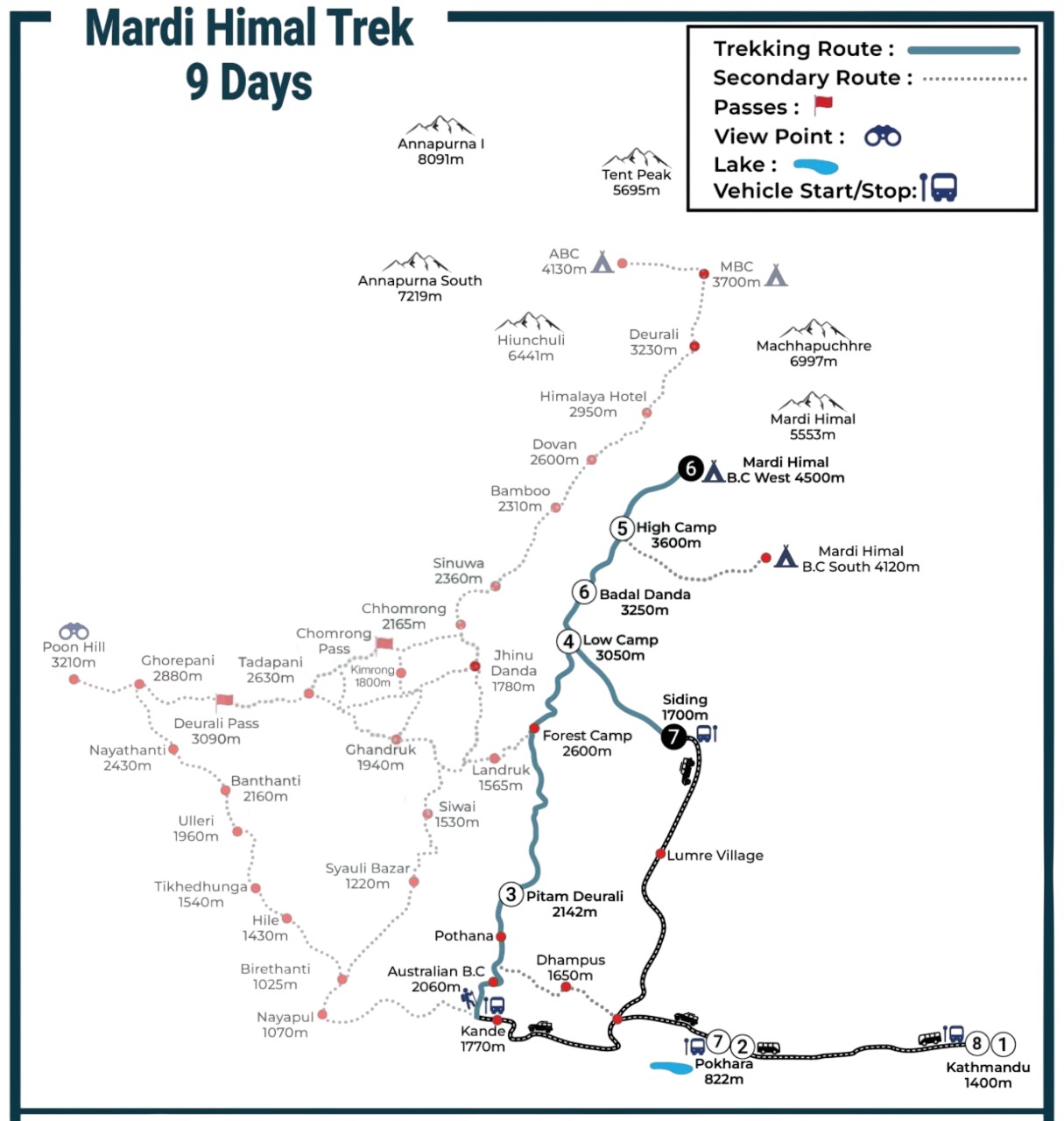
Map of Mardi Himal Trek
The Mardi Himal trek follows a ridge that climbs steadily northward from the Pokhara valley up to Base Camp, beneath Machhapuchhre. The classic route runs in a loop: up one side via Kande and the forest camps, and down the other via Sidhing.
The lower trail winds through dense rhododendron, oak, and pine forest, often draped in moss
Above Low Camp, the forest opens into a dramatic exposed ridge with mountains on both sides
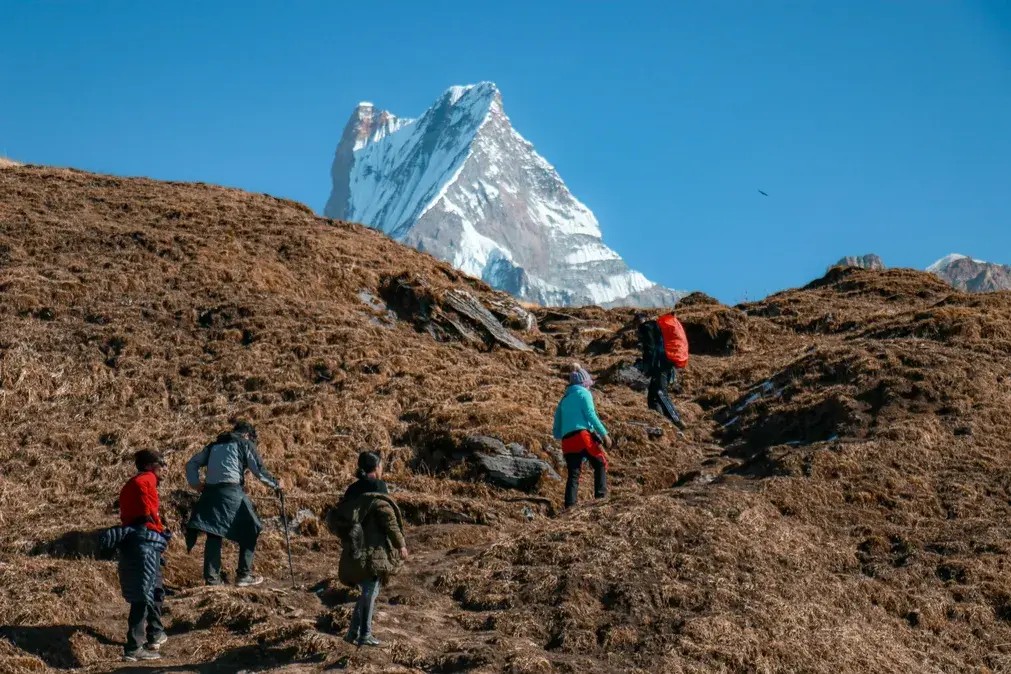
The upper ridge to Base Camp is narrow, with steep drops — spectacular but demanding focus
The descent to Sidhing is steep and passes through terraced farmland and Gurung villages
Because the upper ridge is exposed and the trail can be faint in cloud or snow, a guide is genuinely valuable here for navigation and safety — and, since 2023, not mandatory. A detailed physical trekking map is worth carrying, though your guide will know every turn.
Mardi Himal Trek Cost 2026
The cost of a guided Mardi Himal Trek varies depending on the number of days, group size, transport choices, and level of comfort. As a general guide, most guided packages fall in the range of a few hundred US dollars, making Mardi Himal one of the more affordable treks in Nepal.
What affects the price:
Number of days — a 3-day trek costs less than a 5 or 7-day version
Group size — per-person cost drops as the group grows, since guide and transport costs are shared
Transport — private jeep versus shared transport, or a flight upgrade to Pokhara
Accommodation standard — basic tea houses versus more comfortable lodges, and your Pokhara hotel
Season — peak seasons can be slightly higher
A typical guided package usually includes the licensed guide, ACAP permit, tea house accommodation, meals on the trek, and transport between Pokhara and the trailheads. It usually excludes international flights, Nepal visa, travel insurance, drinks and snacks, hot showers and charging on the trail, and tips.
For an exact, up-to-date price tailored to your dates, group size, and preferred itinerary, see our Mardi Himal Trek trip page or contact us directly — we will build a transparent quote around exactly what you want. Because we are a local operator based in Kathmandu rather than a reseller, our pricing is genuinely competitive.
How Difficult Is the Mardi Himal Trek?
Mardi Himal trek is Moderate
The Mardi Himal Trek is graded moderate, making it one of the best treks in Nepal for fit beginners and first-time Himalayan trekkers. You do not need any climbing skills, ropes, or technical experience — just the ability to walk uphill for four to six hours a day on forest trails and stone steps, carrying a light daypack.
What actually makes Mardi challenging, in honest order:
The stairs and steep sections — much of the lower trail climbs steadily; steady stair practice beforehand is the best preparation
The exposed ridge — from Low Camp to Base Camp the trail follows a narrow ridge with steep drops, demanding focus, especially in wind or cloud
The descent — coming down from Base Camp in one long day is hard on the knees; trekking poles help a lot
The early summit morning — the pre-dawn push to the viewpoint in the cold is short but demanding
The maximum altitude of 4,500 m is high enough that altitude matters, but because you sleep no higher than around 3,550 m, serious altitude sickness is uncommon on a well-paced itinerary. With a month of regular cardio and stair training beforehand, most reasonably fit people complete Mardi comfortably — which is exactly why we recommend it as a first Himalayan trek.
Is Mardi Himal or ABC Harder?
Annapurna Base Camp (ABC) is generally considered harder than Mardi Himal, mainly because it is longer, involves more total climbing, and has more relentless stone stairs. Interestingly, though, Mardi Himal reaches a higher maximum altitude — 4,500 m at Base Camp versus 4,130 m at Annapurna Base Camp.
Here is the honest comparison:
Factor
Mardi Himal
Annapurna Base Camp
Duration
4-5 days
7-12 days
Max altitude
4,500 m
4,130 m
Distance
~40-45 km
~110 km
Difficulty
Moderate
Moderate-Hard
Crowds
Quiet
Busier
Stairs
Fewer
Many, relentless
So which is harder depends on what you mean. ABC is harder overall because of its length and the sheer number of stone steps, which wear trekkers down over more days. Mardi is shorter and quieter but reaches a slightly higher point, and its upper ridge is more exposed.
For a first trek with limited time, Mardi Himal is the gentler, faster choice. For a fuller Himalayan experience and the famous Annapurna Sanctuary amphitheatre, ABC is worth the extra days. Many trekkers do Mardi first, then return for ABC or Everest Base Camp later.
Can Beginners Do Mardi Himal? Is It Worth It?
Yes, Mardi Himal is one of the best treks in Nepal for beginners, and it is absolutely worth it. Its short duration, moderate difficulty, relatively low sleeping altitude, and comfortable tea houses make it ideal for first-time trekkers, while its close-up mountain views rival treks twice its length.
Why Mardi Himal is great for beginners:
Short enough to fit a tight schedule (4-5 days)
No technical skills required
Highest sleeping point is only ~3,550 m, reducing altitude risk
Comfortable tea houses with food, hot showers, and charging
Far less crowded than ABC or Poon Hill
Why it is worth it, honestly:
Some of the closest views of Machhapuchhre (Fishtail) of any trek in Nepal
A dramatic, quiet ridge that feels wild and remote
Rhododendron forests that bloom red and pink in spring
Sunrise from the ridge with the whole Annapurna range glowing gold
For most first-time trekkers with limited time, Mardi Himal delivers the highest mountain-view-to-effort ratio in the Annapurna region. The only travelers who might skip it are those wanting a longer, more immersive expedition — for whom Annapurna Base Camp or Everest Base Camp is a better fit.
Best Time to Trek Mardi Himal
The best times to trek Mardi Himal are spring (March to May) and autumn (September to November), which offer the clearest mountain views and most stable weather. Because Mardi is shorter and lower than the big treks, it also handles the shoulder months reasonably well.
Spring (March-May): Warm days, blooming rhododendrons on the lower trail, and sharp Annapurna views. A favourite season, though busier.
Autumn (September-November): The most stable weather of the year, crisp air, and reliable sunrise views. Peak season, so the trail is at its fullest.
Winter (December-February): Quiet and beautiful but cold, with possible snow on the upper ridge. Doable with the right gear and a guide who knows the conditions.
Monsoon (June-August): Lush and empty, but rain, mud, leeches, and cloud make views unreliable — the hardest season.
For a first Himalayan trek with the best chance of clear Machhapuchhre and Annapurna South views, choose spring or autumn.
Permits Required for Mardi Himal Trek 2026
The Mardi Himal Trek lies inside the Annapurna Conservation Area, so every foreign trekker needs the Annapurna Conservation Area Permit (ACAP). As of 2026, this is the only permit required — the old TIMS card is no longer needed for this trek — and a licensed guide is not mandatory under Nepal's trekking regulations.
The 2026 permit details:
ACAP: NPR 3,000 for foreign nationals, NPR 1,000 for SAARC nationals, NPR 100 for Nepali citizens. Children under 10 are free.
No TIMS card required for Mardi Himal in 2026.
Licensed guide not mandatory — Guide is no mandatory
Practical notes: permits are checked at official checkpoints (such as Pothana), so carry your permit and passport at all times, and bring two passport photos and a passport copy for processing. There are no ATMs on the trail, so sort cash in Pokhara beforehand.
New for 2026 — guaranteed lodge assignment: Under a new official system, a local organization assigns trekkers to specific lodges at each camp, covering both Nepali and solo foreign trekkers, so your accommodation is secured in advance and nobody is left stranded at High Camp in peak season.
When you trek with Majestic Trails Nepal, we handle the entire permit process for you — you simply send your passport details and photos, and everything is ready before you start walking.
Accommodation and Food on the Trek
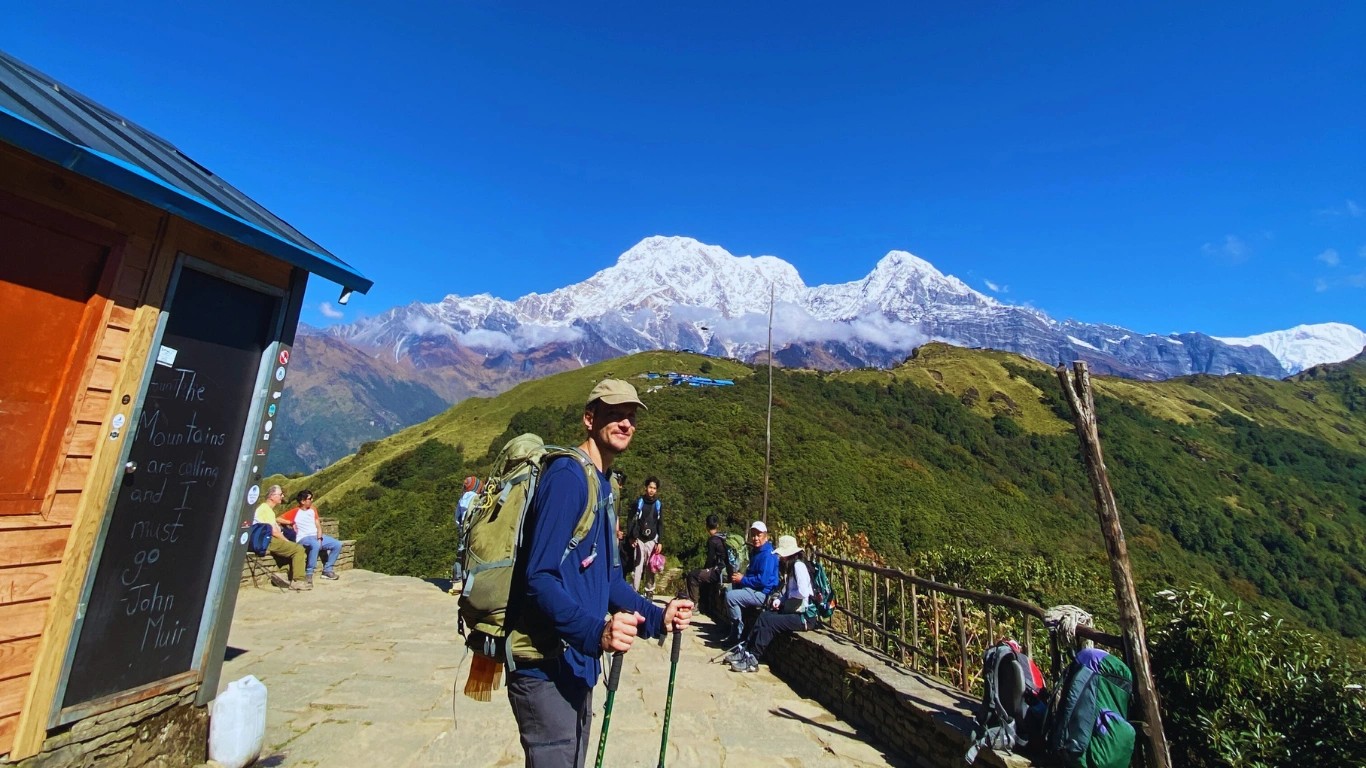
Accommodation on the Mardi Himal Trek is in tea houses — simple, family-run lodges along the trail, often run by families from the nearby Gurung villages. You stay in basic twin-share rooms with a bed and blankets, and shared bathrooms. Because the route is newer, the lodges are smaller and more authentic than on the busier Annapurna routes.
What to expect:
Rooms: Simple twin-share; we provide a sleeping bag, which matters at cold High Camp
Bathrooms: Mostly shared; hot showers available at most stops for a small fee
Charging and Wi-Fi: Available at most tea houses up to High Camp for a small charge, slow and unreliable higher up — bring a power bank
Prices rise with altitude, since everything is carried up by porter
The food is simple, freshly cooked, and good. Every tea house serves a mix of Nepali and international dishes, but the most reliable and best-value choice at every altitude is dal bhat — rice, lentils, vegetable curry, and pickle, usually with a free refill. Our honest advice: eat dal bhat for your main meal each day. It is fresh, filling, and gentle on the stomach.
How to Get to the Mardi Himal Trailhead
The Mardi Himal Trek begins near Pokhara, so getting there is a two-step journey: first Kathmandu to Pokhara, then Pokhara to the trailhead at Kande, Phedi, or Dhampus.
Kathmandu to Pokhara (~200 km):
Tourist bus: A comfortable 6-7 hour scenic drive, the most popular option
Domestic flight: A quick 25-30 minute flight, ideal to save time
Private vehicle: For comfort and flexible timing
Pokhara to the trailhead:
Kande is about an hour's drive from Pokhara; Phedi and Dhampus are closer
The trek typically ends at Sidhing, from where a jeep returns you to Pokhara in 2-3 hours
When you book with us, all transport is arranged and timed around your itinerary, so you never negotiate local vehicles or worry about being stranded. Most trekkers spend a night in Pokhara before and after the trek.
What to Pack for the Mardi Himal Trek
Packing for Mardi Himal is about being ready for two worlds in one short trek: warm subtropical forest at the bottom and cold, windy ridge at the top. You can rent most gear in Pokhara or Kathmandu, so you don't need to buy everything beforehand. Keep your pack light — 8-10 kg, since a porter typically carries one bag between two trekkers.
Essentials:
Layers: moisture-wicking base layers, a warm fleece or down mid-layer, and a waterproof jacket
Down jacket: essential for cold mornings and High Camp (we provide one)
Trekking boots: broken-in, waterproof, with good ankle support
Trekking poles: strongly recommended for the steep descent
Hat, gloves, buff, sunglasses: for sun, cold, and wind on the ridge
Headlamp: for the pre-dawn summit morning
Power bank, reusable water bottle with purification, sunscreen, personal first-aid, and Nepali cash
Our guides carry a first-aid kit with an oximeter on every trek, so you don't need to bring medical equipment yourself.
Altitude, Safety & Insurance
Mardi Himal reaches 4,500 m at Base Camp, high enough that altitude needs respect but low enough that serious altitude sickness is uncommon on a well-paced itinerary — especially because you sleep no higher than around 3,550 m. Most trekkers feel only mild effects that pass with rest, hydration, and a slow pace.
How we manage safety:
Sensible pacing and climbing high to the viewpoint while sleeping lower
Guides carrying a pulse oximeter for daily monitoring
First-aid kits and guides trained to spot early altitude symptoms
Because Mardi is close to Pokhara, a rescue helicopter can reach the trail quickly in a genuine emergency, flying a trekker to a Pokhara hospital in a short flight. This is exactly why travel insurance with helicopter evacuation cover up to at least 4,500 m is essential. A standard travel policy is not enough — you need one that specifically covers high-altitude trekking and emergency rescue in Nepal. Buy it in your home country before you fly, and share the details with us before the trek.
Frequently Asked Questions
How long is the Mardi Himal Trek?
The Mardi Himal Trek usually takes 4 to 5 days from Pokhara and covers around 40-45 km. It can be done in 3 days by fit trekkers or extended to 7+ days by combining it with Ghandruk, Poon Hill, or Annapurna Base Camp.
How difficult is the Mardi Himal Trek?
Mardi Himal is a moderate trek suitable for fit beginners. It requires no technical skills, just the ability to walk 4-6 hours a day uphill. The main challenges are the steep sections, the exposed upper ridge, and the descent.
Can you do Mardi Himal in 3 days?
Yes, Mardi Himal can be done in 3 days, but it involves long days and faster altitude gain, making it better suited to fit, experienced trekkers. First-timers are recommended to take 4-5 days for better acclimatization and enjoyment.
Is Mardi Himal or ABC harder?
Annapurna Base Camp is harder overall because it is longer (7-12 days) with far more stone stairs, though Mardi Himal reaches a slightly higher maximum altitude (4,500 m versus 4,130 m). Mardi is the easier, quicker choice for beginners.
How high is Mardi Himal Base Camp?
Mardi Himal Base Camp sits at 4,500 m (14,763 ft). The popular viewpoint below it is around 4,200 m, and the highest point trekkers sleep at is High Camp, at about 3,550 m.
What is the cheapest trek in Nepal?
Mardi Himal is one of the most affordable treks in Nepal, thanks to its short duration and proximity to Pokhara. Ghorepani Poon Hill is another budget-friendly short option in the Annapurna region.
Is Mardi Himal worth it?
Yes. Mardi Himal offers some of the closest views of Machhapuchhre (Fishtail) of any trek in Nepal, a dramatic quiet ridge, and spring rhododendron blooms — all in just a few days. It delivers excellent mountain views for the effort involved.
Can beginners do the Mardi Himal Trek?
Yes, Mardi Himal is one of the best beginner treks in Nepal. Its short length, moderate difficulty, low sleeping altitude, and comfortable tea houses make it ideal for first-time trekkers with basic fitness.
Do you need a guide for Mardi Himal?
A licensed guide is officially required for the Mardi Himal Trek under Nepal Tourism Board regulations, and is strongly recommended for safety on the exposed upper ridge. In practice, some trekkers still trek independently. A guide handles navigation, altitude monitoring, permits, and lodge arrangements, which removes most of the risk and hassle.
Nepal's Best Short Himalayan Trek
The Mardi Himal Trek proves you don't need two or three weeks to experience the Himalayas at their best. In just 4 to 5 days, it delivers a dramatic high ridge, some of the closest Fishtail views in Nepal, quiet forests, and warm Gurung hospitality — all within easy reach of Pokhara. For first-time trekkers, families, and anyone short on time, it is the perfect introduction to trekking in Nepal.
After 10+ years guiding across the Annapurna region, Majestic Trails Nepal recommends Mardi Himal as our top choice for a first Himalayan trek, or as a quiet alternative for experienced trekkers who have already done the busier trails. Whether you want the fast 3-day push, the relaxed 5-day classic, or an extended route via Ghandruk and Poon Hill, we can build the trek around your time, fitness, and goals.